Rome · St Peter's Basilica
Who built St Peter's Basilica?
Twenty popes and 120 years of building, with the old basilica still standing inside the new one as it rose.
St Peter's Basilica was begun by Pope Julius II in 1506 on a plan by Bramante, took its dome from Michelangelo and its long nave and façade from Carlo Maderno, and was consecrated in 1626, twenty popes later. Bernini completed the picture with the bronze canopy over the altar and the colonnade around the square. Underneath lies the Roman cemetery where, the Church holds, St Peter was buried, and entry to the basilica is free.
Who built St Peter’s Basilica: Julius II and twenty popes
The St Peter’s you walk into today was started by Pope Julius II, who laid its first stone on 18 April 1506. It took more than a century and twenty popes to finish, and Urban VIII consecrated it on 18 November 1626. In between, the work passed from one architect to the next, and each one changed the plan he inherited.
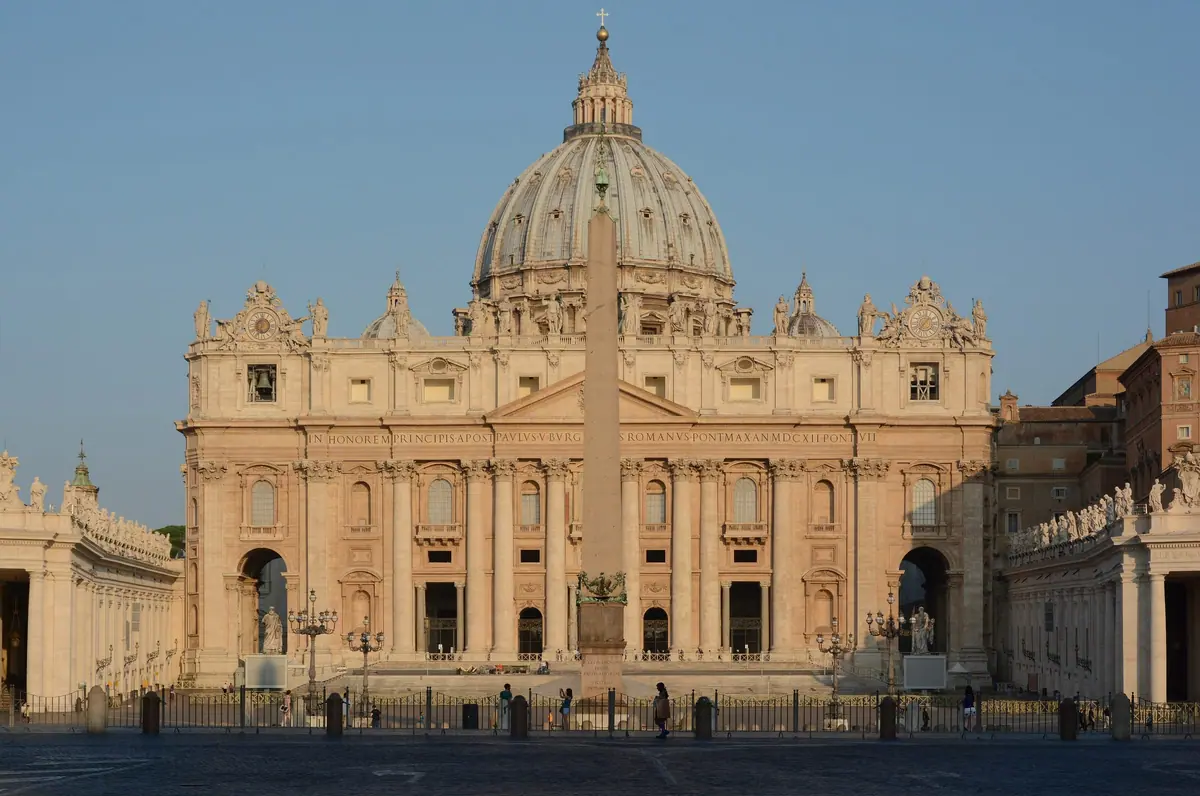
That’s why the short answer to who built it has four names. Bramante drew the first plan, Michelangelo designed the dome, Carlo Maderno lengthened the nave and built the façade, and Bernini, the sculptor and architect of Baroque Rome, gave it the bronze canopy over the altar and the square outside.
The first St Peter’s: Constantine’s basilica over a Roman cemetery
Before any of them, this slope was outside the city. The emperors Caligula and Nero had a circus here, a track for chariot races, with a cemetery beside it along the Via Cornelia. Christian tradition holds that Peter, the apostle the Church counts as the first pope, died in Rome and was buried in that cemetery.
In the 4th century Constantine, the first Christian emperor, built a basilica right on top of the graves. It stood for more than a thousand years: Charlemagne, king of the Franks, was crowned emperor inside it at Christmas in the year 800, and Saracen raiders sacked it in 846, because it lay outside Rome’s walls. By the 15th century the building was falling apart, and Pope Nicholas V began planning a new one.
Michelangelo’s Pietà, carved for the old St Peter’s
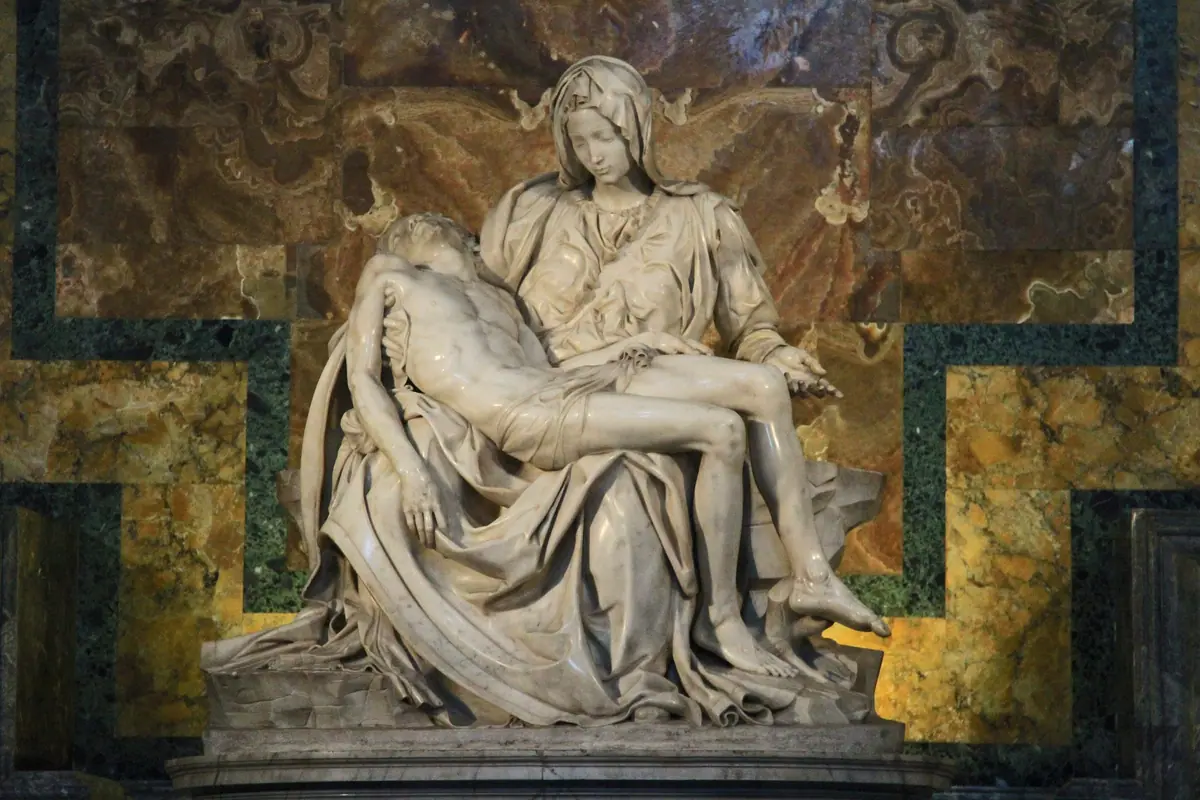
One of the masterpieces you see in St Peter’s today was made for Constantine’s church. A French cardinal, Jean Bilhères de Lagraulas, ordered the Pietà for his funeral chapel in the old basilica, and Michelangelo carved it in 1498 and 1499, when he was still in his twenties.
It moved into the new building when the old one came down. Look at the sash across the Virgin’s chest: it carries the only signature Michelangelo ever put on a work, “Michelangelo Buonarroti, Florentine, made this”.
1506: Bramante’s new basilica, built around the old one
Julius II decided to pull Constantine’s basilica down and start again, on Bramante’s plan for a church shaped like a Greek cross, with four equal arms. On 18 April 1506 he laid the first stone at the bottom of a foundation pit 7.45 metres deep, where the pier of St Veronica stands today, together with a vase holding twelve medals made by Caradosso.
The old church didn’t disappear overnight, though. The new one rose around it, and the old walls were demolished in stages, so for years the two buildings stood together. After Bramante came Giocondo, Raphael, the painter of the Raphael Rooms in the Vatican Museums, then Giuliano and Antonio da Sangallo and Peruzzi, each with his own ideas about the plan.
Who designed St Peter’s dome: Michelangelo, finished by Della Porta and Fontana
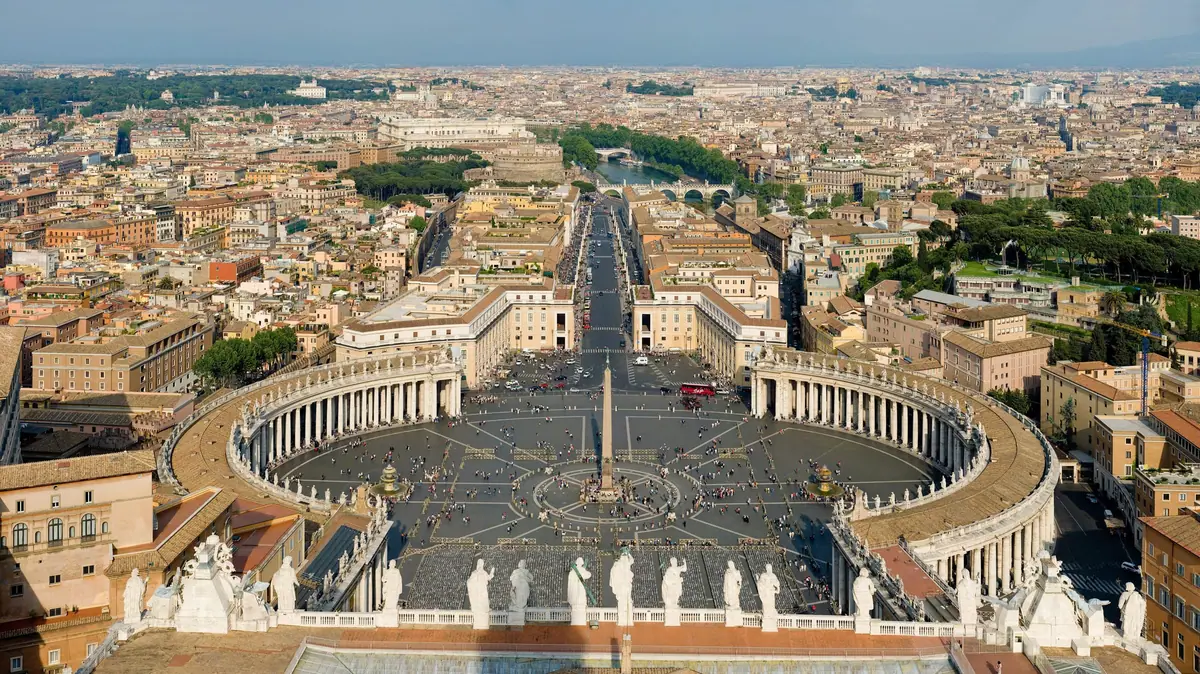
Michelangelo took charge of the works in the mid-16th century and went back to Bramante’s idea of a church built around a central point, with the dome at its heart. He died on 18 February 1564 with only the drum finished, the round wall the dome rests on. Giacomo della Porta and Domenico Fontana closed the dome in 1590, under Pope Sixtus V, and made it taller and more pointed than his drawings.
It’s built of brick, held together by four iron chains that act as a ring around it, and it rises 136 metres to the top, according to the Fabbrica di San Pietro, the office that runs the basilica. You can climb up inside it and walk out at the top, where the view above comes from.

Maderno’s nave and façade, and the consecration of 1626
The dome was up, but the church still had Bramante’s and Michelangelo’s compact plan. Carlo Maderno stretched it into a Latin cross, with the long nave you walk down today, and built the façade between 1608 and 1612. The Fabbrica puts the length of the finished basilica at about 187 metres.
Some books end the story with the façade in 1612, or in 1615, under Paul V. The date the basilica gives is 1626, the year Urban VIII consecrated the new St Peter’s, 120 years after Julius II’s first stone.
Bernini’s baldachin and St Peter’s Square
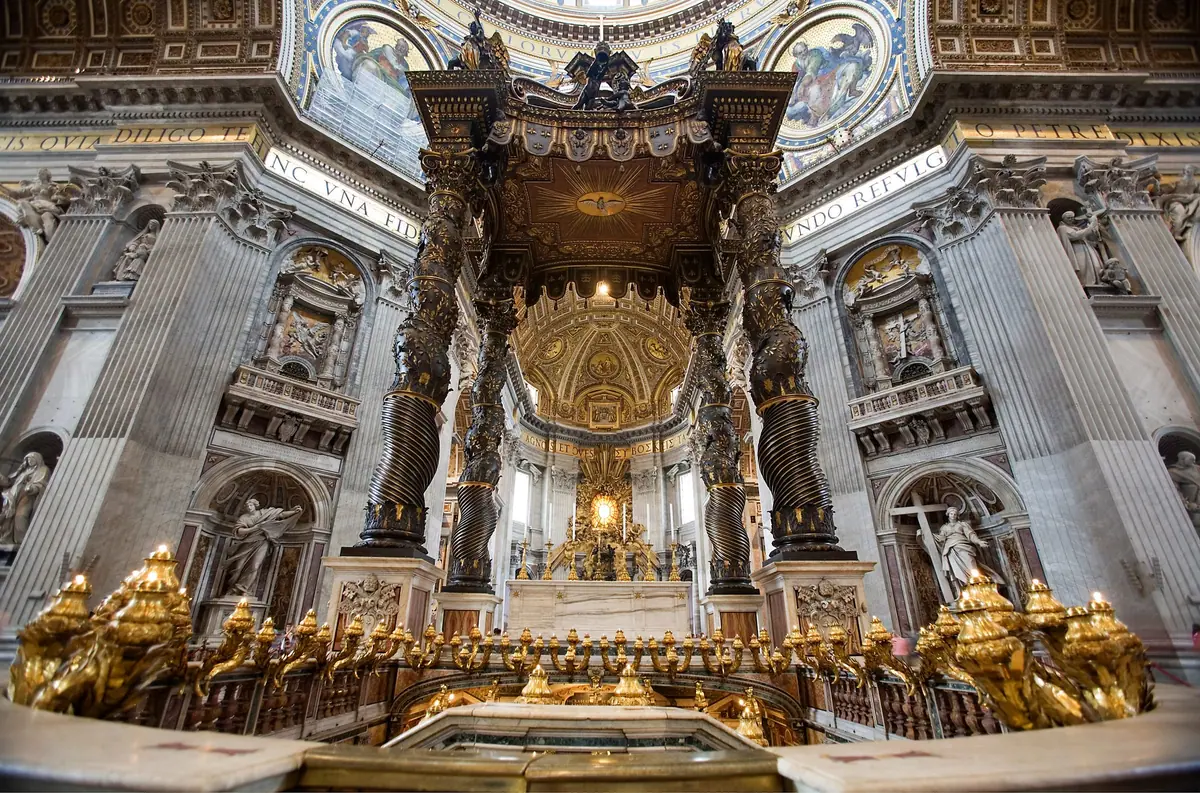
The same pope, Urban VIII, gave the young Bernini his first big job here: the bronze canopy over the papal altar, made between 1624 and 1633. It stands about 29 metres high, on twisted columns, right above the spot where the Church places Peter’s tomb.
Urban VIII came from the Barberini family, and a Roman joke has followed the baldachin ever since. The story goes that its bronze was stripped from the porch of the Pantheon, and someone wrote “what the barbarians didn’t do, the Barberini did”. How much Pantheon bronze actually went into it is still argued over.
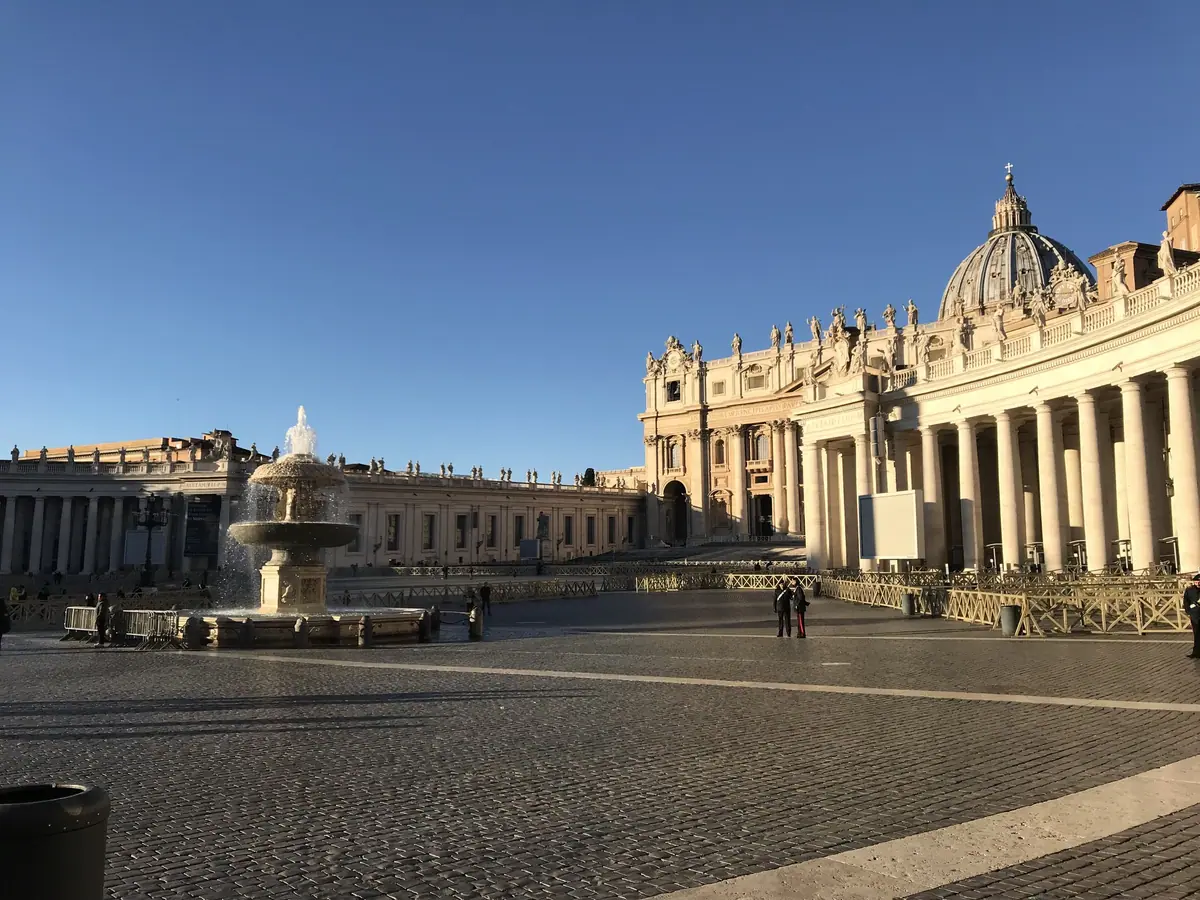
Outside, Bernini wrapped the square in his colonnade in the 17th century: 284 columns in four rows, curving out from the basilica like two arms. In the middle stands the obelisk Caligula brought from Alexandria in AD 37 for his circus. Fontana moved it 260 metres to its present spot in 1586, lowering it on 30 April and raising it there on 10 September, and it’s the only obelisk in Rome that has never fallen.
Is St Peter buried under St Peter’s Basilica?
The Church places Peter’s tomb under the high altar, and in the 20th century it went looking. Pius XII had the ground under the basilica dug from 1939 to 1958, in a dig led by the archaeologist Antonio Ferrua, and the team found the Roman cemetery of the Via Cornelia, with 22 tombs identified.
What the excavations found
- 1939 to 1958
- Excavations under the basilica, ordered by Pius XII
- 23 December 1950
- Pius XII announces that Peter's tomb has been found, but says no bones can be linked to him with absolute certainty
- 26 June 1968
- Paul VI announces that bones from a second niche have been identified as Peter's
So the Church holds that Peter lies there, though the evidence is less certain than many accounts make it sound. You can see the dig for yourself: the Vatican Necropolis, the Roman cemetery under the nave, is a separate visit you book on the basilica’s own site. The Vatican Grottoes, just below the floor, are free, and between them and the basilica about 91 popes are buried, John Paul II and Pius XII among them.
St Peter’s Basilica facts that surprise visitors
For all its size, St Peter’s isn’t Rome’s cathedral. That title belongs to St John Lateran, because the Pope is the bishop of Rome and his chair is there. St Peter’s is one of Rome’s four major basilicas, alongside St John Lateran, Santa Maria Maggiore and St Paul Outside the Walls.
Five things to look for in St Peter's
- The Holy Door
- The right-hand door of the portico opens only in Jubilee years
- The bronze St Peter
- The apostle holds the keys, his symbol and the sign of his power to bind and loose
- The dome
- Michelangelo's design, closed 26 years after his death, and you can climb up inside it
- The obelisk
- Brought to Rome by Caligula, and in the Middle Ages said to hold Julius Caesar's ashes in its gilded ball
- The Pietà
- Michelangelo's signature on the sash across the Virgin's chest, carved when he was in his twenties
Visiting St Peter’s Basilica today
Entry to the basilica is free, and you go in through the security check in the right-hand curve of Bernini’s colonnade. It opens at 7:00 and, until 28 March 2027, closes at 19:00. The basilica names Wednesday, the day of the papal audience, and Sunday, when the Pope leads the noon prayer, as its busiest days, so we’d pick an early morning on another weekday.
With a guide, you find the story above on the spot, from the Pietà to the baldachin. We sell a guided tour of the basilica for €17, and a guided tour of the Vatican Museums, the Sistine Chapel and St Peter’s for €68.40 if you want the whole Vatican in one go. Our St Peter’s Basilica page has the visiting rules and dress code in full.


St Peter’s is included in the Vatican City Pass, Go City and Turbopass, and it’s one of the choices in the Rome Tourist Card, where the alternative is the Pantheon; the Roma Pass leaves it out.

City cards
St Peter's Basilica with a city card
Pick the one that fits your trip. Prices are per adult, and you choose your dates on the next page.


See what you’d save, if anything
Which Rome card pays off for your trip?
Pick how many days you’ve got and the sights you want to see. The calculator adds up the tickets and rides, sets them against the card and tells you right away whether it pays off, and by how much, at today’s prices. No email, no sign-up.
Step 1 of 3
How long, and who’s going?
People also ask
Frequently asked questions
Who built St Peter's Basilica?
Pope Julius II started it, laying the first stone on 18 April 1506 to a plan by Bramante. Michelangelo designed the dome, Carlo Maderno added the long nave and the façade, and Bernini made the bronze canopy over the altar and the colonnade of the square. Twenty popes reigned while it was built, and Urban VIII consecrated it in 1626.
How long did it take to build St Peter's Basilica?
About 120 years, from the first stone in 1506 to the consecration on 18 November 1626. The façade was already finished by 1612, which is why some books end the story earlier. Bernini's colonnade around the square came later still, in the 17th century.
Did Michelangelo build the dome of St Peter's?
He designed it, but he died on 18 February 1564 with only the drum built, the round wall the dome sits on. Giacomo della Porta and Domenico Fontana closed the dome in 1590, giving it a taller, more pointed profile than Michelangelo's drawings.
Is St Peter really buried under St Peter's Basilica?
The Church holds that he is, under the high altar. Excavations from 1939 to 1958 found a Roman cemetery and what Pius XII announced in 1950 as Peter's tomb, though he said no bones could be tied to Peter with absolute certainty. In 1968 Paul VI announced that bones from a second niche had been identified as his.
How much does it cost to enter St Peter's Basilica?
Entry to the basilica is free, and so is the visit to the Vatican Grottoes, where many popes are buried. You pay for a timed booking, which comes with a digital audio guide, for the climb up the dome and for guided tours.
When is the best time to visit St Peter's Basilica?
The basilica itself names Wednesday, the day of the papal audience, and Sunday, with the Pope's noon prayer, as its busiest days. It opens at 7:00 every day and closes at 19:00 until 28 March 2027, so we'd go early on any other weekday.