
Rome · Rome Tourist Card
Pantheon in Rome
Nineteen centuries on, the sky still comes in through the roof.
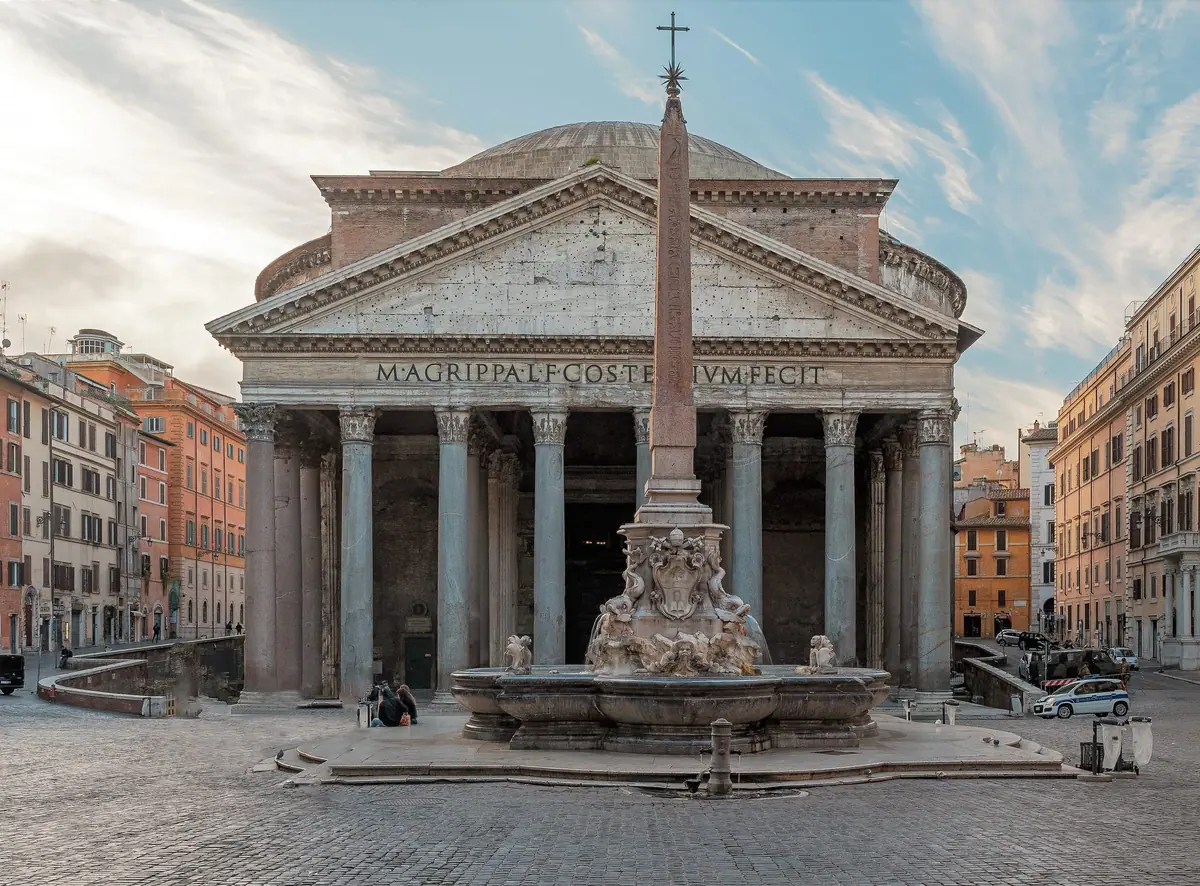
Rome's Pantheon is the temple Emperor Hadrian rebuilt between AD 118 and 125, and it's the building you walk into today. Its dome was the largest in the world until the 15th century, set over a round hall as wide as it is high. Since 609 it has been a church, and Raphael and Vittorio Emanuele II, the first king of a united Italy, are buried inside. Tickets come with a time slot, the one we sell adds an audio guide app, and the Rome Tourist Card, Go City and the Turbopass include it.
Before you go
- Time inside15–45 min
- OpenEvery day
- Best timeAt opening
TipAround noon on a sunny day, the beam of light from the oculus falls across the floor. During Sunday morning Mass only worshippers go in.


Pantheon tickets and how the time slots work
You’ve needed a ticket to go into the Pantheon since 3 July 2023. Each one is for a one-hour slot between 9:00 and 18:00, with up to 1,200 people let in per hour, and it’s issued in your name, so bring an ID to show with it.
Booking isn’t compulsory. The ticket desks and machines at the entrance sell on the day, in order of arrival, until 18:00, and a time booked ahead spares you that queue. The Pantheon releases its slots a month at a time, so if your dates don’t show yet, they will around the middle of the month before.
Under-18s go in free, and so do Rome residents and anyone coming in for Mass. Everyone else gets in free on the first Sunday of each month, the next ones being 6 December 2026 and 3 January 2027. Those days work differently: the free tickets are handed out at the entrance, to a single line that groups join too.
On every other day, the ticket we sell gets you in at the time you choose: from €11.80, a booked slot with an audio guide app on your phone. The app doesn’t come with headphones, so pack your own earphones. You can cancel for free, or move the date, up to 24 hours before.


What “Fast Track” means on a Pantheon ticket
The Pantheon has no skip-the-line entry. Italy’s Ministry of Culture, which runs it, doesn’t offer one, and visitors go in in the order they arrive. The Fast Track on our ticket is a booked time, which Tiqets describes as a dedicated line for visitors who booked, so you don’t queue at the ticket desk. The security check is the same for everyone.
The ticket comes in three versions, chosen at checkout, and the starting price of €11.80 is the one with the app. The other two need a stop before you go in:
Before your slot, by version of the Fast Track ticket
- 1Fast Track + Digital Audio Guide: you get your booked time and an audio guide app, so bring earphones. Its page lists no collection point.
- 2Fast Track + Official Audio Guide: you get the church's own audio guide, with video. Collect it first at Via dei Bergamaschi 49, five minutes' walk away, leaving an original ID as a deposit.
- 3Skip The Line + Navona Square 3D: you get virtual-reality glasses. Be at Piazza Navona 25 fifteen minutes early, and know that this one can't be refunded or moved.
If you take one of the versions with a pick-up, leave time for that walk before your slot: in October one visitor lost their slot that way. For a guide in person, the guided tours start at €24. One is 45 minutes with a live guide in English, French, Italian or Spanish, in groups of up to 25 with headsets, and can’t be refunded or moved; the other spends three hours on the Pantheon, the Stadium of Domitian and the Vicus Caprarius, and the price depends on the one you pick. If the Vatican Museums are on your list too, one ticket from €59 books both, with the Vatican first and the Pantheon afterwards at your own pace.
Inside the Pantheon, from the portico to Raphael’s tomb
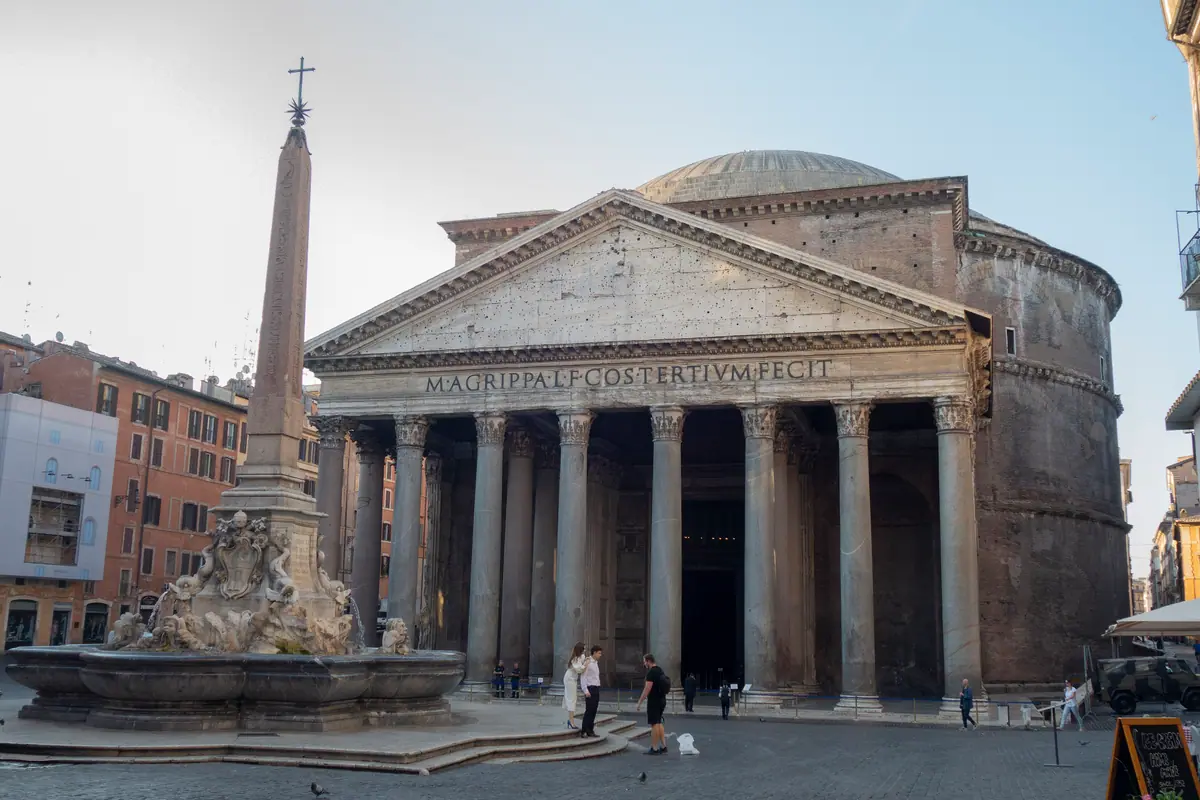
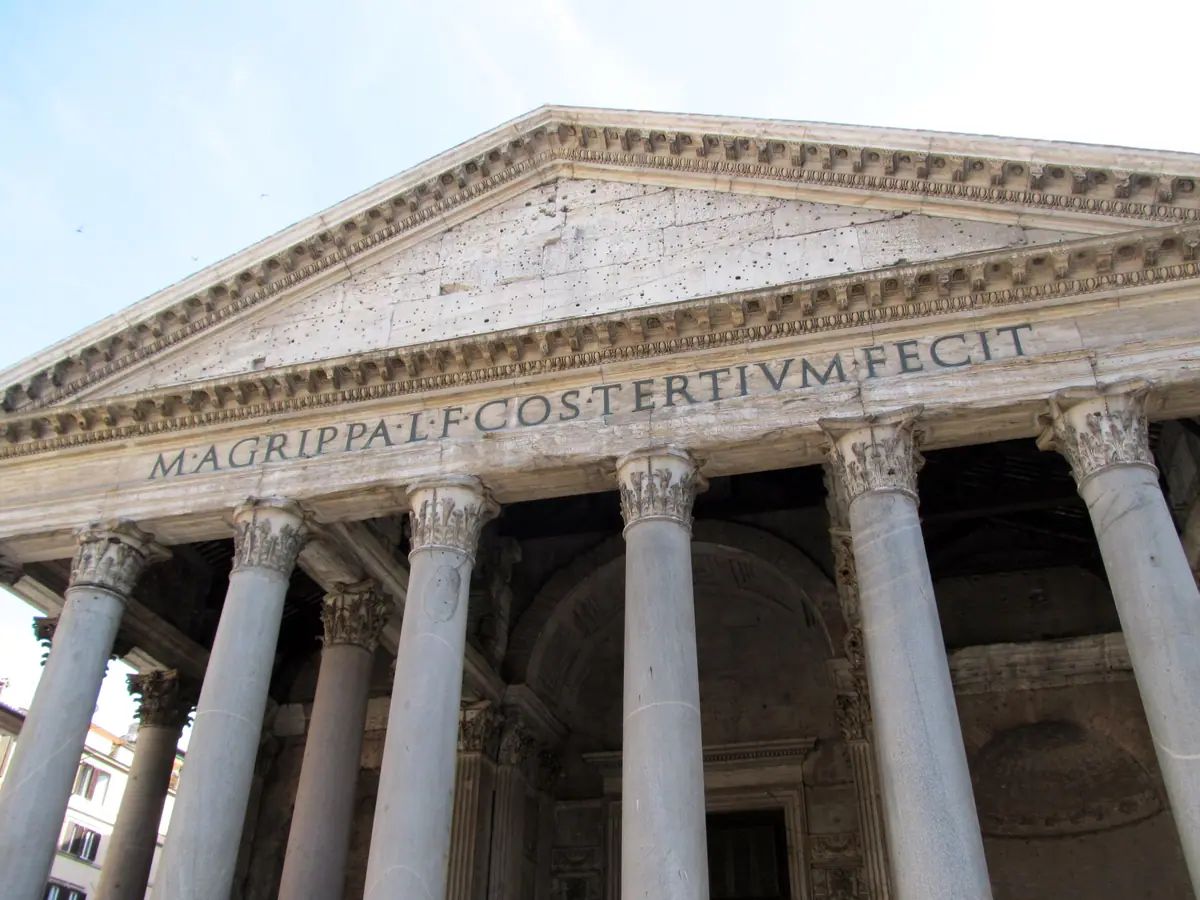
You come in under the portico, a porch of 16 Corinthian columns in grey and pink granite, with an inscription across the front naming Marcus Agrippa, son-in-law of the emperor Augustus, who built the first temple on this spot. Past the bronze doors is the Rotunda, the round hall, 43.30 metres across and the same in height, with walls more than six metres thick.
Above you, the dome rises in five rings of 28 coffers, the sunken square panels, up to the oculus, an opening about nine metres wide. It was the largest dome in the world until the 15th century, and it’s still the largest made of unreinforced concrete. Brunelleschi drew on it for his dome in Florence, and Michelangelo studied it before his dome for St Peter’s.
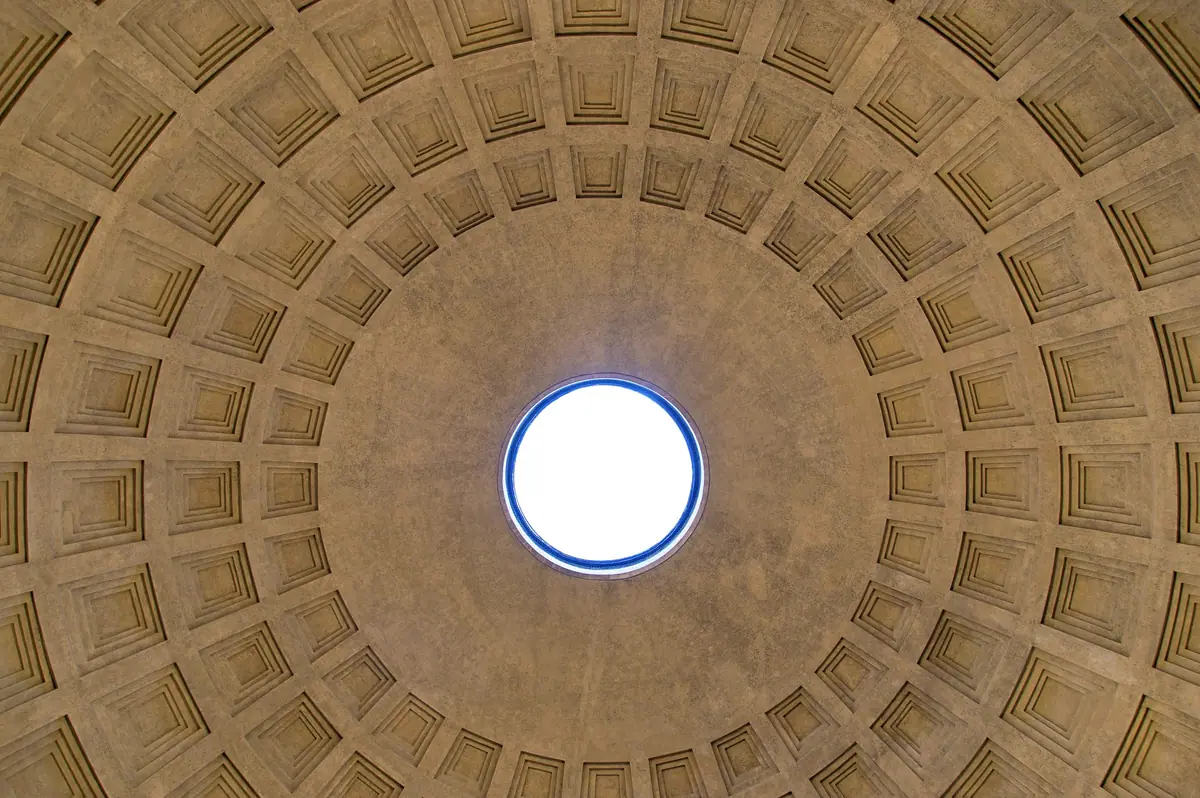
The oculus is the building’s only window. When it rains, the rain falls straight in, which is why the floor is slightly domed and has 22 drainage holes. On a sunny day the disc of light moves across the walls: at noon it lines up with the door, and the priests who serve the church say it reaches the highest coffer at the winter solstice, the cornice at the equinoxes and, at the summer solstice, whoever is standing in the doorway.
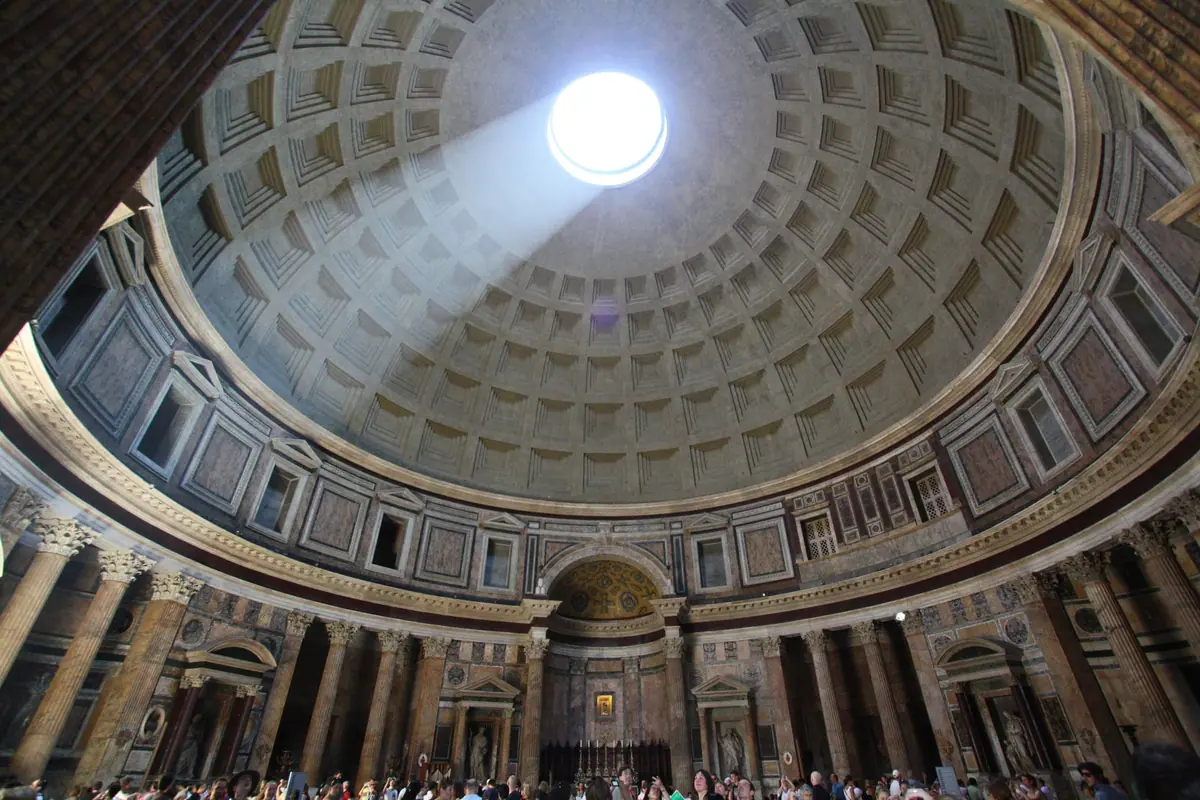
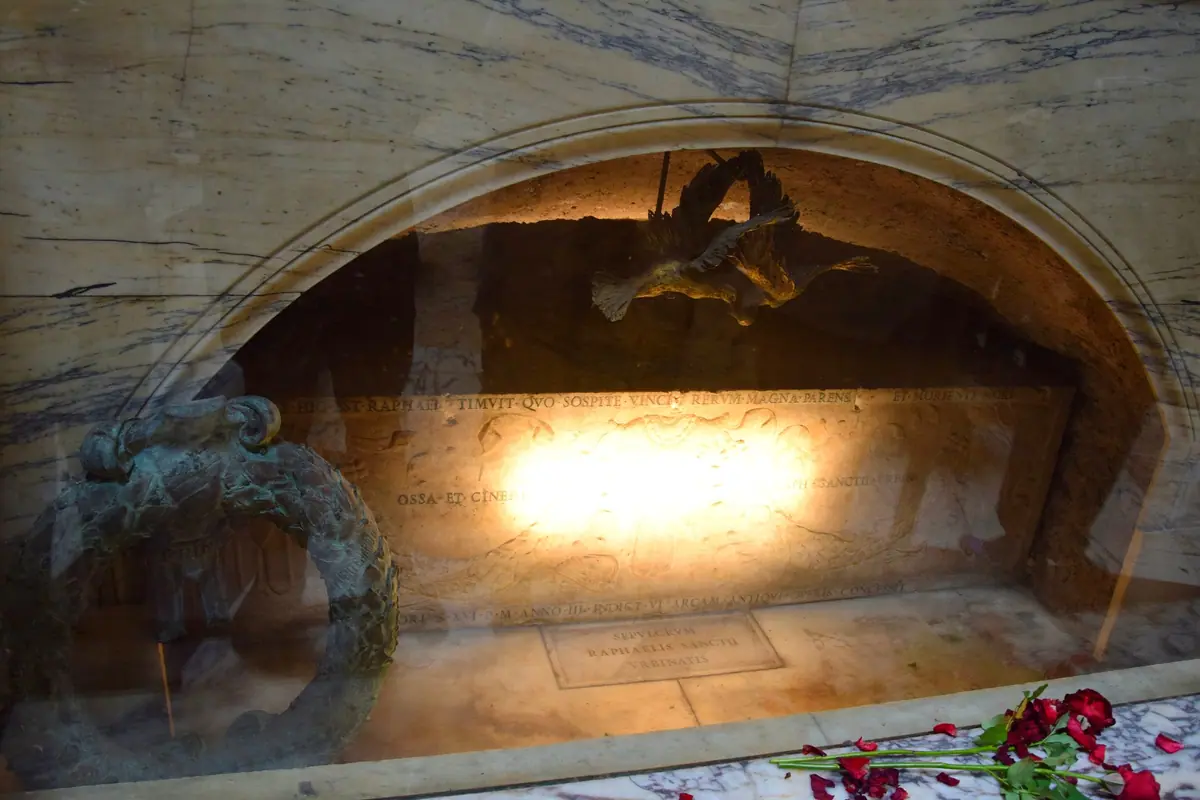
The tombs are set around the walls. Raphael, the painter, lies on your left as you come in, beneath Lorenzetto’s Madonna del Sasso. Vittorio Emanuele II is across the hall, and King Umberto I is buried here too, with Queen Margherita of Savoy, the queen the pizza Margherita is said to be named after. On the high altar is an icon of the Madonna and Child from the 7th century.
Oltre il Pantheon, the rooms behind the Rotunda
Since November 2025 the Pantheon has had a second visit, Oltre il Pantheon (“beyond the Pantheon”), in the rooms of the Basilica of Neptune, directly behind the Rotunda. It lasts 45 minutes, in groups of up to 25, with video mapping of the oculus, scale models and an 8th-century ciborium, the canopy that stood over an altar, pieced back together. From those rooms you go into the Rotunda through an entrance of its own, with a lift.
It runs every day except the first Sunday of the month, until 31 December 2026 according to Rome’s tourist board. It costs €10 on top of the entry ticket, with no reductions apart from free entry for under-18s, and it’s sold only through Musei Italiani, the booking app of Italy’s Ministry of Culture.
Which Rome city passes include the Pantheon
The Roma Pass and the Omnia Card leave the Pantheon out (our comparison of the Rome passes has the rest): the Ministry’s page for the Pantheon says it isn’t part of either. Three others include it, and each gets you in differently.
-
Rome Tourist Card
One pick in the third group, instead of St Peter's Basilica
from €89
Buy pass→ -
Go City Rome Explorer Pass
One of your choices, with an audio guide; the ticket comes from the Touristation desk on Piazza d'Aracoeli on your first day
from €89
Buy pass→ -
Turbopass Rome City Pass
Included, with a time slot booked ahead and the ticket collected a few minutes' walk from the entrance
from €144.90
Buy pass→

Neither the Roma Pass nor the Omnia Card includes the Pantheon, so with those you buy a Pantheon ticket.
The Rome Tourist Card is a bundle of timed tickets sold by Tiqets, made up of three groups: you pick one ticket from each, and in the third you choose St Peter’s Basilica or the Pantheon. The tickets arrive by email, for the dates you chose.
The Go City Explorer Pass doesn’t need booking before the trip, but the pass on its own isn’t accepted at the door, so you collect a ticket at the Touristation desk first. On the day, the visit itself starts at Piazza Navona 25, at 9:00, 12:30, 14:30 and 16:00 from Monday to Saturday, and every hour from 12:00 to 17:00 on Sundays. With the Turbopass, you bring the pass’s QR code and a photo ID to the pick-up point, and collecting the ticket takes about five minutes. None of the three covers Oltre il Pantheon or gets you in while Mass is on.
Pantheon opening hours, Mass times and the best time to go
The Pantheon keeps the same hours all year, with no weekly closing day, and shuts only on 25 December and 1 January. It’s still a church, though, and Mass closes it to visitors for part of every Saturday, Sunday and holiday.
Opening hours
- Every day
- 9:00–19:00, last entry 18:30
- Ticket desks at the entrance
- Close at 18:00
- Saturdays and the day before a holiday
- Mass at 17:00, ticket sales stop at 16:00
- Sundays and holidays
- Mass at 10:30, ticket sales stop at 9:30
- Closed
- 25 December and 1 January, unless a special opening is announced
Ticket sales stop an hour before each Mass, and while it’s on only people coming to worship go in, so Sunday morning and late Saturday afternoon are the times to avoid. We haven’t found when visits resume after the Sunday service; Go City’s own Sunday visits start at 12:00.
Travel guides point to 9:00, when the doors open, or the hour before closing for shorter lines. The light is another reason to pick your hour: around noon on a sunny day, the beam from the oculus lines up with the door.
It’s a working church, so dress for one: shoulders covered, and nothing very short, low-cut or see-through, or staff can turn you away. Inside, keep your phone on silent and use it only for photos and video, and leave food, drinks and cigarettes, electronic ones included, outside.
On the day, with a booked time
- 1At your time: go to the portico in Piazza della Rotonda with your ticket. The Pantheon asks you to be on time for your slot.
- 2At the door: show your ticket with an ID (a copy is fine) carrying the same name as the ticket.
- 3Security: everyone goes through the check, and there's no cloakroom, so travel light. Dogs can't come in, apart from guide and assistance dogs.
- 4Step-free access: visitors with reduced mobility use the ramp on the Via della Minerva side. The square outside is cobbled and uneven.
How the Pantheon became a church
Agrippa’s temple went up between 27 and 25 BC, for all the gods, which is what pantheon means in Greek. After it was damaged in AD 80 and again in 110, Emperor Hadrian rebuilt it between 118 and 125 as the building you see, and left Agrippa’s name on the front.
In 609 the Byzantine emperor Phocas gave it to Pope Boniface IV, who consecrated it on 13 May as Santa Maria ad Martyres, St Mary and the Martyrs. Being a church is what spared it from being plundered in the Middle Ages.
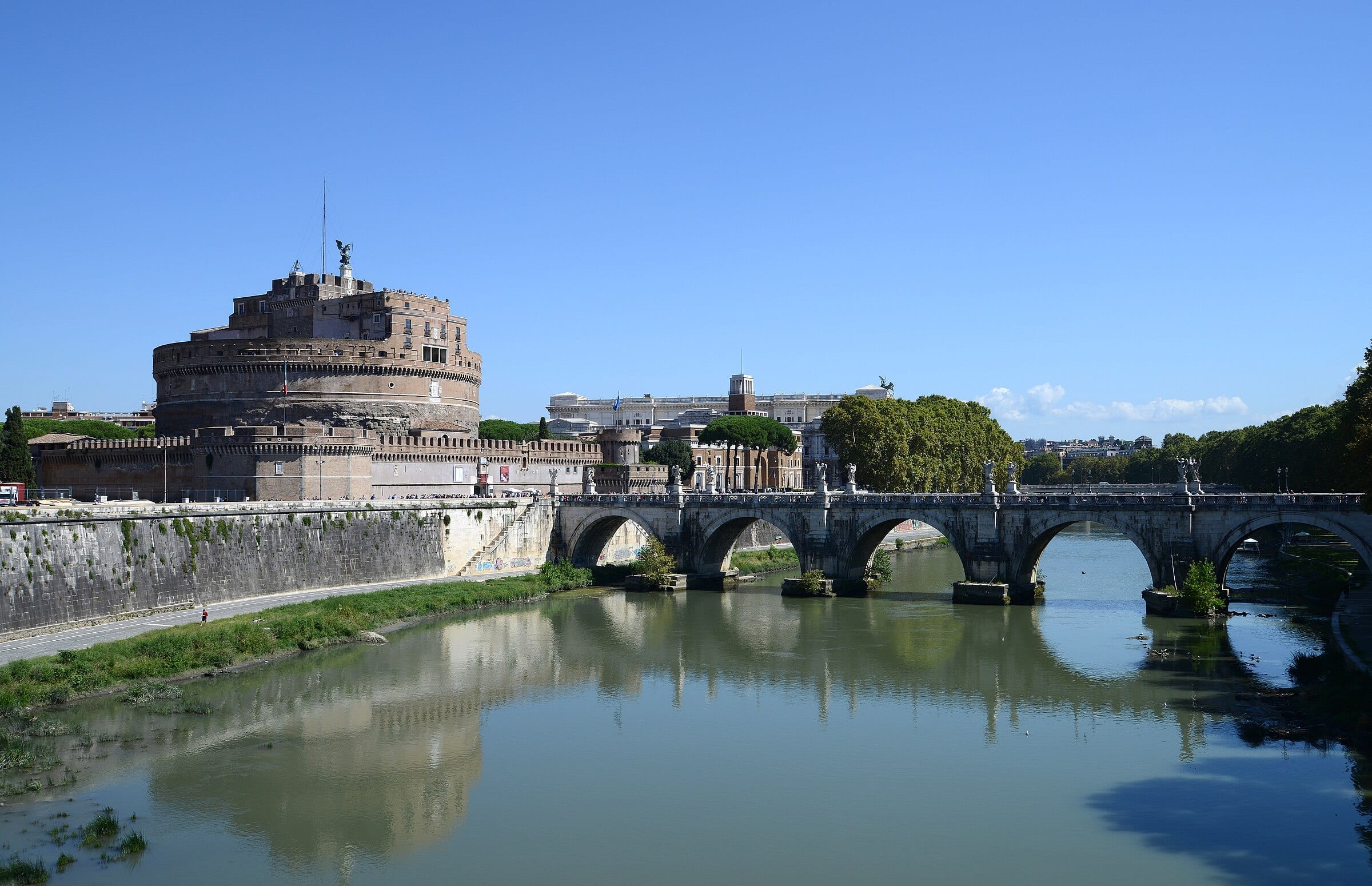
The portico’s bronze was another matter. In 1625 Pope Urban VIII, from the Barberini family, had it taken down for cannons at Castel Sant’Angelo, the fortress on the Tiber, and Romans had a saying for it: “Quod non fecerunt barbari, fecerunt Barberini”, what the barbarians didn’t do, the Barberini did. In 1870 the Pantheon became the memorial chapel of Italy’s kings, which is why two of them lie inside.
How to get to the Pantheon from the metro or by bus
The Pantheon stands in Piazza della Rotonda, in Rome’s historic centre, where the metro doesn’t reach. From Barberini, on line A, it’s about a 15-minute walk; for less walking, a bus to Largo di Torre Argentina leaves you about 400 metres away.
Getting there
- Metro
- Line A to Barberini (about 15 minutes on foot) or Spagna
- Bus
- 30, 40, 62, 64, 81, 87 or 492 to Largo di Torre Argentina, about 400 m away
- From Termini station
- Bus 64 to Largo di Torre Argentina
- Step-free entrance
- The ramp on the Via della Minerva side
City cards
Pantheon with a city card
Pick the one that fits your trip. Prices are per adult, and you choose your dates on the next page.

Tickets
Popular tickets around Rome
The ones other visitors book most.


People also ask
Frequently asked questions
Is the Pantheon free with the Roma Pass?
No, and the Omnia Card doesn't include it either. The passes that do are the Rome Tourist Card, where it's the alternative to St Peter's Basilica, the Go City Explorer Pass, where it uses one of your choices, and the Turbopass.
Is there a skip-the-line ticket for the Pantheon?
No ticket skips the queue at the Pantheon, and everyone goes through the same security check. A ticket booked online, like the Fast Track one we sell, gets you a set time, so you don't wait to buy at the ticket desk.
Can you visit the Pantheon during Mass?
Only to attend it. Mass is at 17:00 on Saturdays and the day before a holiday, and at 10:30 on Sundays and holidays. Ticket sales stop an hour before, and during the service only worshippers go in.
When is the Pantheon free?
Under-18s and Rome residents go in free. For everyone else it's free on the first Sunday of each month, and on those days tickets are handed out at the entrance rather than booked.
What should I wear to the Pantheon?
What you'd wear to church, because it is one: shoulders covered, and nothing very short, low-cut or see-through. Staff can turn you away at the door.
When is the best time to visit the Pantheon?
Travel guides suggest 9:00, when it opens, or the last hour before closing for shorter lines. For the beam of sunlight from the oculus, go around noon on a sunny day, and avoid Sunday mornings, when Mass closes it to visitors.
