Rome · Pantheon
When was the Pantheon built?
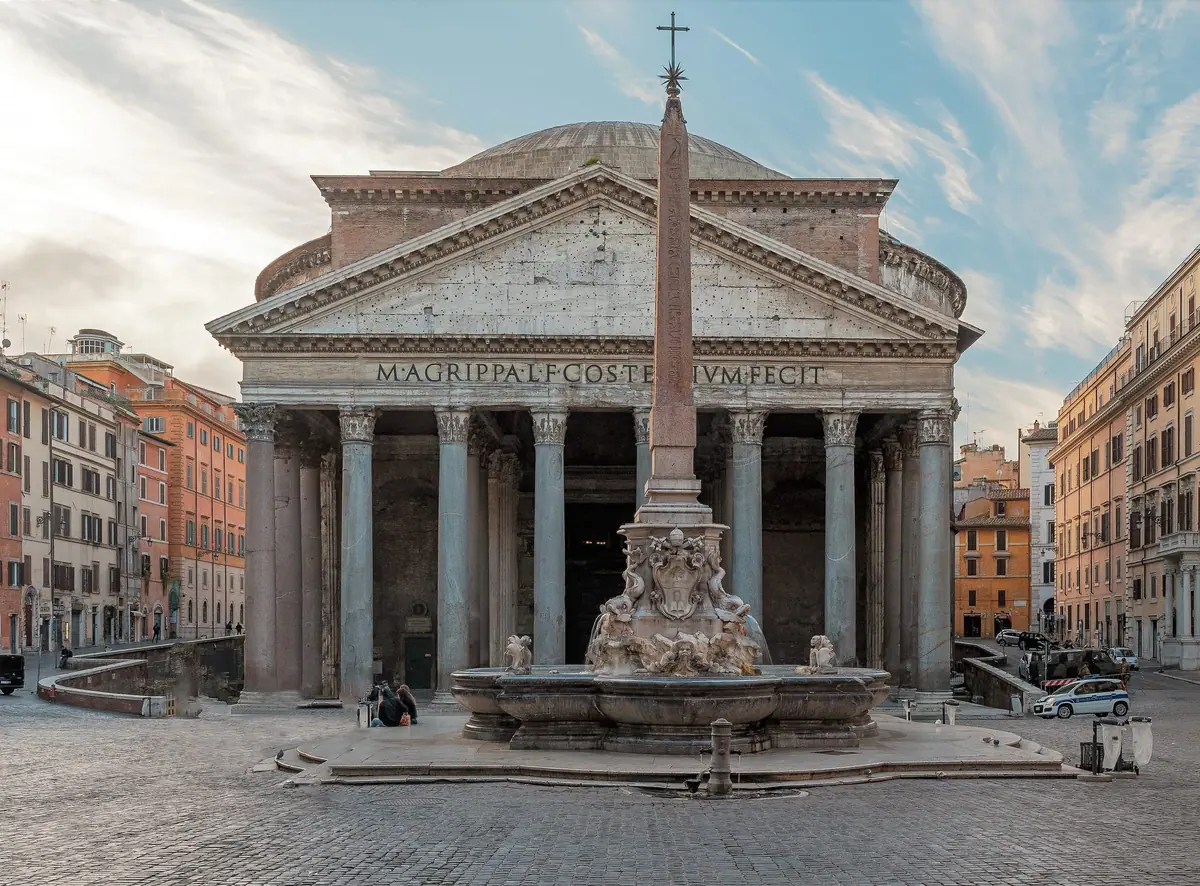
Agrippa's name is on the front, but the dome behind it is a century and a half younger.
The Pantheon you see in Rome today was built under the emperor Hadrian between about AD 118 and 125, on the official dating, though some historians put the finish as late as 126 to 128. It stands on the site of a temple that Agrippa, Augustus's son-in-law, began in about 27–25 BC. That's why Agrippa's name is still over the door. It became a church in 609, which kept it standing, and its dome is still the largest unreinforced concrete dome in the world.
When was the Pantheon built, and who built it?
The Pantheon you walk into today was built under the emperor Hadrian, between about AD 118 and 125 on the official dating, and some historians put the finish as late as 126 to 128. It stands on the site of an earlier temple begun in about 27–25 BC by Marcus Agrippa, the friend and son-in-law of Augustus, Rome’s first emperor.
Agrippa’s temple didn’t last. A fire destroyed it in AD 80 and the emperor Domitian rebuilt it, then another fire in 110 took that one too. So the building in front of you is the third Pantheon on the spot, not the second.
The Hadrian date has a wrinkle of its own. Re-examining the stamps the brickmakers pressed into the bricks, the archaeologist Lise Hetland has argued that work began around 114, under Trajan, the emperor before Hadrian. The reference books still say Hadrian. Who designed it, nobody knows: Apollodorus of Damascus, Trajan’s architect, is the name suggested on grounds of style, but it’s a guess.
Three Pantheons on one spot
- c. 27–25 BC
- Agrippa builds the first Pantheon
- AD 80
- A fire destroys it, and Domitian rebuilds it
- AD 110
- Another fire
- c. AD 118–125
- Today's Pantheon goes up under Hadrian (some historians say finished up to 128)
- AD 202
- Septimius Severus and Caracalla restore it
- 13 May 609
- Consecrated as the church of Santa Maria ad Martyres
Why the Pantheon says Agrippa on the front
Look up at the portico and the long line under the pediment reads M·AGRIPPA·L·F·COS·TERTIVM·FECIT: “Marcus Agrippa, son of Lucius, consul for the third time, made this.” It’s the dedication of the first temple, copied onto the new building a century and a half later.
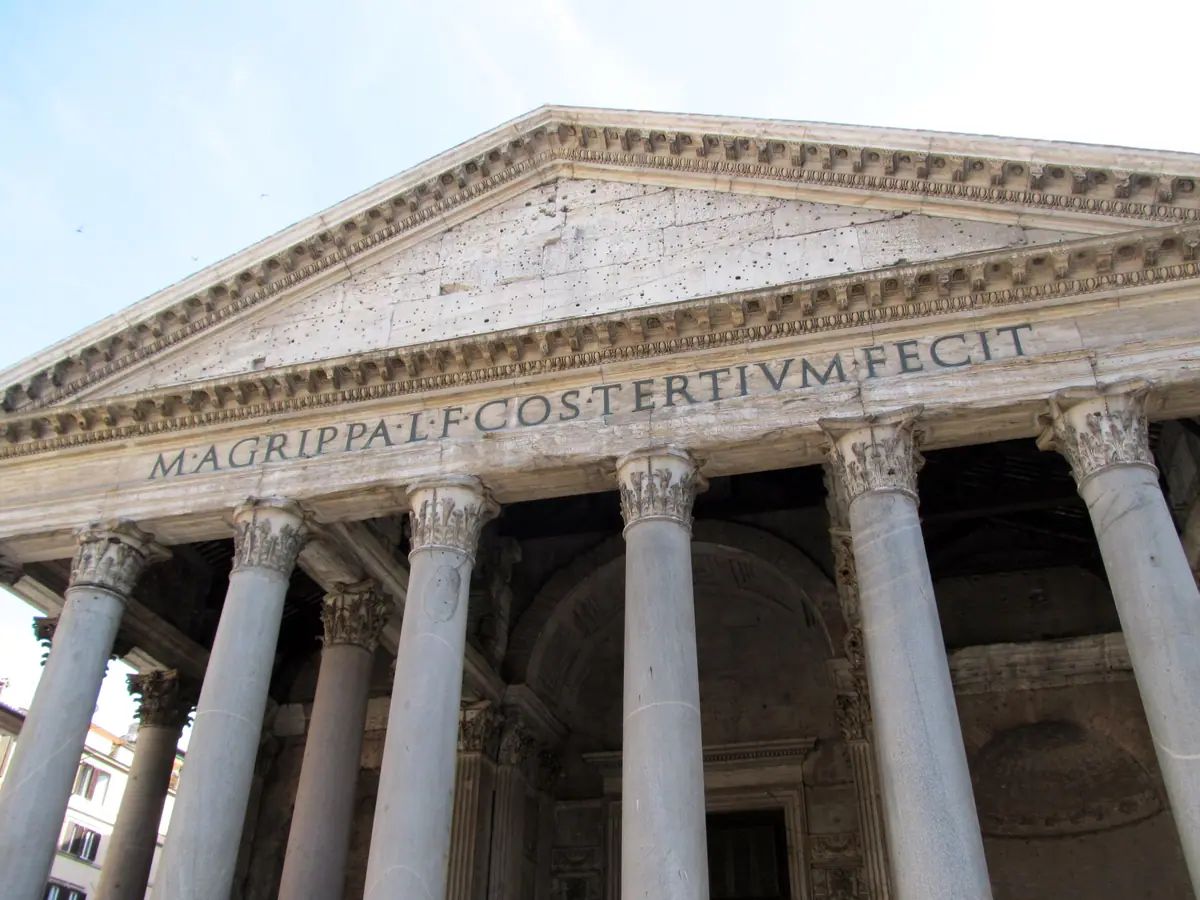
That was Hadrian’s habit. He hardly ever put his own name on what he built, and the Historia Augusta, a Roman collection of emperors’ lives, says he dedicated the Pantheon in the name of its original builder. Just below, a smaller inscription records the restoration by the emperors Septimius Severus and his son Caracalla in 202.
What the temple was actually for is another open question. You’ll read that it honoured the twelve gods and the living emperor, but no ancient source confirms it, and the reference works don’t commit to a purpose.
How the Pantheon was built, starting with granite from Egypt
The portico stands on 16 Corinthian granite columns, eight across the front and two groups of four behind. Each is 11.9 m tall, 1.5 m across and weighs about 60 tonnes. The grey ones came from Mons Claudianus and the pink ones from Aswan, both in Egypt, dragged more than 100 km on wooden sledges to the Nile and then shipped on to Rome.
The Pantheon in numbers
- The dome
- About 43 m (142 ft) across inside, and exactly as high
- The oculus
- 8.95 m across, the only opening for light
- Dome thickness
- 6.4 m at the base, 1.2 m around the oculus
- Portico columns
- 16, each 11.9 m tall and about 60 tonnes
- The coffers
- Five rings of 28
- The doors
- Bronze, 7 m high
Some scholars think those columns are shorter than the builders first planned, with the pediment adjusted to fit, though that’s still argued over. You also walk in lower than the Romans did: the portico once stood seven steps, about 1.3 m, above the square, and centuries of Tiber floods and neglected drains raised the ground until it buried almost all of them.
How the Pantheon’s dome has stayed up for 1,900 years
Through the bronze doors is the rotunda, built of Roman concrete faced with brick, and the trick is in the mix. The builders put heavy travertine in the concrete at the bottom, then terracotta, and light tuff and pumice at the top, and the dome thins from 6.4 m at its base to 1.2 m at the rim of the opening. Nearly 1,900 years on, it’s still the largest unreinforced concrete dome in the world.
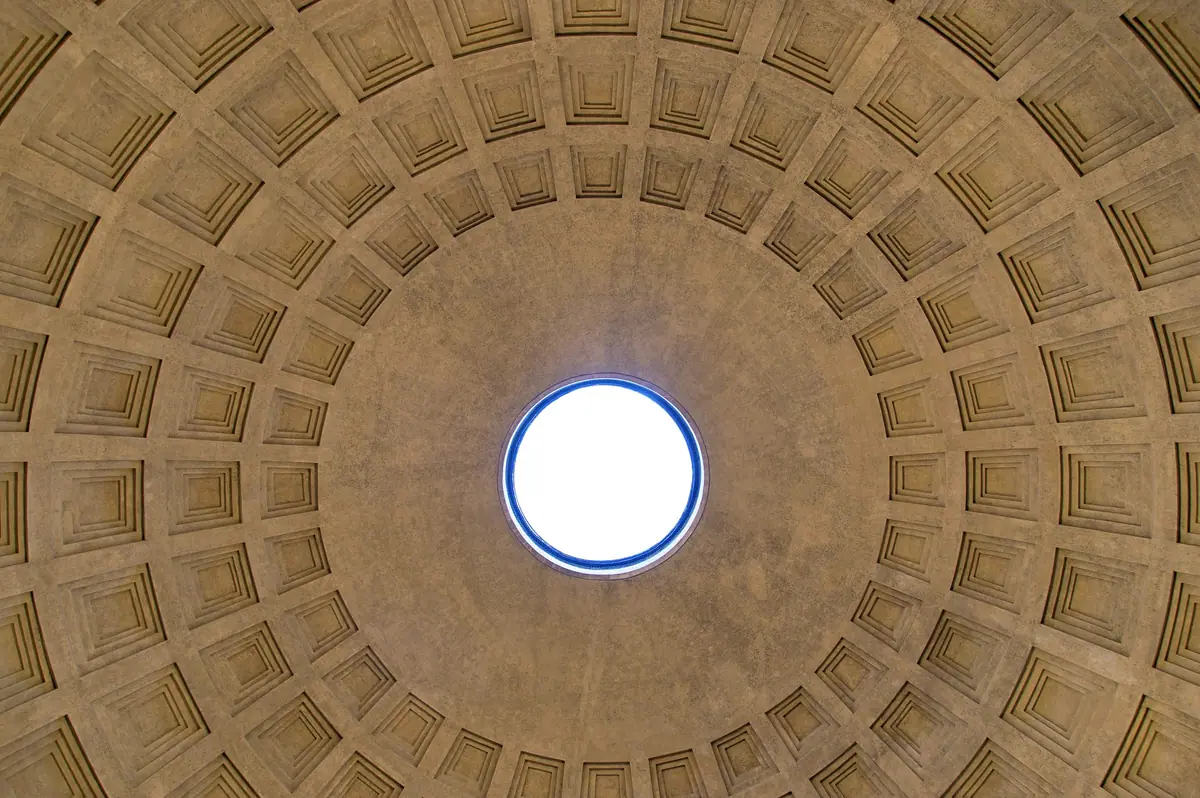
The proportions are as neat as the engineering. The height from the floor to the oculus equals the diameter, so a sphere 43 m wide would fit inside exactly; in Roman measure that’s 150 feet, with an oculus of 30. Nobody knows whether the coffers, the five rings of 28 sunken panels, meant anything; numbers, geometry and the moon have all been suggested.
That oculus is the only window, and it’s open to the sky, so when it rains, it rains inside. The marble floor is slightly domed, and 22 small holes in it carry the water away.
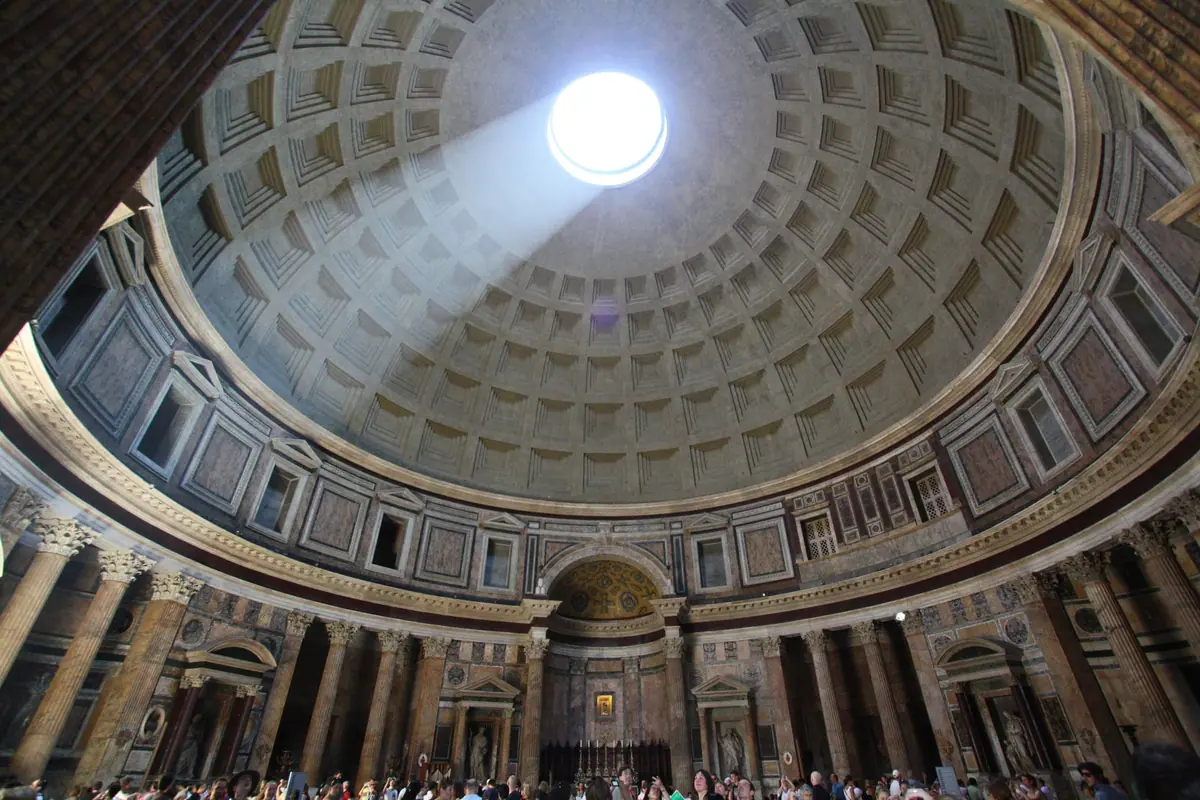
On a sunny day you can watch the disc of light slide across the coffers. The basilica’s own website follows it through the year: at noon on the winter solstice it reaches the highest coffers, and at the summer solstice it lights up the people at the door. Reading the Pantheon as a solar temple from that is an interpretation, not a proven fact. Once a year the oculus lets something else in: on Pentecost, Rome’s firefighters drop rose petals through it.
How the Pantheon became a church in 609
After the empire, the building’s luck turned on a gift. The Byzantine emperor Phocas handed it to Pope Boniface IV, who consecrated it on 13 May 609 to St Mary and the Martyrs, Santa Maria ad Martyres. A church was too useful to tear down, so while much of ancient Rome was plundered for stone and metal, the Pantheon kept its walls and its dome.
It’s still a working church, with Mass on the timetable and a request for silence inside. You need a ticket to go in. Ours is sold as fast-track entry, though the Pantheon itself has no official skip-the-line lane: €11.80 for the Pantheon, fast track. If you’d like someone to point out the inscriptions and the coffers as you go, there’s a guided tour for €24.


Where the Pantheon’s bronze went
Being a church saved the stone, not the metal. In July 663 the Byzantine emperor Constans II, visiting Rome, had the gilded bronze tiles stripped off the roof. You’ll sometimes read that it was Constantine in 655, including on the basilica’s own site, but the chronicler Paul the Deacon names Constans II. Lead covers the dome today.
The next raid came from a pope. Urban VIII, who reigned from 1623 to 1644 and came from the Barberini family, had the bronze pulled from the portico’s beams, and most of it was cast into cannons for Castel Sant’Angelo. Romans answered with a satirical verse: “quod non fecerunt barbari, fecerunt Barberini”, what the barbarians didn’t do, the Barberini did. The story that some went into Bernini’s canopy over the altar of St Peter’s is told often, but it isn’t proven.
The same century added two baroque bell towers on the front, by the architects Carlo Maderno and Francesco Borromini. Romans called them the donkey’s ears, they were blamed on Bernini by mistake, and they came down after the unification of Italy in the 19th century.
Who is buried in the Pantheon
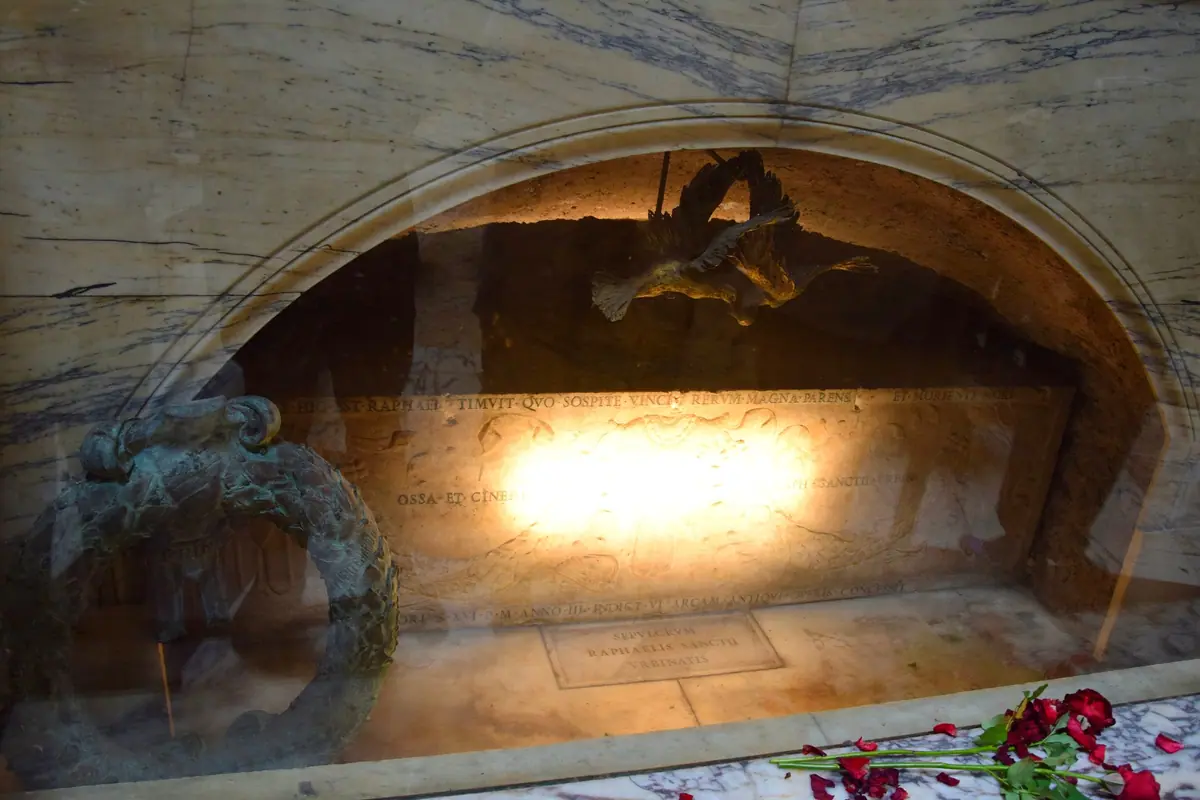
Unification also turned the Pantheon into a burial place for Italy’s kings, but the most visited tomb is older. Raphael, one of the great painters of the Italian Renaissance, chose the Pantheon for his grave, and his sarcophagus sits in a niche of the rotunda. Maria Bibbiena, the woman he was engaged to, lies to the right of it.
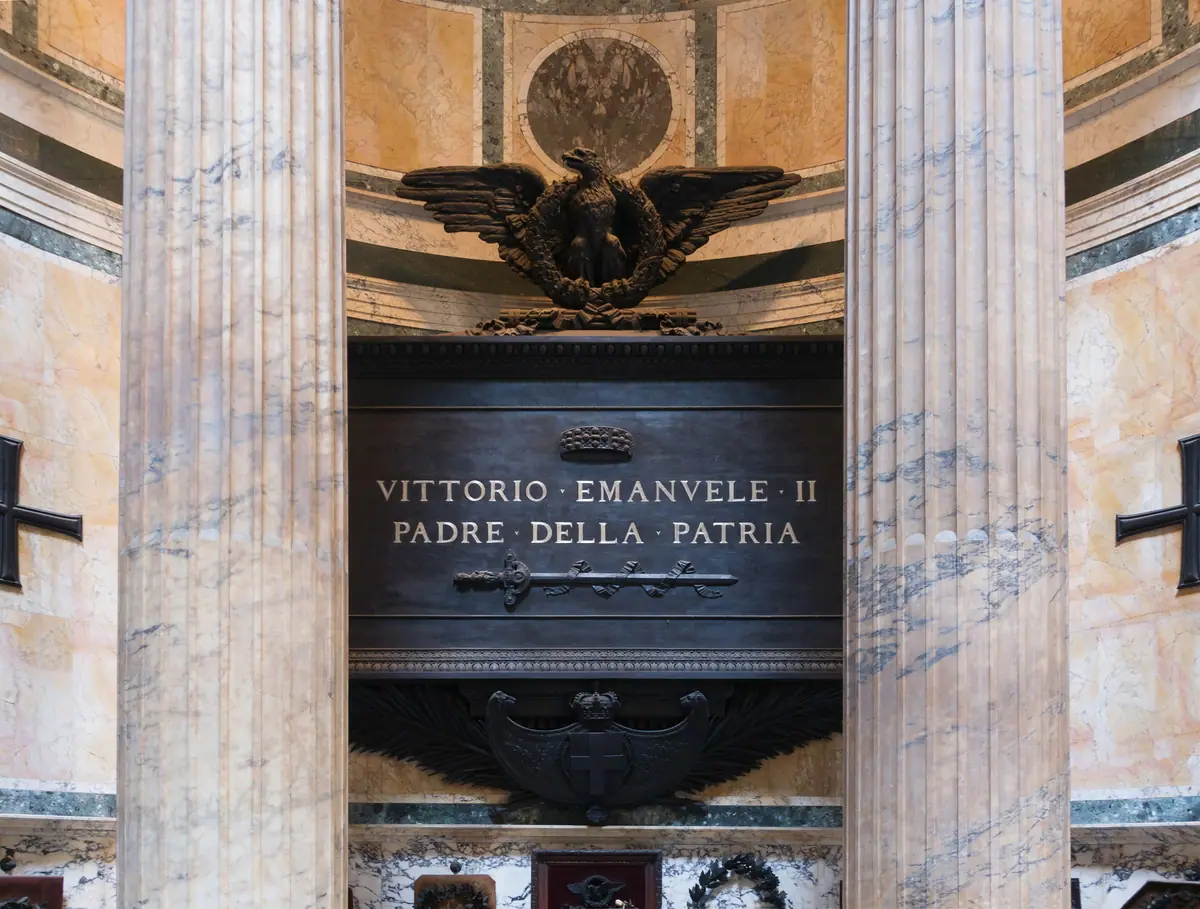
The painter Annibale Carracci, the composer Arcangelo Corelli and the architect Baldassarre Peruzzi are buried here too. So are two kings of united Italy, Vittorio Emanuele II and Umberto I, and Queen Margherita. When Italy abolished the monarchy in 1946, the kings who later died in exile were refused a place beside them.
Visiting the Pantheon today
All of this sits under one roof, from Agrippa’s line on the front to Raphael’s niche inside, and you can see it in under an hour. The hours, the Mass times and how to book are on our page for Pantheon tickets.
If you’re planning several sights, the Pantheon is one of the choices in the Rome Tourist Card (in place of St Peter’s) and in the Go City pass, and it’s included in the Turbopass; the Roma Pass doesn’t include it. Roma Pass and Rome’s other city passes puts them side by side.

See what you’d save, if anything
Which Rome card pays off for your trip?
Pick how many days you’ve got and the sights you want to see. The calculator adds up the tickets and rides, sets them against the card and tells you right away whether it pays off, and by how much, at today’s prices. No email, no sign-up.
Step 1 of 3
How long, and who’s going?
People also ask
Frequently asked questions
Who built the Pantheon in Rome?
Marcus Agrippa, Augustus's son-in-law, built the first Pantheon in about 27–25 BC. The building standing today went up under the emperor Hadrian between about AD 118 and 125 (some historians say up to 128), though a study of the brick stamps suggests work began around 114, under Trajan. Nobody knows who designed it; Apollodorus of Damascus, Trajan's architect, is a guess based on style.
Why does the Pantheon say Agrippa if Hadrian built it?
The inscription on the front copies the dedication of Agrippa's original temple. Hadrian hardly ever put his own name on his buildings, and the Historia Augusta, a Roman collection of emperors' lives, says he dedicated the Pantheon in the name of its first builder.
How old is the Pantheon?
The building you walk into is about 1,900 years old, built between about AD 118 and 125. The site is older: Agrippa's first Pantheon dates from about 27–25 BC, and two fires, in AD 80 and 110, destroyed the earlier versions.
Why does the Pantheon have a hole in the roof?
The oculus, about 9 m across, is the building's only window, and it lets the rain in. The marble floor is slightly domed and has 22 drainage holes to carry the water away. On Pentecost, firefighters drop rose petals through it.
Is the Pantheon still a church?
Yes. It was consecrated on 13 May 609 as Santa Maria ad Martyres, St Mary and the Martyrs, and Mass is still said there. Becoming a church is what saved it from being stripped for stone like much of ancient Rome.
Read more