
Verona · VeronaCard
Scaliger Tombs
Verona's medieval lords lie under Gothic canopies beside Santa Maria Antica, fenced in by iron ladders, the emblem of their house.
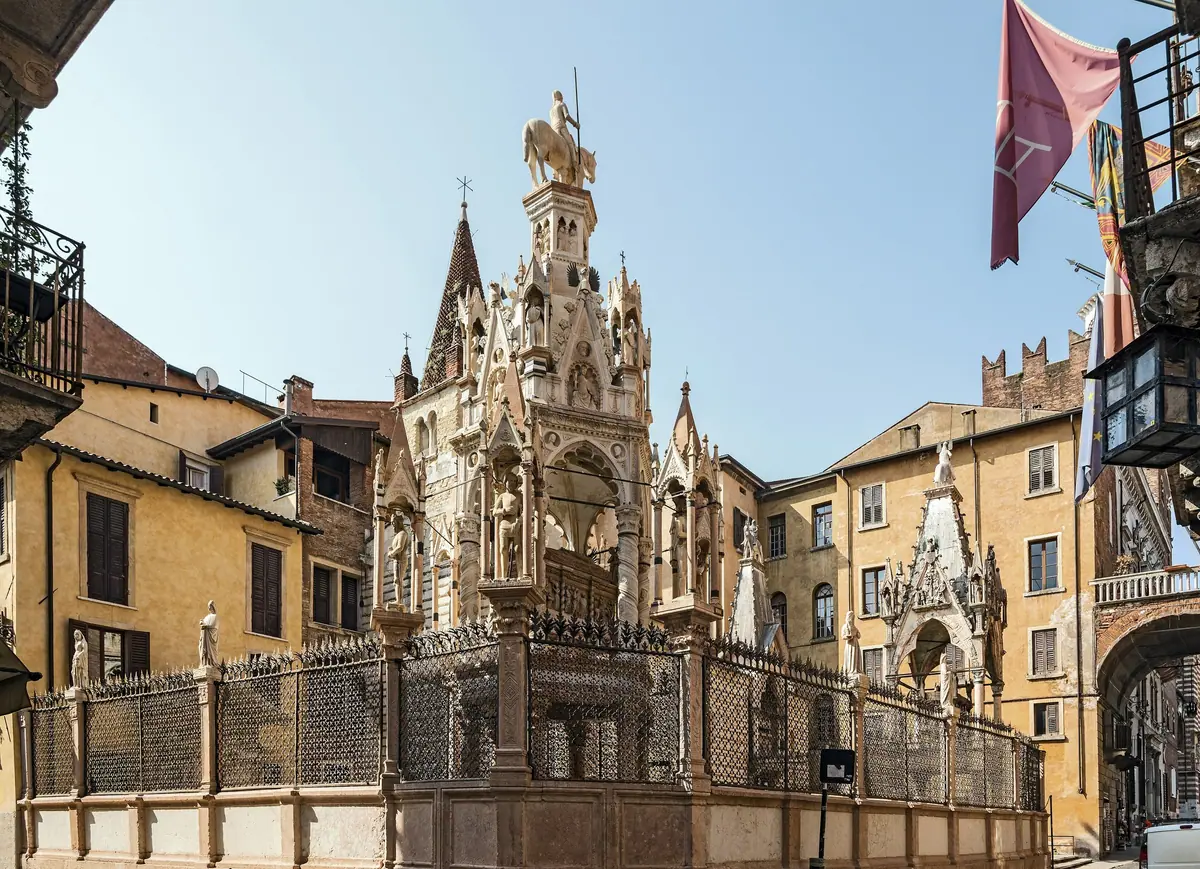
Verona's Scaliger Tombs, the Arche Scaligere, are the Gothic monuments of the Della Scala family, the lords of medieval Verona, beside the church of Santa Maria Antica. Cangrande I's tomb sits above the church door, and the canopied tombs of Mastino II and Cansignorio rise inside a wrought-iron fence worked with the family's ladder. The enclosure opens in the summer months, and there's no ticket to buy: a civic museum ticket from the same day or the VeronaCard lets you in.
Are the Scaliger Tombs open? Not until summer 2027
In 2026 the Scaliger Tombs opened on Saturdays and Sundays, plus 15 August, and the last day was Sunday 1 November. For 2027 the city says only that they open “in the summer period”, with no dates yet. While the enclosure is shut, the city doesn’t say how much of the tombs can be seen from the street.
Opening times in 2026
- Days
- Saturdays and Sundays, plus 15 August
- Until 27 September
- 10:00–13:00 and 15:00–19:00
- 3 October to 1 November
- 10:00–13:00 and 14:00–18:00
- From 2 November 2026
- Closed until the summer
Entry to the Scaliger Tombs: a same-day civic ticket or the VeronaCard
The tombs themselves cost nothing, but there’s no ticket for them and no ticket office. You get in with a ticket already used that day at another of Verona’s civic museums, such as Castelvecchio, the fresco museum at Juliet’s Tomb, the Roman Theatre’s archaeological museum or the Museo Lapidario Maffeiano, or with a valid VeronaCard. The Lamberti Tower’s ticket doesn’t count, because the tower isn’t one of the civic museums.
The VeronaCard gets you in too, though it adds nothing here that a civic ticket from the same day wouldn’t. Where it helps is the rest of your day, since the card also includes Castelvecchio and the Arena.

The five Scaliger tombs, from Alberto I to Cansignorio
The Della Scala, or Scaligeri, ruled Verona in the Middle Ages, and they buried their lords here, in a small enclosure by Santa Maria Antica. The fence around it is worked with ladders, the scala of their name and the emblem of their house, and inside, the sarcophagi stand on the ground or raised up on canopied monuments.
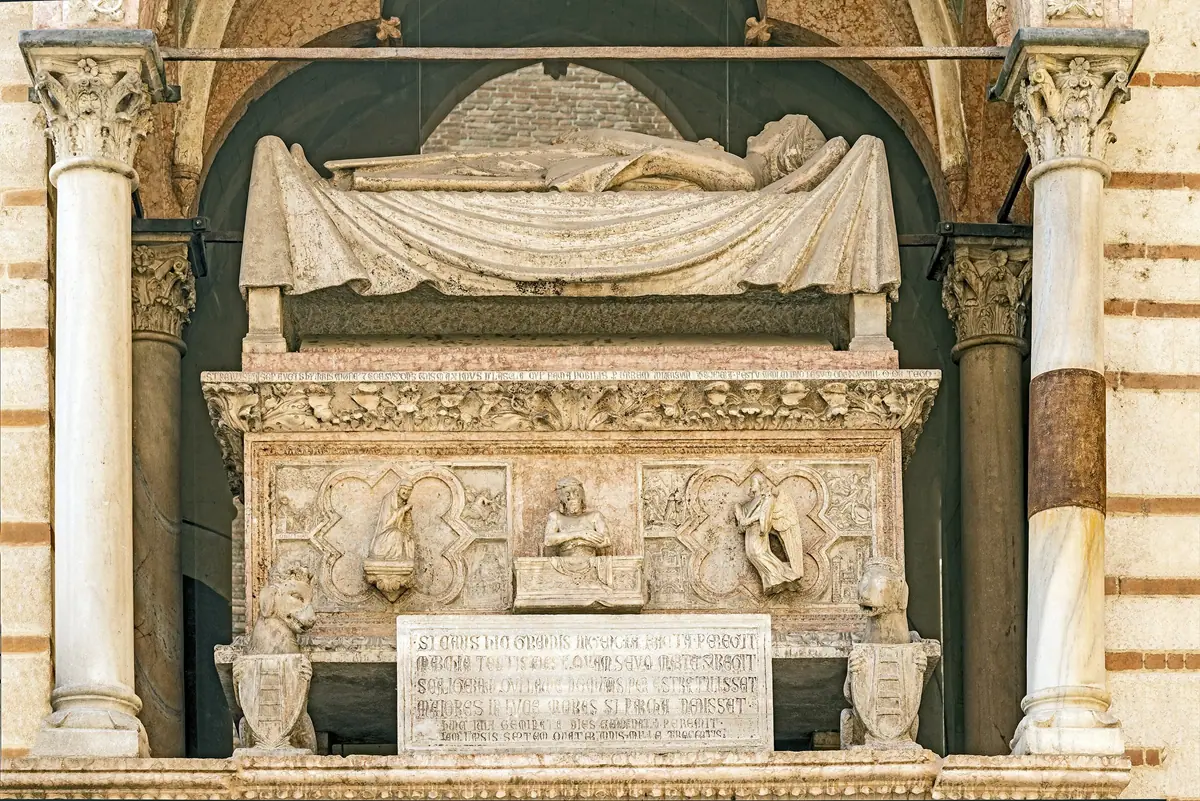
Cangrande I’s tomb is the one above the church door. He was “il magnifico Signore”, lord of Verona from 1309 to 1329, who welcomed Dante to his court. His figure lies on the sarcophagus inside a Gothic tabernacle that stands on armoured dogs, the work of the designer of the church of Sant’Anastasia. Above it, a canopy holds his statue on horseback, now a copy.
Mastino II’s tomb, begun in 1345, was once painted and gilded, with statues of the four Virtues at its corners and its own horseman on top, also a copy today.
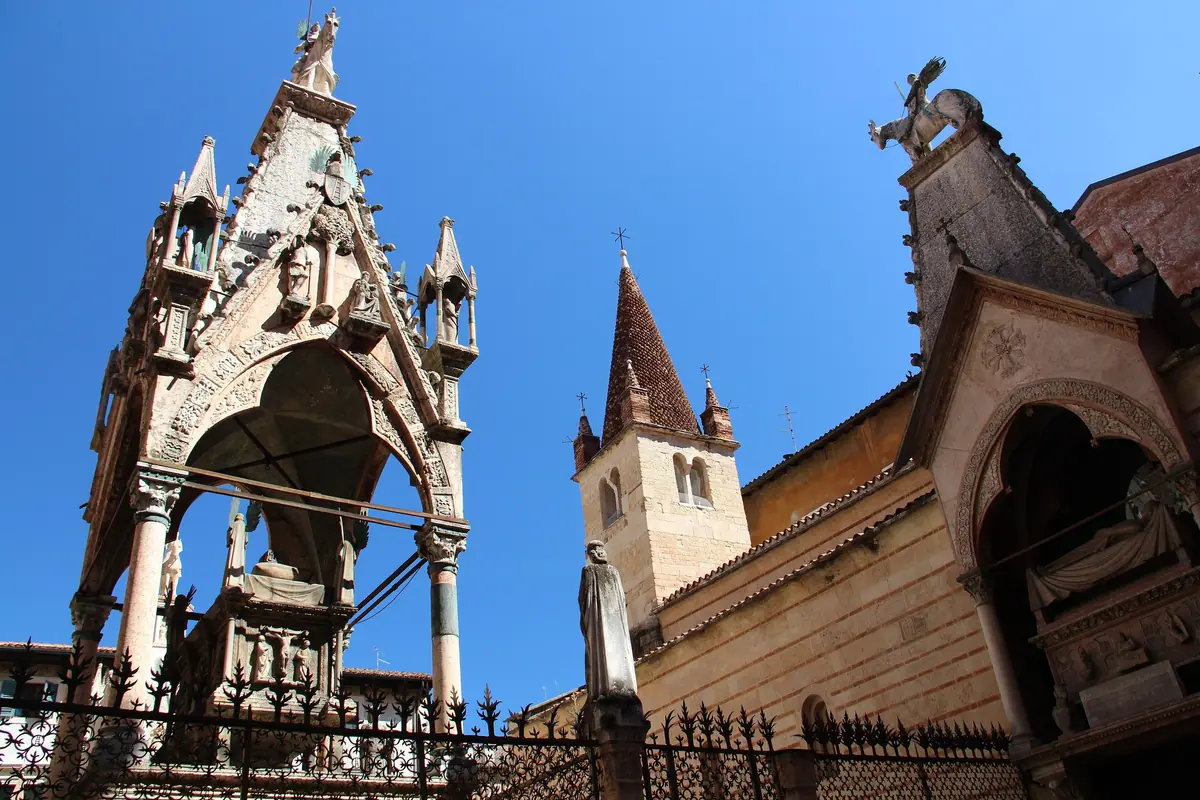
The richest is Cansignorio’s, of 1375, designed by the sculptor Bonino da Campione, with warrior saints, the evangelists, the Virtues and the apostles, and a large statue of Cansignorio on horseback at the top. The other two are the sarcophagus of Alberto I, from 1301, and the hanging tomb of Giovanni della Scala, finished in 1359 by Andriolo de’ Santi. That one stood in the church of San Fermo Maggiore until 1400.
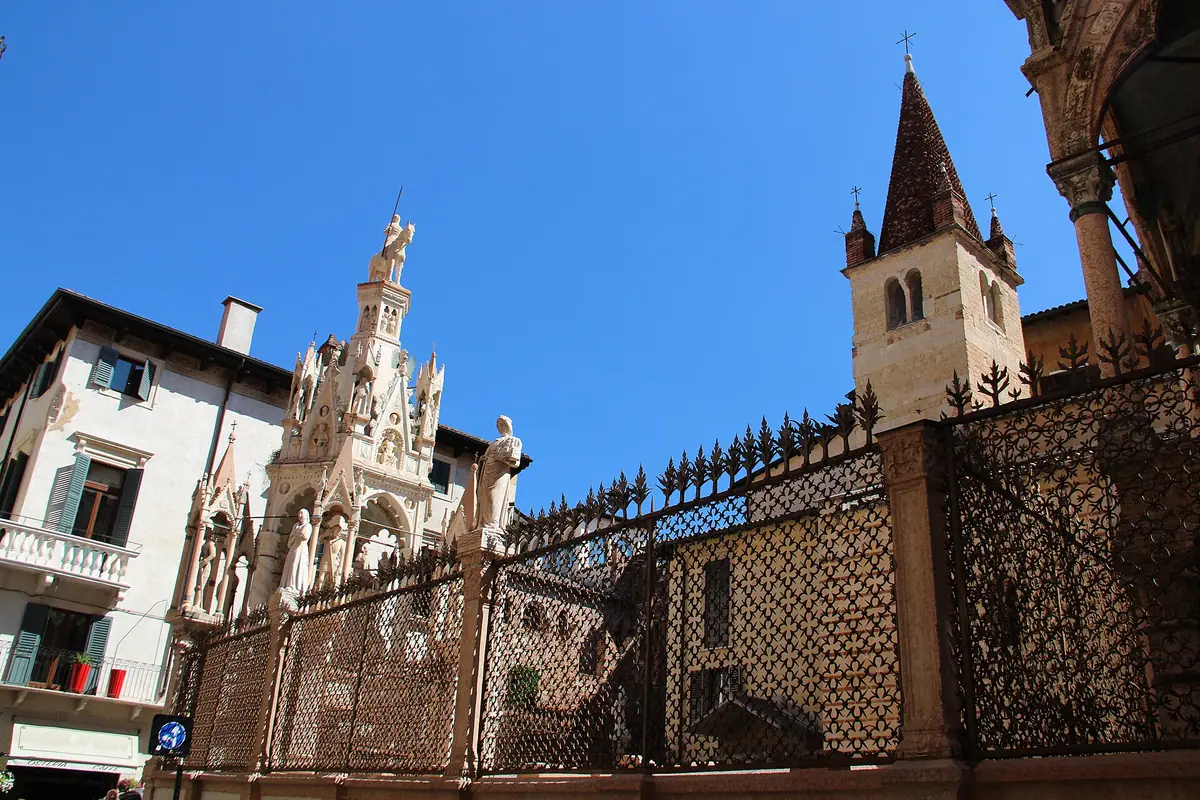
Cangrande I and Mastino II: the original statues at Castelvecchio
The horsemen on top of the tombs of Cangrande I and Mastino II are copies, and the originals are in the Castelvecchio Museum. Cangrande I came down in 1909 and is now the centrepiece of the museum, on a concrete plinth designed by the architect Carlo Scarpa, while Mastino II is in the castle’s clock tower.
On a summer weekend, seeing the copies here and the originals there on the same day also takes care of the entry rule, since your Castelvecchio ticket is the civic ticket that opens the tombs.
Finding the Scaliger Tombs at Santa Maria Antica
The tombs are at Via Santa Maria Antica 4, beside the church, close to Piazza delle Erbe and Piazza dei Signori, the two squares UNESCO picks out in its listing of Verona. There’s no cloakroom, and small dogs can come in a carrier.
Tickets
Popular tickets around Verona
The ones other visitors book most.


People also ask
Frequently asked questions
Are the Scaliger Tombs open?
Not until the summer. In 2026 they opened at weekends until Sunday 1 November, and the city hasn't published the 2027 dates; it says only that they open in summer.
How much does it cost to see the Scaliger Tombs?
The tombs themselves cost nothing, but there's no ticket for them either. You get in with a ticket already used that day at another of Verona's civic museums, such as Castelvecchio, or with a valid VeronaCard.
Do I need a VeronaCard for the Scaliger Tombs?
No. The card gets you in, and so does any civic museum ticket used the same day, such as Castelvecchio's.
Where is the original statue of Cangrande I?
In the Castelvecchio Museum, on a concrete plinth designed by the architect Carlo Scarpa. It came down from the tomb in 1909, and the horseman on the tomb today is a copy.
Who were the Scaligeri?
The Della Scala family, the lords of Verona in the Middle Ages. Among them was Cangrande I, lord from 1309 to 1329, who welcomed Dante to his court and whose tomb sits above the door of Santa Maria Antica.
