
Verona · VeronaCard
Verona Arena
Gladiators fought on this floor in the first century, and since 1913 its stone tiers have filled up for opera on summer nights.
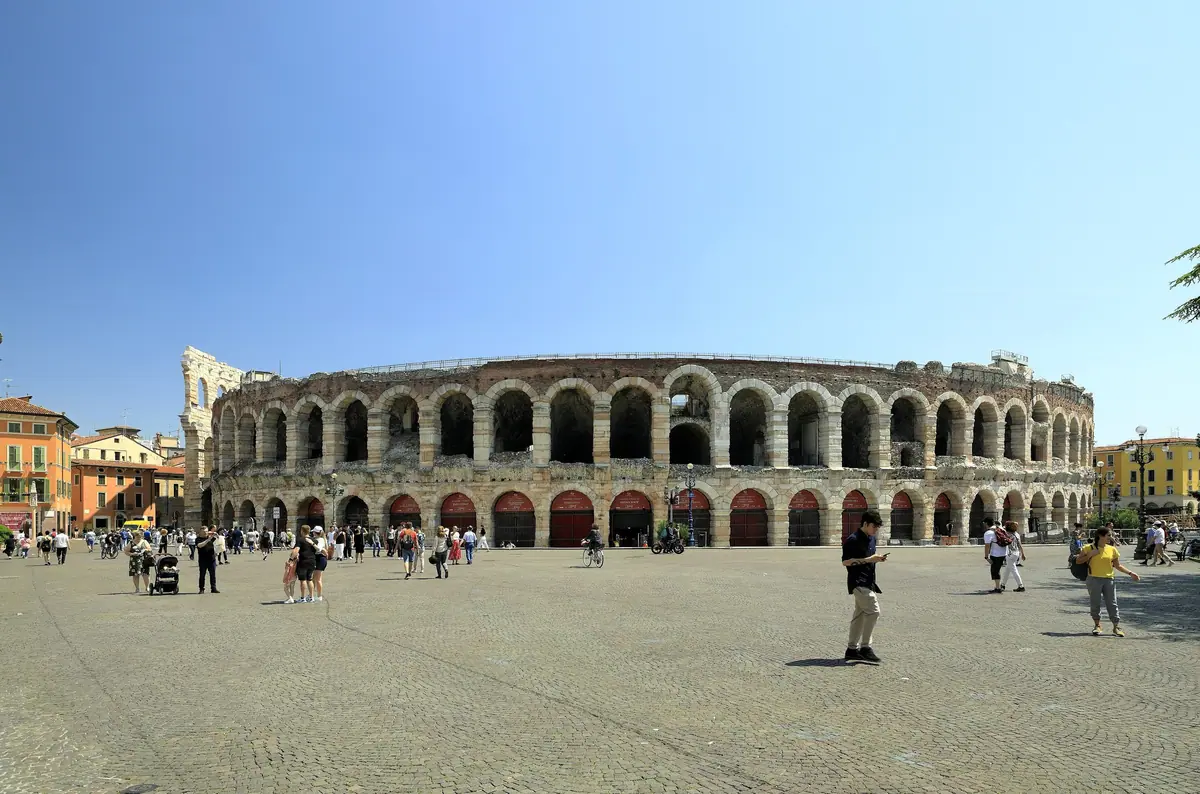
Verona's Arena, one of the largest Roman amphitheatres in Italy, held about 30,000 people for gladiator fights and animal hunts, and since 1913 it has been an open-air opera house in summer. By day you walk its ground-floor galleries and climb the stone tiers of the cavea. The VeronaCard includes the entry, and the tickets we sell are guided visits with the entry built in.


Verona Arena tickets: the VeronaCard or a guided visit
You can get into the Verona Arena with the VeronaCard, which includes the entry, or on a guided visit that has the entry built in. If the Arena is one stop in a day of sights, the card is the easy way in. If you want someone to tell you what happened on that floor, book the guide.
Our guided visit, at €39, is 45 minutes with a licensed guide, in English or Italian. You meet in Piazza Bra ten minutes before your time and go in through a fast-track entrance, and the guide takes you from how the Romans built the amphitheatre to the gladiators, the legends and the earthquake it came through in the 12th century. Children from 6 to 13 pay €29 for the visit, 14- to 17-year-olds pay the adult price, under-6s go free, and you can cancel up to 24 hours before your slot.
The second guided option is a two-hour walk through Verona with an English-speaking guide, from €29, and admission to the Arena is part of it. You arrive 15 minutes before the start, and the cancellation rule is the same.


The Verona Arena on the VeronaCard
The VeronaCard includes the Arena, with no booking: you show the card’s QR code at the entrance. It runs for 24 or 48 hours from the moment you activate it in the app, not from the day you buy it, and it covers the city buses as well. The version we sell, from €39 for 24 hours or €44 for 48, adds a digital audio guide to Verona and Lake Garda.
There’s no child VeronaCard, and under-18s don’t need one here, because they go into the Arena free. The card is in one name and gives one entry per site. It also includes Castelvecchio, the Lamberti Tower and Juliet’s House, where you still book a time.
Plan the card’s hours around Monday, the day the Arena is shut: a 24-hour card started on a Sunday afternoon runs out before the Arena opens again on Tuesday. The rest of the card’s sights and how the 24 and 48 hours work are on the VeronaCard page.

Verona Arena opening hours, Mondays and the summer stage
Opening hours
- Tuesday to Sunday
- 9:00–19:00, last entry 18:30
- Monday
- Closed, except Monday 7 December 2026
- Also closed
- 25 December and 1 January
- Opera days, April to October
- The day visit can end earlier; the times aren't published
From April to October the opera season’s modern stage stands inside the Arena, and the city says the building can’t be fully visited then. The route inside can also be restricted while the stage goes up or comes down, as it was for a week from 27 October 2026. On Saturday 7 November 2026, from 10:00 to 12:30, the arena floor hosts Il Terzo Paradiso, a performance by the artist Michelangelo Pistoletto in which members of the public take part; the city doesn’t say whether the normal visit changes that morning.
Big luggage and baby carrier backpacks can’t go in, and the cloakroom is free. Dogs need to be small and in a carrier, while assistance dogs are always welcome. Prams aren’t allowed, and visitors with disabilities can reach the ground-floor galleries, which are flat, but not the tiers; they go in free with a companion.
Inside the Verona Arena: the cavea, the floor and the Ala
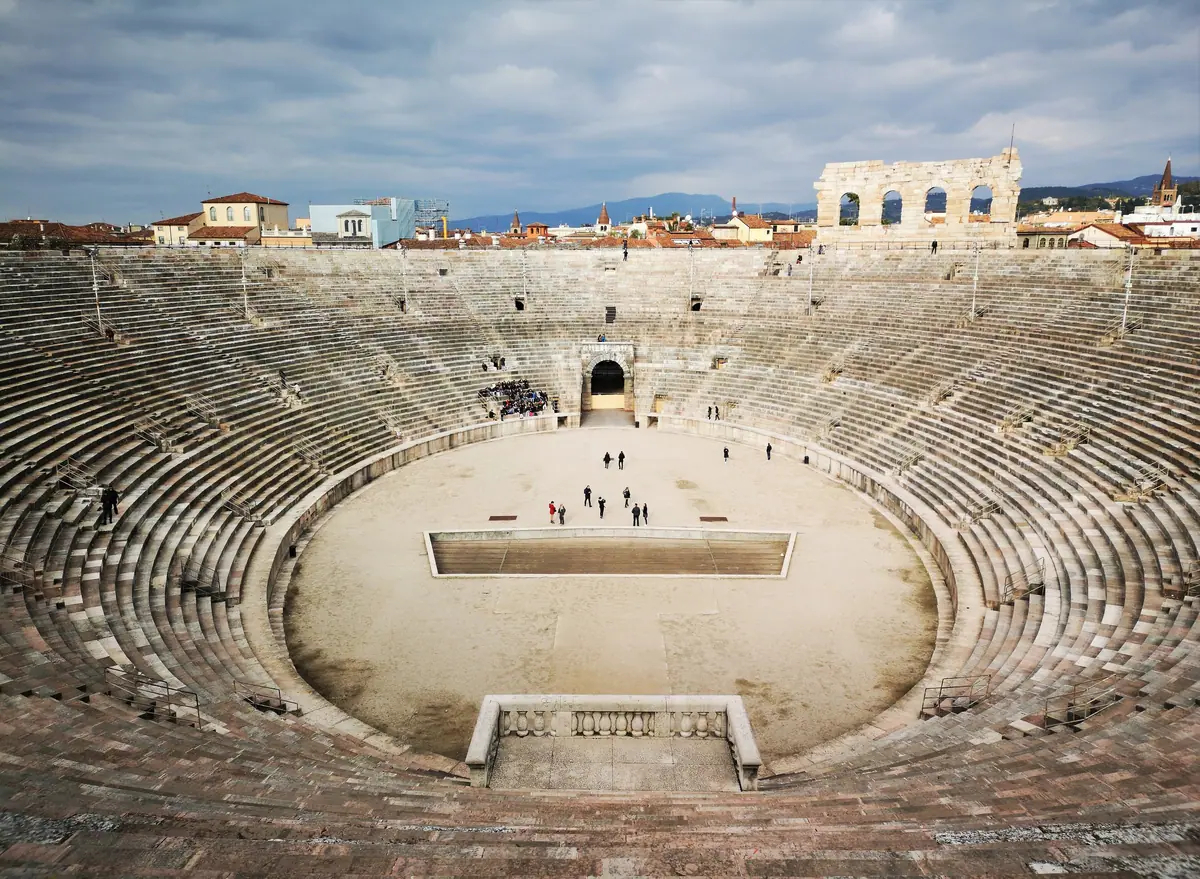
The flat floor where the games were held is the arena itself, and the stepped seating that rises all round it is the cavea. The ring galleries on the ground floor are flat, and you climb the cavea on its rebuilt stone steps until the whole bowl opens out below you. The building measures about 152 by 123 metres, and the floor alone 75 by 44.
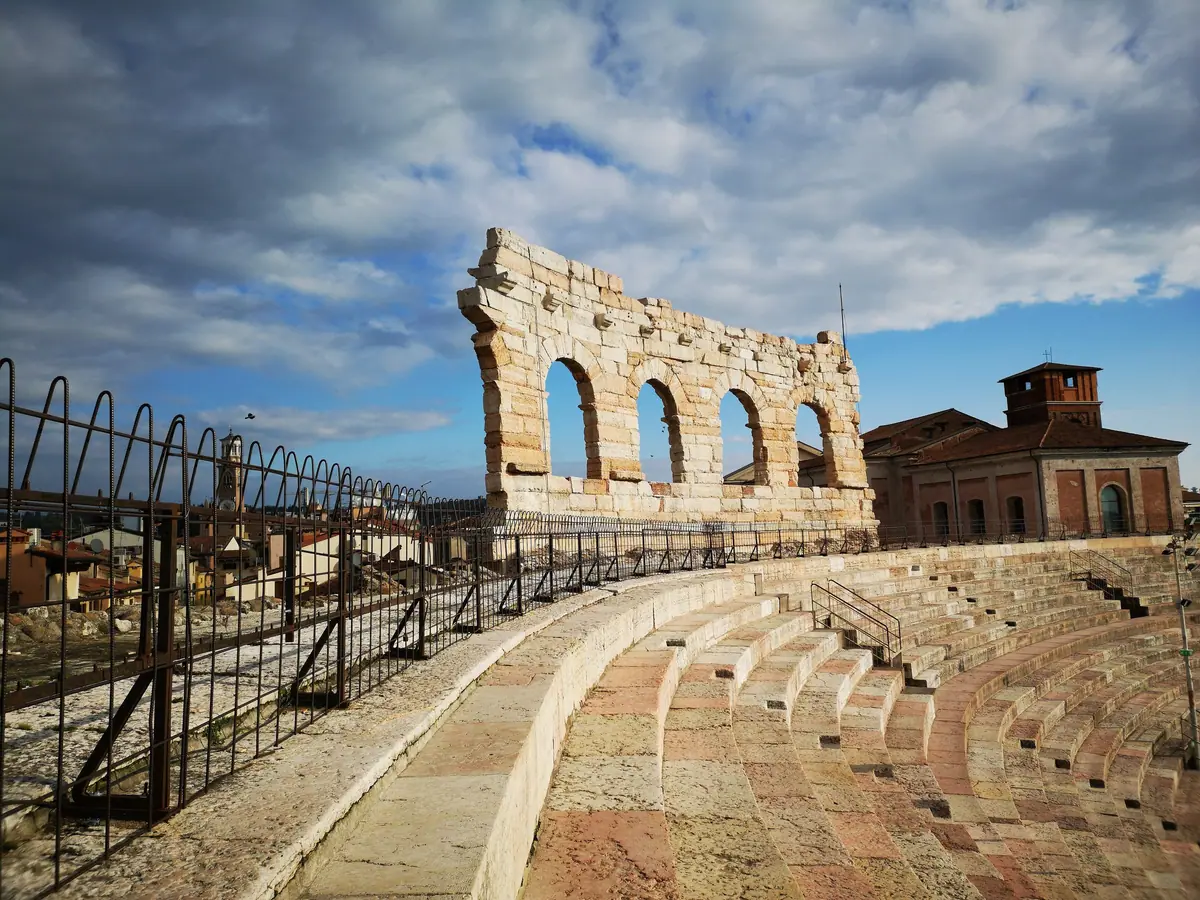
Up on the tiers, look across to the far rim for the Ala, “the wing”: a stretch four arches wide and three storeys tall, it’s the only piece left of the outer ring that once wrapped the whole building. The guided visit covers it too.
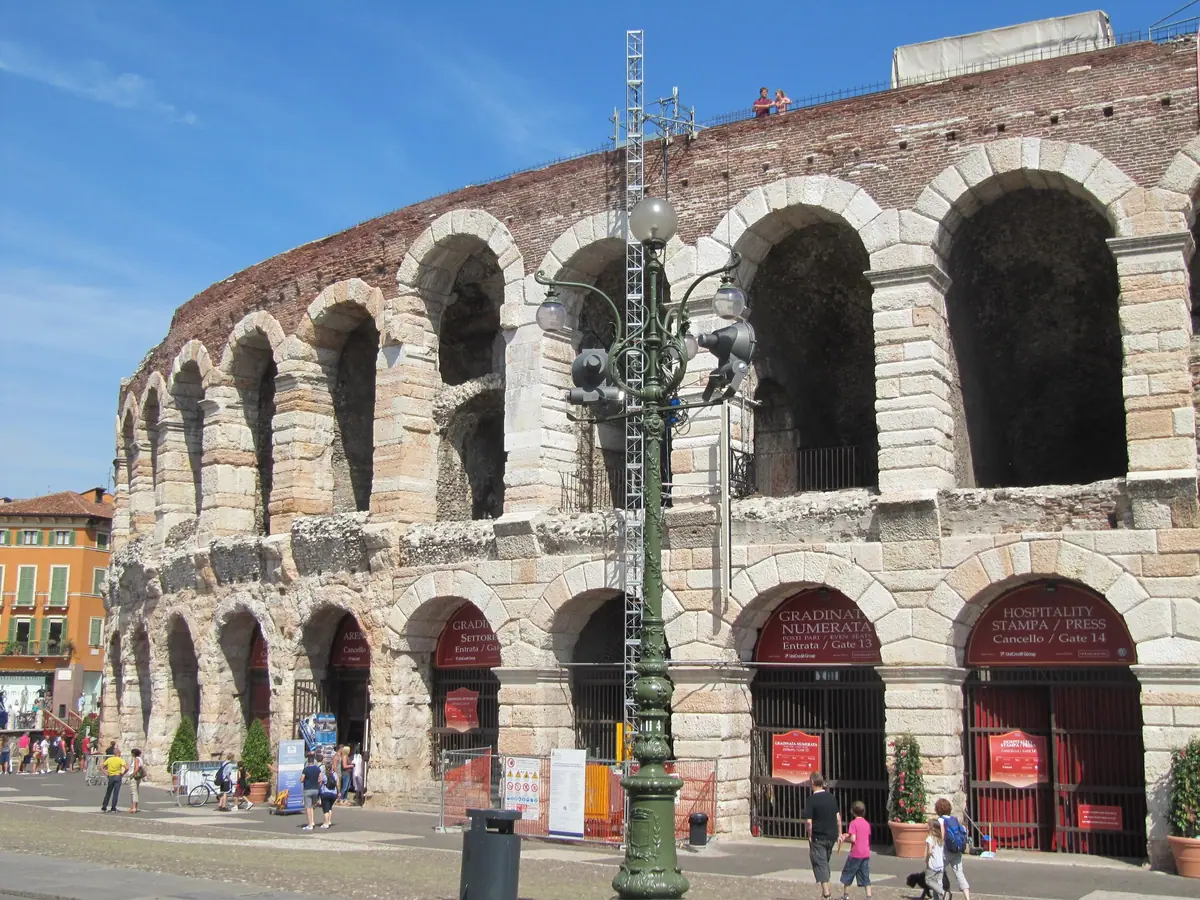
Back outside, walk round the arches at street level. They’re built of limestone from the Valpolicella, cut into rough-faced blocks. A restoration that began in 2024 is working through the steps, the galleries and arches, the lighting and the toilets, and no timetable for it has been published.
From Roman games to opera: the Verona Arena’s history
The Romans built the Arena in the first century AD, outside the city walls of the time, for gladiator fights and hunts of wild animals in front of about 30,000 people. The outer ring didn’t survive the Middle Ages: Theodoric, king of Italy from 493 to 526, pulled part of it down for a second city wall, and until the Renaissance the Arena served as a quarry.
The city rented out the arches on the outside, to prostitutes until the 16th century and then to workshops. Opera came much later: in 1913 Aida, by the Italian composer Giuseppe Verdi, was staged in the Arena, and it has hosted summer opera seasons ever since.
Opera at the Verona Arena in summer 2027
The 2026 festival, the 103rd, finished in September. The 104th runs from mid-June to 11 September 2027, and tickets are already on sale from the Fondazione Arena. Performances begin at 21:00, 21:15 or 21:30, so a night at the opera is a separate outing from the daytime visit.
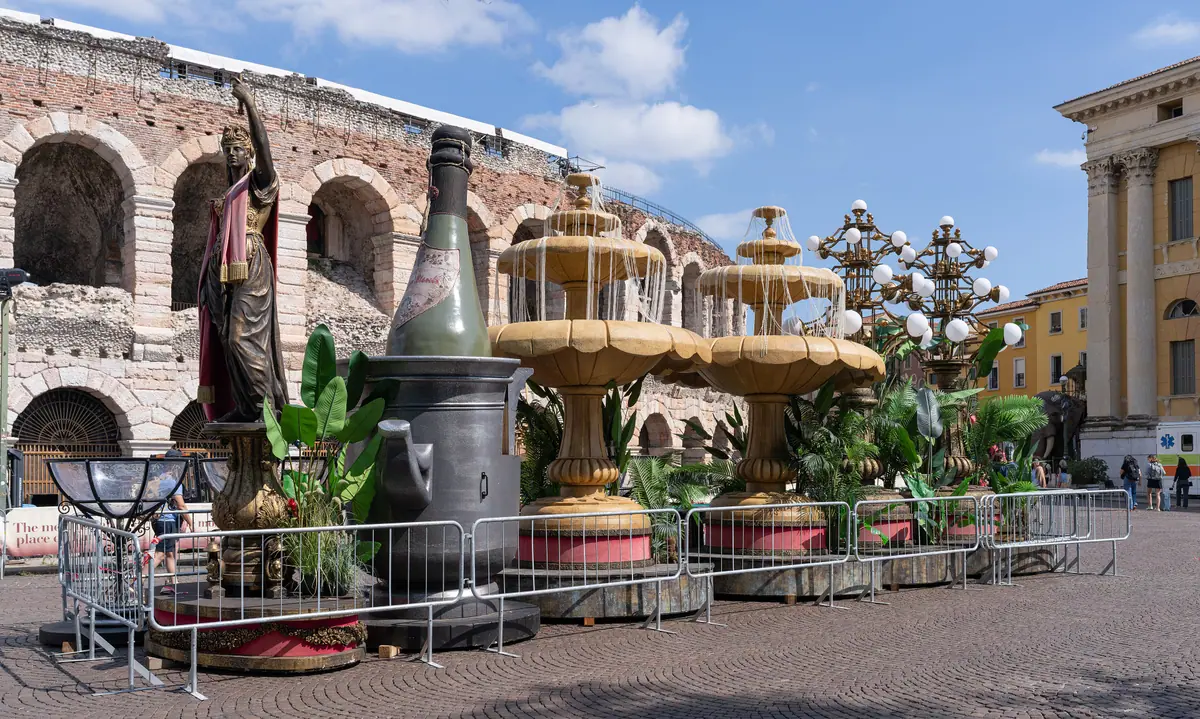
If it rains, the Fondazione, which runs the festival, can hold back the start by up to 150 minutes, and a performance stopped part-way through isn’t refunded. Small backpacks are fine, but nothing over 17 litres, and if your seat is on the stone steps you can bring a cushion. The VeronaCard gives a discount on festival tickets, though the size of it isn’t published.
Getting to the Verona Arena on Piazza Bra
The Arena’s address is Piazza Bra 1, in the historic centre. From Verona Porta Nuova station it’s about a kilometre and a half on foot, or you can take one of the city’s ATV buses, which the VeronaCard covers.
The guided visit starts on Piazza Bra too, and the Museo Lapidario Maffeiano, one of the oldest public museums in Europe, is on the same square, at number 28.
Tickets
Popular tickets around Verona
The ones other visitors book most.


People also ask
Frequently asked questions
Where can I book Verona Arena tickets?
On this page, in two ways. The VeronaCard includes the Arena with nothing to book, and our guided visits have the entry built in: a 45-minute guided tour of the Arena, or a two-hour walk through Verona that includes admission to the Arena.
How long does the Verona Arena take?
The Arena doesn't give a visiting time. Our guided visit lasts 45 minutes, and on your own you set the pace between the ground-floor galleries and the top of the tiers.
Is it worth going inside the Arena in Verona?
Inside you climb the stone tiers of the cavea and look across the floor to the Ala, the one surviving stretch of the outer ring. From April to October the opera stage fills part of the inside, so the building can't be visited in full then. Seeing the Arena at a summer performance is a different outing, with tickets of its own.
How many seats are in the Verona Arena?
In Roman times it held about 30,000 spectators, according to the city. There's no official figure for the opera seating today, and the estimates you'll find online are far apart.
Is the Verona Arena open on Mondays?
No, it's closed all day on Mondays, and on 25 December and 1 January. The exception this winter is Monday 7 December 2026, when it opens as on any other day.
What happens if it rains at the Verona Arena?
On an opera night the Fondazione Arena can hold back the start by up to 150 minutes, and if a performance is stopped part-way through, tickets aren't refunded. For a daytime visit there's no published rain rule.
