
Rome
Hadrian's Villa and Villa d'Este in Tivoli
An emperor's palaces and baths outside the town, a cardinal's terraces of fountains inside it.
Hadrian's Villa and Villa d'Este are Tivoli's two UNESCO World Heritage Sites, a day trip from Rome. One is the estate the Roman emperor Hadrian built between AD 118 and 138, with palaces, baths and gardens joined by underground passages. The other is the Renaissance villa of Cardinal Ippolito II d'Este, whose terraced garden holds the Fountain of the Organ and the Hundred Fountains. The tours we sell take you there and back from Rome, with entry to both villas.


Hadrian’s Villa from Rome: the two day tours to Tivoli
Hadrian’s Villa is where the Roman emperor Hadrian built himself palaces, baths and gardens joined by underground passages, and you’ll find it in Tivoli rather than in Rome. Villa d’Este, a cardinal’s Renaissance garden of fountains, is in Tivoli too. Both tickets we sell are day tours from Rome that cover the transport there and back and entry to the two villas. Neither one is a plain entry ticket.
The cheaper tour, at €95, comes with a live guide, headsets to hear them, skip-the-line entry to both villas and someone to welcome you at the departure point in Rome. Hotel pick-up and lunch aren’t included, and the ticket can’t be cancelled or refunded. There’s a reduced price at checkout, though the listing doesn’t say who it’s for.
The other tour, at €118.80, lists the transport, entry to both villas and time to explore Tivoli, in an English or a Spanish version and with a price for children. A guide and skip-the-line entry aren’t on its list. What it gives you instead is free cancellation up to 24 hours before.


On your own, the two entries add up to €30, so the rest of a tour’s price pays for the bus and, on the cheaper tour, the guide. That bus does more work than it seems, because the two villas aren’t next to each other.
Hadrian’s Villa and Villa d’Este: two places in Tivoli, and the day on your own
Villa d’Este is in the town centre, at Piazza Trento 5. Hadrian’s Villa stands outside it, at Largo Marguerite Yourcenar 1, in the district named after it, Villa Adriana. Each one has its own ticket office, hours and rules, so a day without a tour is really two visits joined by a bus ride.
If you go it alone, we’d start with Hadrian’s Villa and leave Villa d’Este for the afternoon. Hadrian’s Villa has the earlier last entry this winter, and on Mondays Villa d’Este doesn’t open until 14:00.
A day in Tivoli without a tour
- 1Out of Rome: take metro line B to Ponte Mammolo, then the Cotral bus towards Tivoli, about 50 minutes to an hour, and get off at the Villa Adriana stop before the town. Regional trains also run from Termini and Tiburtina in about an hour, but Tivoli station is a long way from both villas.
- 2Hadrian's Villa: be through the gate by 15:30 in November and December. The site stays open until 17:00.
- 3Into town: the CAT 4 bus links Hadrian's Villa with the centre of Tivoli.
- 4Villa d'Este: be in by 16:00 in November and December, with the garden open until 17:00.
Look up the Cotral and CAT timetables before you set off, and check whether a Rome transport ticket is valid on the Cotral bus or you need a separate one.
Entry prices at Hadrian’s Villa and Villa d’Este, the Villæ Pass and the free days
Without a tour, you pay at each villa. Booking is optional: you can buy at the ticket office when you arrive, or ahead on the villas’ own ticket site.
Entry at the villas
- Hadrian's Villa
- €15, or €2 for EU citizens aged 18 to 25
- Villa d'Este
- €15, or €2 for EU citizens aged 18 to 25
- Villæ Pass, 72 hours
- €30, or €4: both villas and the Sanctuary of Hercules Victor
- Villæ 365, 12 months
- €40, or €10
- EU citizens under 18
- Free
The Villæ Pass is new, announced in June 2026, and it costs the same €30 as two single tickets. For that you get three days instead of one, so you can split the villas over two days, plus a third site in Tivoli, the Sanctuary of Hercules Victor.
Entry is free for everyone on the first Sunday of the month, 25 April, 2 June and 4 November, and for women on 8 March. The next is Sunday 6 December. On those days there’s no booking, and you collect your ticket at the ticket office.
Hadrian’s Villa with the Roma Pass and Rome’s other city passes
We haven’t confirmed that the Roma Pass or any of Rome’s other city passes covers the Tivoli villas, so don’t plan your day around one. Out here the Villæ Pass does the job of a city pass, and for your days in the city itself, Roma Pass and Rome’s other city passes sets them side by side.
Opening hours this winter at Hadrian’s Villa and Villa d’Este, and Mondays
Last entry and closing time
- Hadrian's Villa, November and December
- 8:30, last entry 15:30, closes 17:00
- Villa d'Este, November and December
- 8:30, last entry 16:00, closes 17:00
- Villa d'Este on Mondays
- Opens at 14:00
- Both closed
- 25 December and 1 January
Both villas switched to winter hours on 25 October, and the times to watch are the last entries, since once you’re in you can stay until closing. When a public holiday falls on a Monday, Villa d’Este opens at 8:45 that day and only at 14:00 on the Tuesday after. A tour on a Monday has to fit Villa d’Este into the afternoon, so check the timing when you book.
At Villa d’Este, heavy rain or a flood on the Aniene river can switch the fountains off for a while. On very busy days entry can be limited, and the way out is then through Piazza Campitelli.
What you see at Hadrian’s Villa, from the Maritime Theatre to the Canopus
Hadrian built the villa between AD 118 and 138 near Tibur, the Roman town that is today’s Tivoli. The estate covers at least 120 hectares, about 296 acres, and around 40 hectares of it are open to visitors. Between the palaces and baths stand pavilions and nymphaeums, the Romans’ monumental fountains.
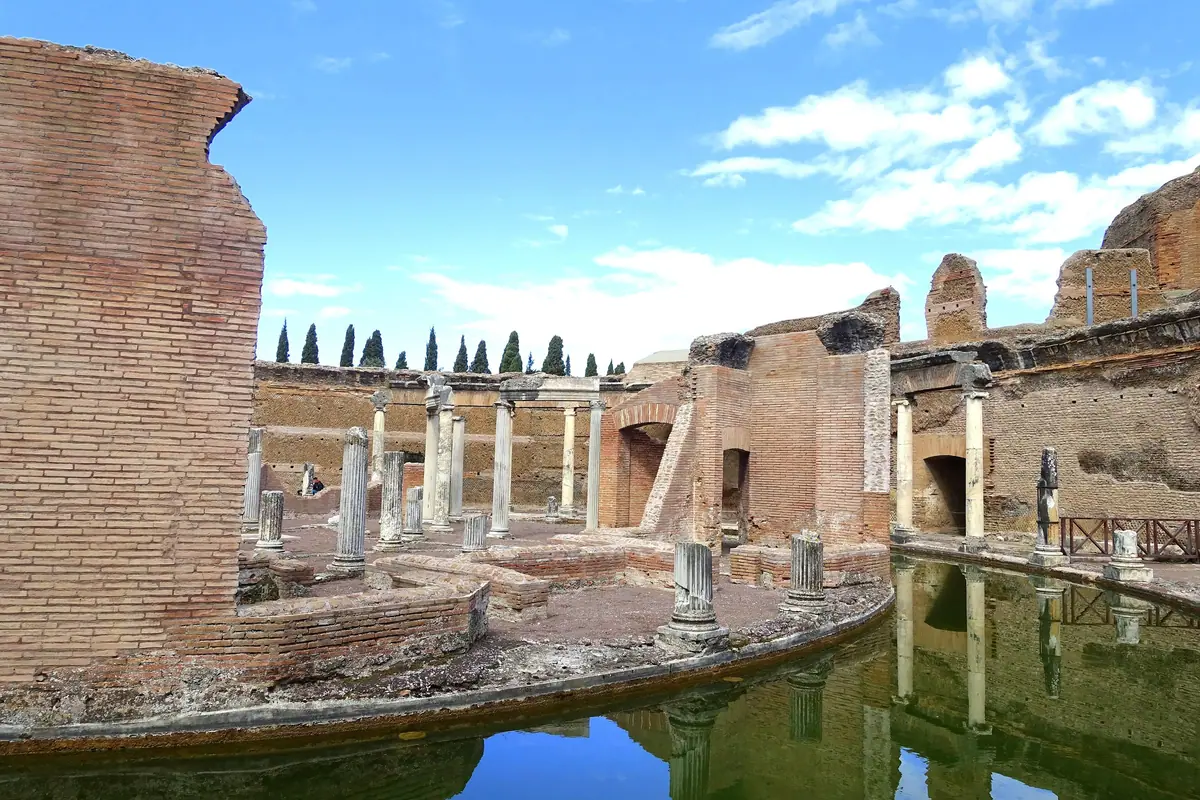
The Maritime Theatre is the one people remember, a round enclosure of brick and columns on an island inside a ring of water. Around the site you’ll also find the Piazza d’Oro, the Great Baths and the Hall of the Philosophers, and the villa’s statues have travelled far: museums in Rome, around Italy and across Europe hold pieces from here. It has been a UNESCO World Heritage Site since 1999.
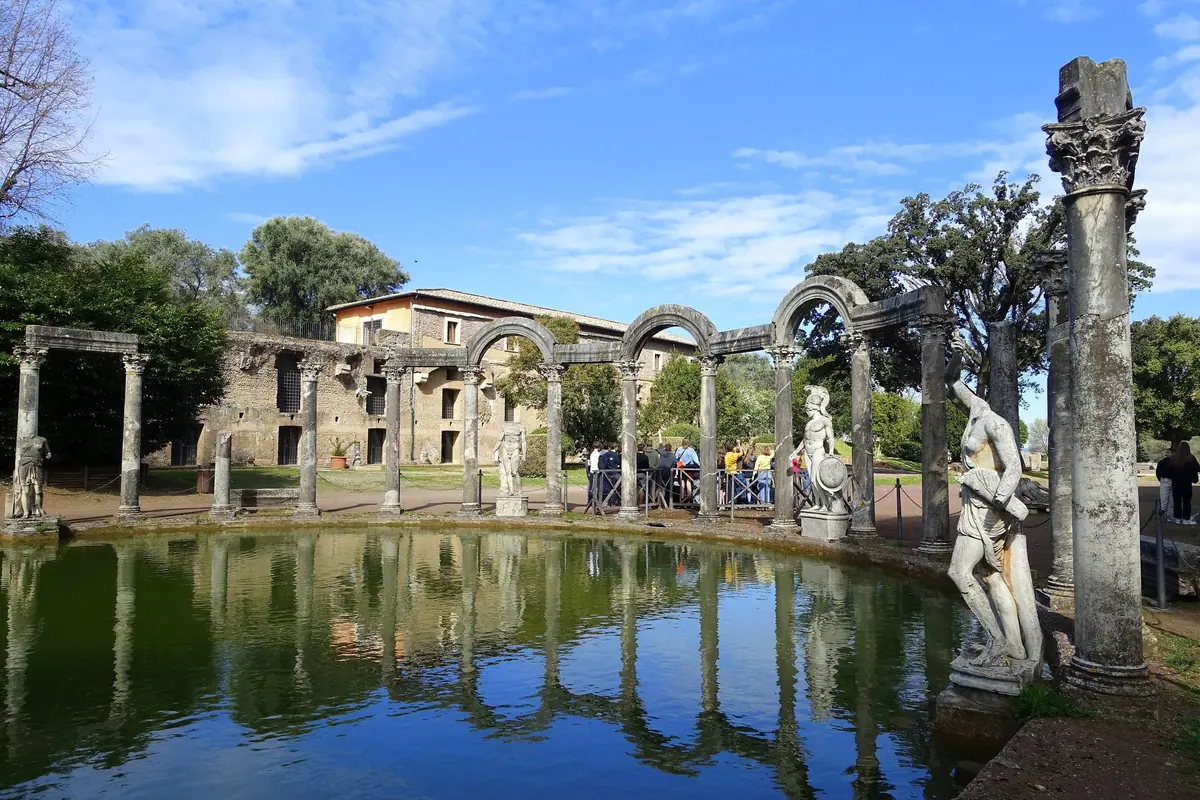
The Canopus is the long pool in the photo at the top of this page, lined with columns and statues. At its far end stands the Serapeum, a vaulted brick hall that opens onto the water.
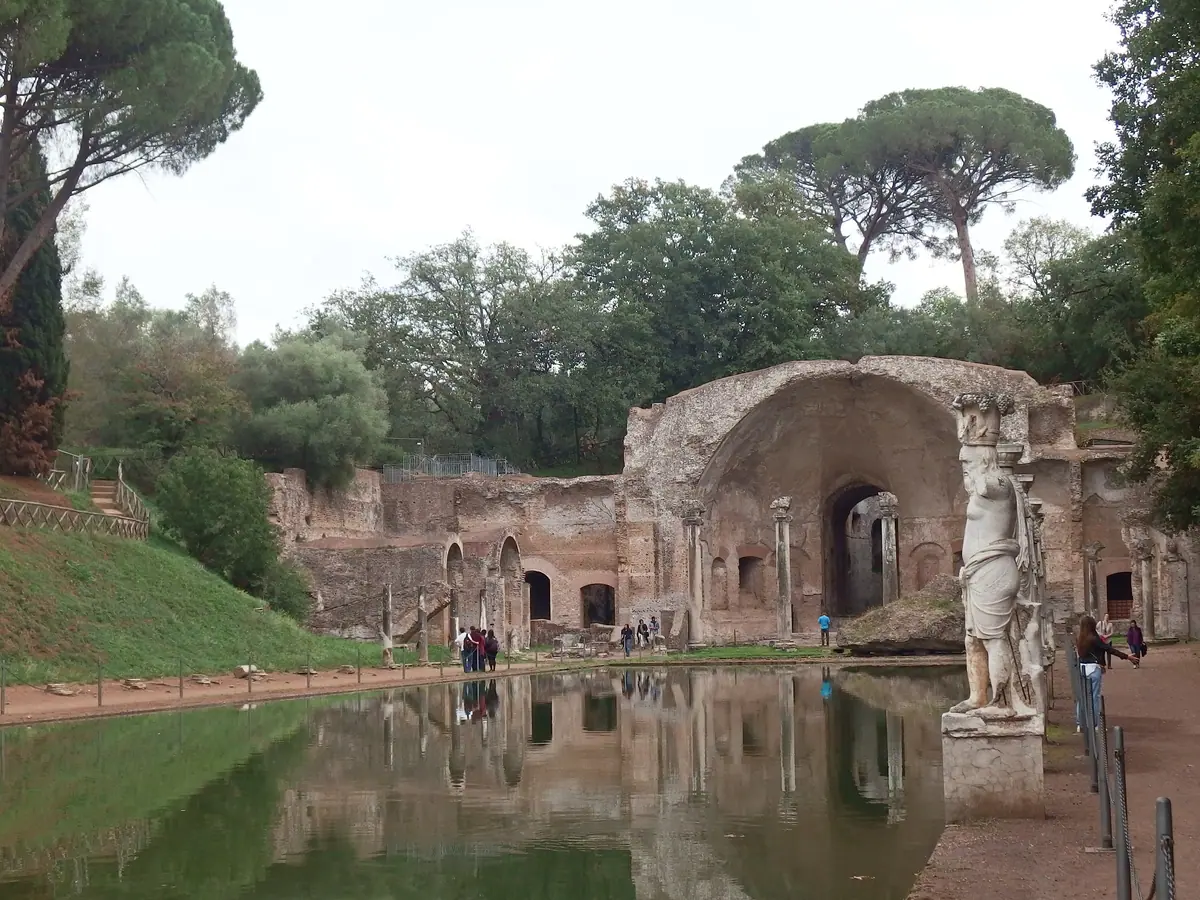
Nearly all of it is outdoors, on paths with slopes, so wear good shoes and dress for the weather. There are toilets, drinking fountains and a small place to get something to eat.
Villa d’Este’s fountains: the Organ, the Hundred Fountains and Neptune
From Hadrian’s estate you go forward fourteen centuries to Villa d’Este, the 16th-century villa of Cardinal Ippolito II d’Este. Its garden is laid out in terraces down a slope, with stairs between them, and the fountains are the reason to come. It became a UNESCO World Heritage Site in 2001.
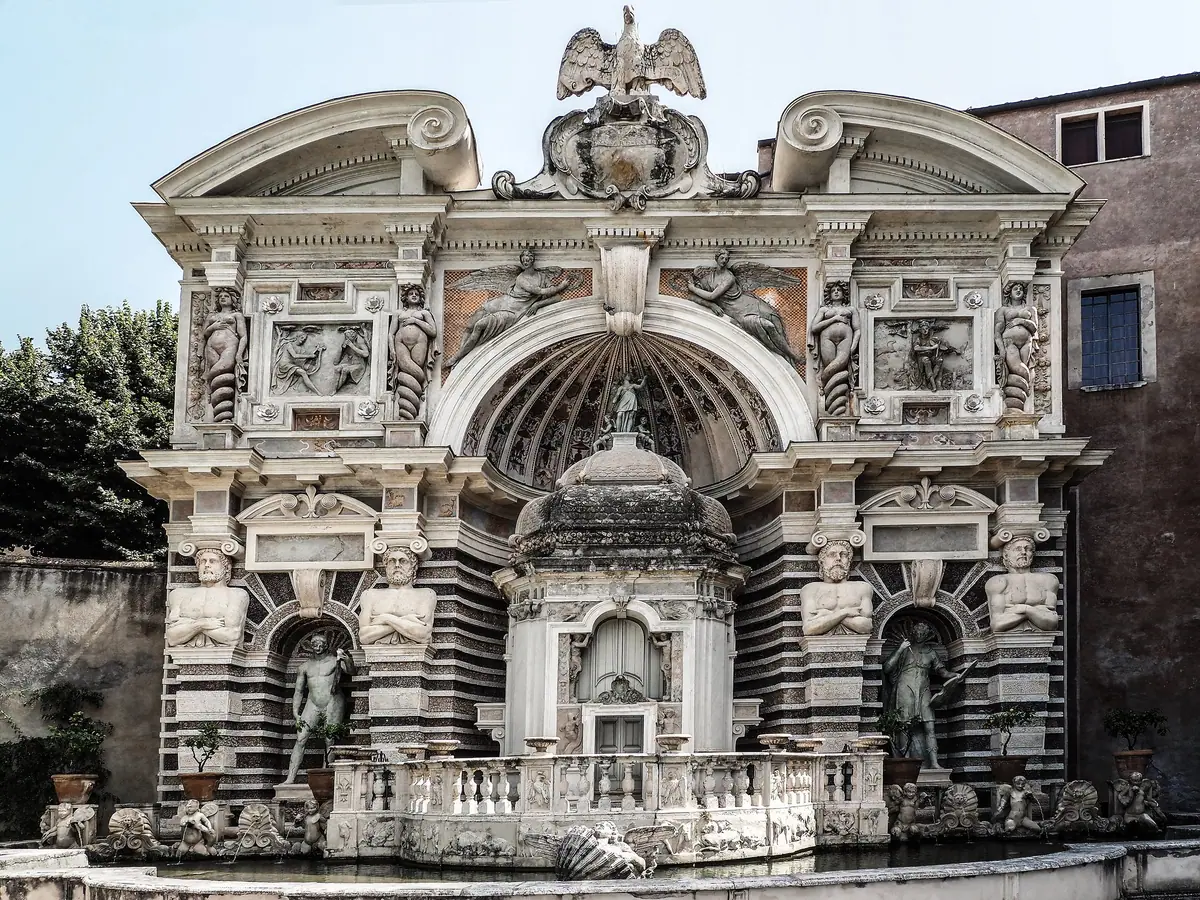
The Fountain of the Organ is a carved stone facade with statues in niches and an eagle on top, and its hydraulic organ, played by water, sounds every day from 10:30 and then every two hours. Time your walk through the garden so you’re in front of it when it plays.
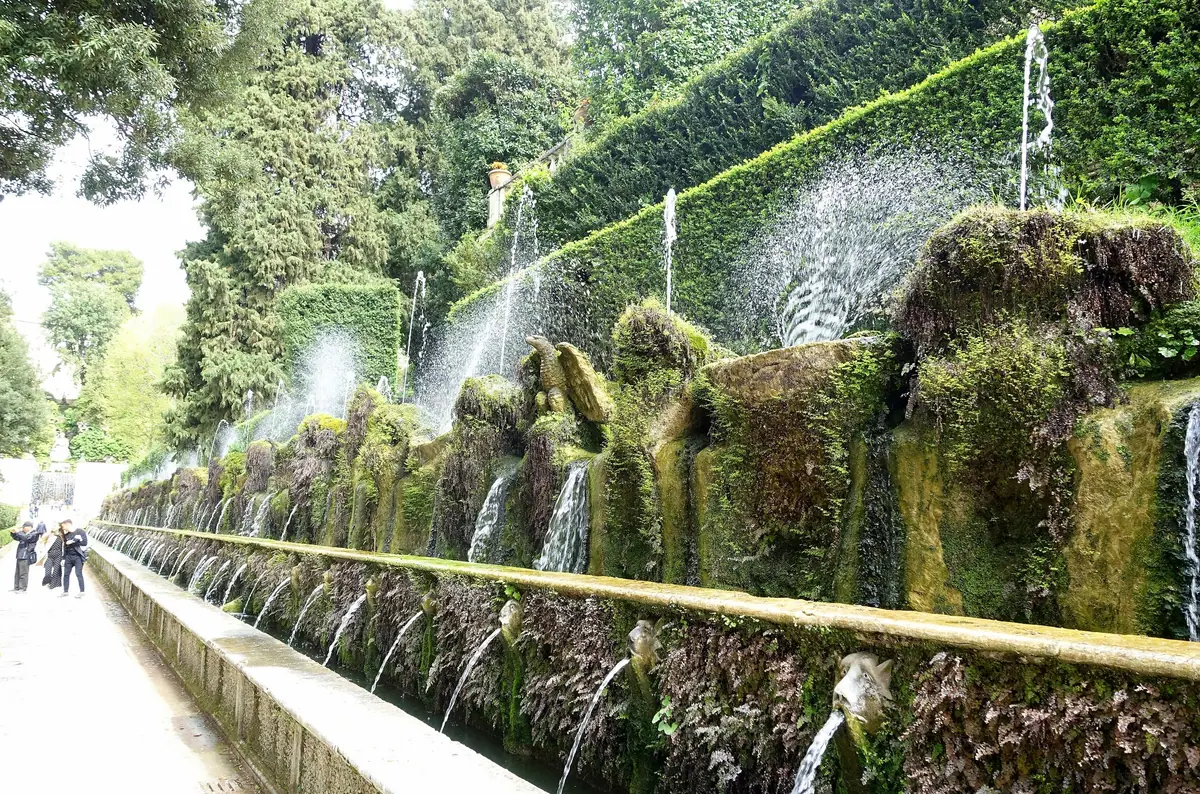
Along one terrace runs the Hundred Fountains, a long stone trough with rows of small jets spraying out of a mossy, planted wall. The Fountain of Neptune is here too, and the Grotto of Diana reopened in May 2025 after more than 50 years closed.
Tickets
Popular tickets around Rome
The ones other visitors book most.


People also ask
Frequently asked questions
Is Hadrian's Villa in Rome?
No, it's in Tivoli, a town outside Rome, at Largo Marguerite Yourcenar 1 in the district called Villa Adriana. Villa d'Este is in Tivoli's town centre, at Piazza Trento 5. Both tours we sell take you there and back from Rome, with entry to the two villas.
How much does it cost to visit Hadrian's Villa and Villa d'Este?
At the villas, each ticket costs €15, or €2 if you're an EU citizen aged 18 to 25, and EU citizens under 18 go in free. The Villæ Pass costs €30 and covers both villas and the Sanctuary of Hercules Victor for 72 hours. Booking ahead is optional. The day tours from Rome cost more because they add the bus there and back.
Is Villa d'Este open on Mondays?
Yes, from 14:00. When a public holiday falls on a Monday, it opens at 8:45 that day and at 14:00 on the Tuesday after. Hadrian's Villa opens at 8:30 every day, Mondays included.
When are Hadrian's Villa and Villa d'Este free?
On the first Sunday of every month, 25 April, 2 June and 4 November for everyone, and on 8 March for women. The next is Sunday 6 December 2026. There's no booking on those days: you collect your ticket at the ticket office.
Can you see Hadrian's Villa and Villa d'Este in one day?
Yes, and both tours we sell cover the two in a day from Rome. On your own, we'd do Hadrian's Villa in the morning, since its last entry is 15:30 in November and December, then take the CAT 4 bus into Tivoli for Villa d'Este, where the last entry is 16:00.
