
Rome · Roma Pass
Ostia Antica
A Roman port town you walk street by street, down to a bar counter with food painted on the wall.
Ostia Antica, half an hour from Rome by train, was ancient Rome's port at the mouth of the Tiber, and you can still walk its streets: past baths with mosaic floors and a marble latrine with 20 seats, a theatre, blocks of flats, a Roman bar with its counter, and a square of trading offices paved with mosaics of ships. One ticket covers every site and museum in the archaeological park for eight days, under-18s go in free, and the Roma Pass covers the train as well as the entry.
Before you go
- Time inside3–4 h
- ClosedMonday
- Best timeMornings
TipFrom late October to February the ticket office closes at 15:30 and a visit takes three to four hours, so take a morning train from Rome.


How to get to Ostia Antica from Rome on the Metromare
The ruins have a station of their own on the Metromare, the suburban line from Rome to the sea that used to be called the Roma-Lido. You catch it at Roma Porta San Paolo, right beside Piramide on metro line B, and about 30 minutes later you’re at Ostia Antica.
From central Rome to the ruins
- 1Metro line B to Piramide. Basilica S. Paolo and EUR Magliana, further along line B, connect with the Metromare too.
- 2Change at Roma Porta San Paolo, the Metromare terminal next to Piramide. A BIT ticket, €1.50 for 100 minutes, covers the metro and the train; if you bought it in an app, activate the same ticket again as you board.
- 3Get off at Ostia Antica, about 30 minutes out and before the end of the line.
- 4Cross the pedestrian crossing outside the station and follow the signs to the entrance on Viale dei Romagnoli, 5 to 10 minutes on foot.
The trip back takes another BIT, unless you have a Roma Pass, whose transport covers the line. Since July 2022 the Metromare has been run by Cotral, the Lazio region’s transport company, so older guides that still send you to ATAC, the city’s company, are out of date.
In September the trains ran every 20 minutes. The line has had its share of breakdowns and closures, though, and this autumn there are a few things to check before you set out:
The Metromare this autumn
- Night works, Monday to Friday
- The last trains leave either end at 22:30, and replacement buses take over after that
- If a train breaks down
- Cotral says it gets buses running within 60 minutes, and they stop at Ostia Antica, on Viale dei Romagnoli by the excavations
Ostia Antica tickets: one price for eight days and every site in the park
Once you’re at the gate, one ticket does it all. It opens every site and museum in the archaeological park, once each, over eight days in a row: the excavations and the Museo Ostiense, the castle of Pope Julius II, the Imperial Ports, the Ship Museum at Fiumicino and the Isola Sacra necropolis.
You don’t need to book, since the ticket office at the entrance sells on the day, by cash or card. The ticket we sell costs €18: you show the voucher at the ticket office and they hand you a paper ticket. It can’t be refunded or changed, and it doesn’t come with a guide or a shuttle.
Under-18s go in free, and so do visitors with disabilities and one companion. EU citizens aged 18 to 25 pay €2, a rate our ticket doesn’t sell, so they buy at the gate. On the first Sunday of the month entry is free for everyone, with nothing to book (the next one is 6 December), though the Museo Ostiense closes on those days.
The other ticket we sell, from €34 with the audio guide, is sold as Skip The Line, but Ostia has no time slots and the park mentions no queue to skip. You still swap the voucher at the ticket office, so what the extra money buys are the options you pick as you book:
The skip-the-line ticket, from booking to the gate
- 1As you book, choose your options: an audio guide, a 10-minute golf-cart ride from the entrance into the site, and an Italian aperitif, one drink, alcoholic or soft, with snacks. Children aged 6 to 17 go in free, so their option pays for the audio guide.
- 2Up to 24 hours before, you can still cancel for free.
- 3At the ticket office, swap the voucher for a paper ticket, and leave an ID as a deposit when you collect the audio guide.
If the audio guide is what you’re after, the park rents its own at the entrance for €7, with about two and a half hours of commentary in English and four other languages, so our entry ticket plus the park’s audio guide comes to less.
For a guide in person and the train sorted, the semi-private half-day tour, at €49, takes you from Rome with an English-speaking guide, in a group of up to 12. Return train tickets and entry are included, it lasts four hours, and you can cancel up to 24 hours before.


Ostia Antica with the Roma Pass and Rome’s other passes
The Roma Pass is the one card that covers the whole day out. Its transport includes the Metromare, listed in the card’s FAQ under the old name Roma-Lido, and Ostia Antica is one of the sites where you can use an included entry, of which the 48-hour card has one and the 72-hour card two. Nothing needs booking.
The open question is the reduced ticket. The Roma Pass price list gives €2 here, the same as the park’s own rate for EU citizens aged 18 to 25, and we couldn’t confirm that the ticket office gives it to every cardholder. If it does, a €2 ticket is all Ostia costs you on the card, and your included entry goes much further at a dearer site, such as the Colosseum (the Roma Pass and Rome’s other city passes page has the sums). Ask at the ticket office before you hand over the card.
-
Roma Pass
One of your included entries, or the reduced ticket, plus the Metromare train there and back
from €44.90
Buy pass→ -
Omnia Card 72h
The Roma Pass inside it, for adults: the same entry and the same train
from €149
Buy pass→ -
Go City Rome Explorer Pass
Entry with a 20-minute golf-cart tour, as one of your choices, booked at the Touristation desk on your first day in Rome. The train isn't included
from €89
Buy pass→ -
Turbopass Rome City Pass
Entry on the City Pass, though not on the Essentials version; public transport is an optional extra
from €144.90
Buy pass→


The Rome Tourist Card and the Vatican City Pass leave Ostia out, and the Omnia Card and Turbopass pages list everything else those two include. Go City’s Touristation desk is at Piazza d’Aracoeli 16, the same address given by Ticketstation, the company behind our skip-the-line ticket with the golf cart.
Ostia Antica opening hours this winter, and how long to stay
Winter hours started on 25 October: the excavations open at 8:30 and close at 16:30 until the end of February, and the time that matters is 15:30, when the ticket office shuts and the last visitors go in. After that the days stretch, to 17:15 in March, 19:00 from April to September and 18:30 from 1 to 24 October, always with the last entry an hour before closing. Public holidays are open days, so the only closures are Mondays and 25 December.
Give the excavations three to four hours at the least. The park’s long audio guide route lasts seven, more than any winter day leaves you, so aim to be through the gate by late morning. Go earlier if you want the Museo Ostiense too, since in winter it lets in its last visitors at 15:00.
Before you set off for Ostia Antica
- 1Wear comfortable shoes, because the paths through the ruins are uneven.
- 2Dress in light colours and skip the perfume, because of the hornets on the site. Visitors find little shade, so bring a hat in the warm months.
- 3Leave the picnic at home, as the park doesn't allow one. There's the Café degli Scavi, snack machines and toilets.
- 4Travel light: there's no left-luggage. Dogs come in on a lead, and drones are banned, as the park is in Fiumicino airport's zone.
- 5In a wheelchair, you can reach part of the site, the road from the ticket office to the museum and the Square of the Guilds. Cars with a disabled badge can drive in to the inner car park.
What to see at Ostia Antica, in the order you walk it
You come in through the Porta Romana, the town gate on the road from Rome, and onto the Decumanus, the main street that runs through the town. The sights below come roughly in the order you meet them along it.
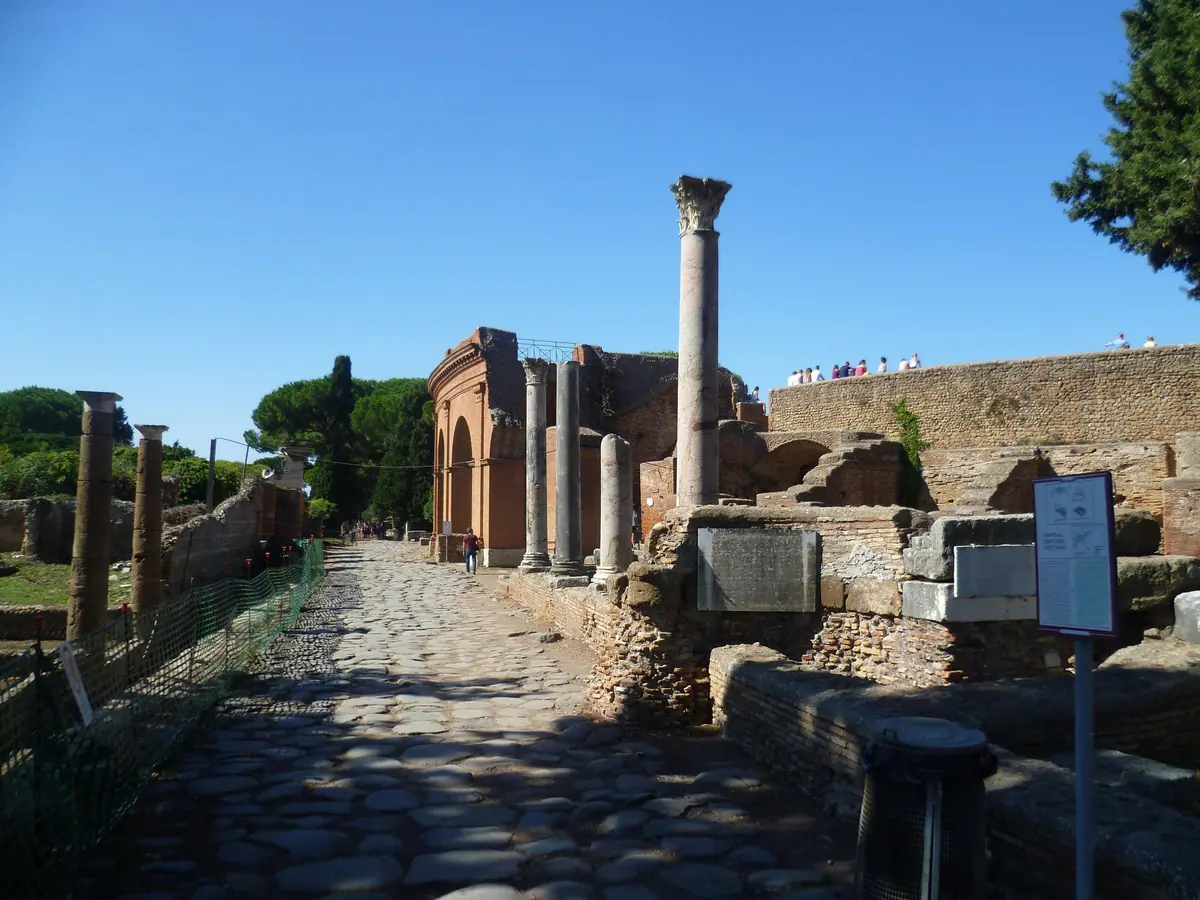
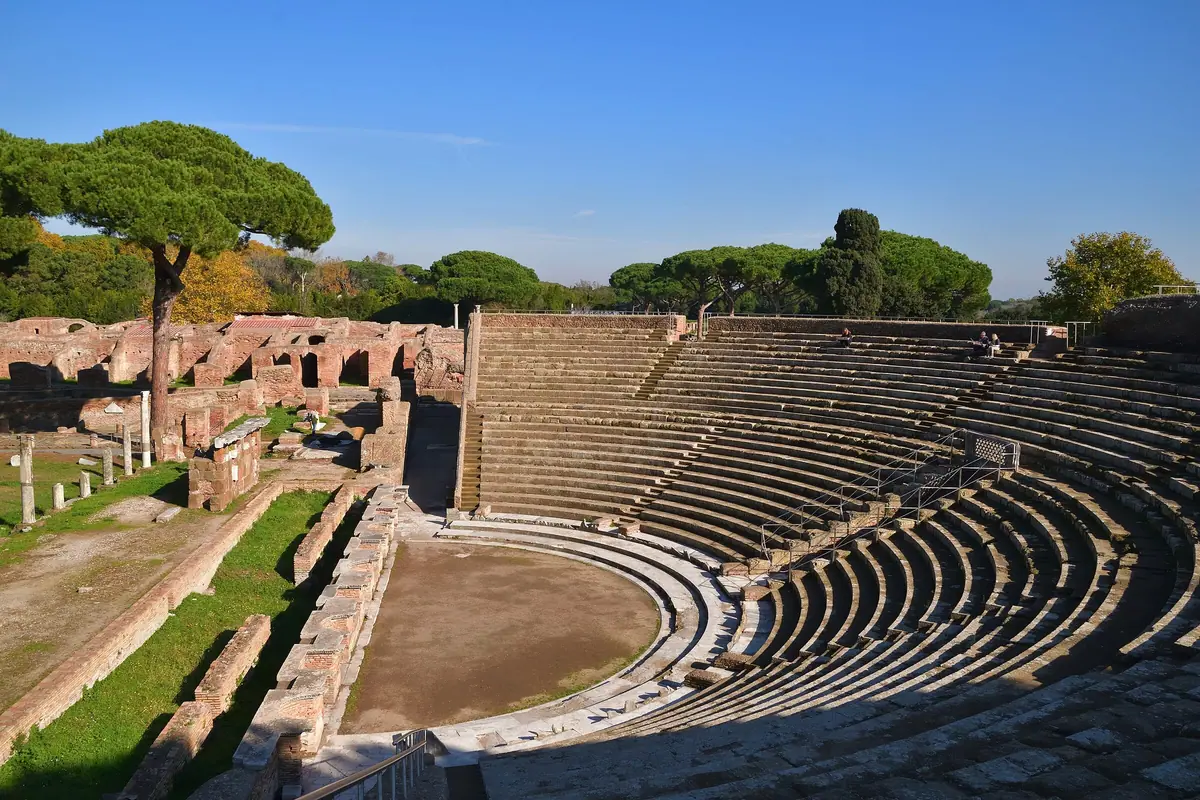
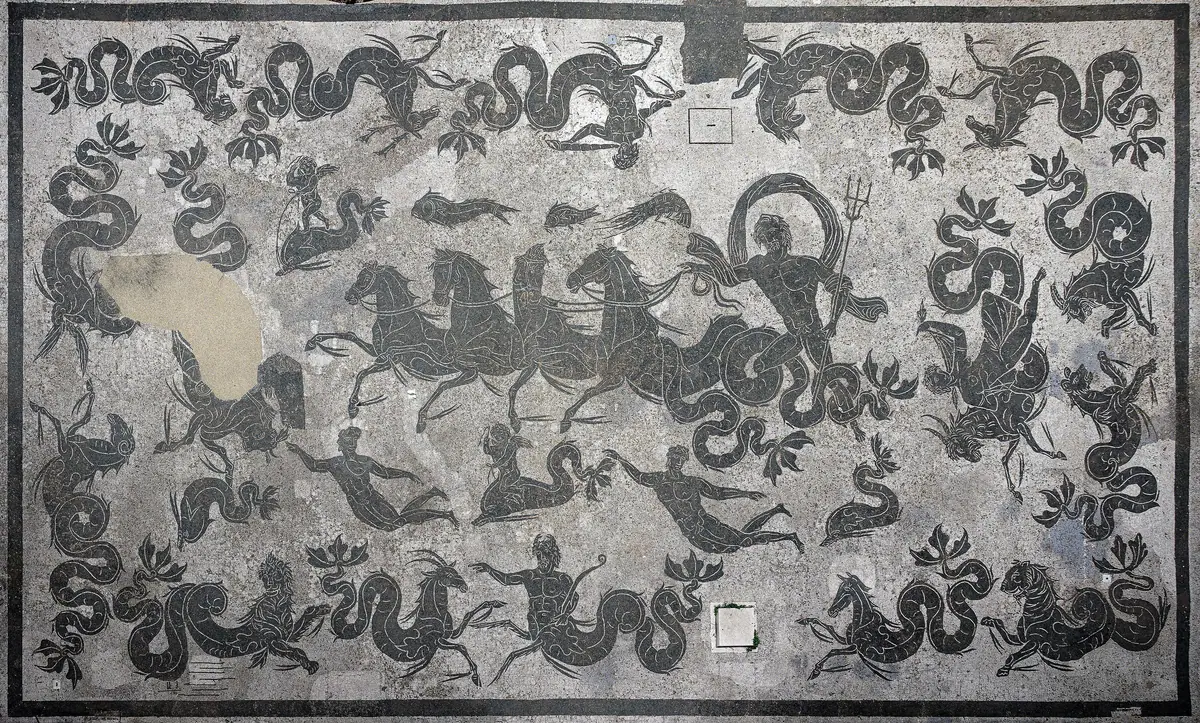
Early on are the Baths of Neptune, named after the large floor mosaic of Neptune, the sea god. A little further is the theatre, built for plays rather than gladiator fights, and laid out in the time of Augustus, the first emperor, together with the square behind it.
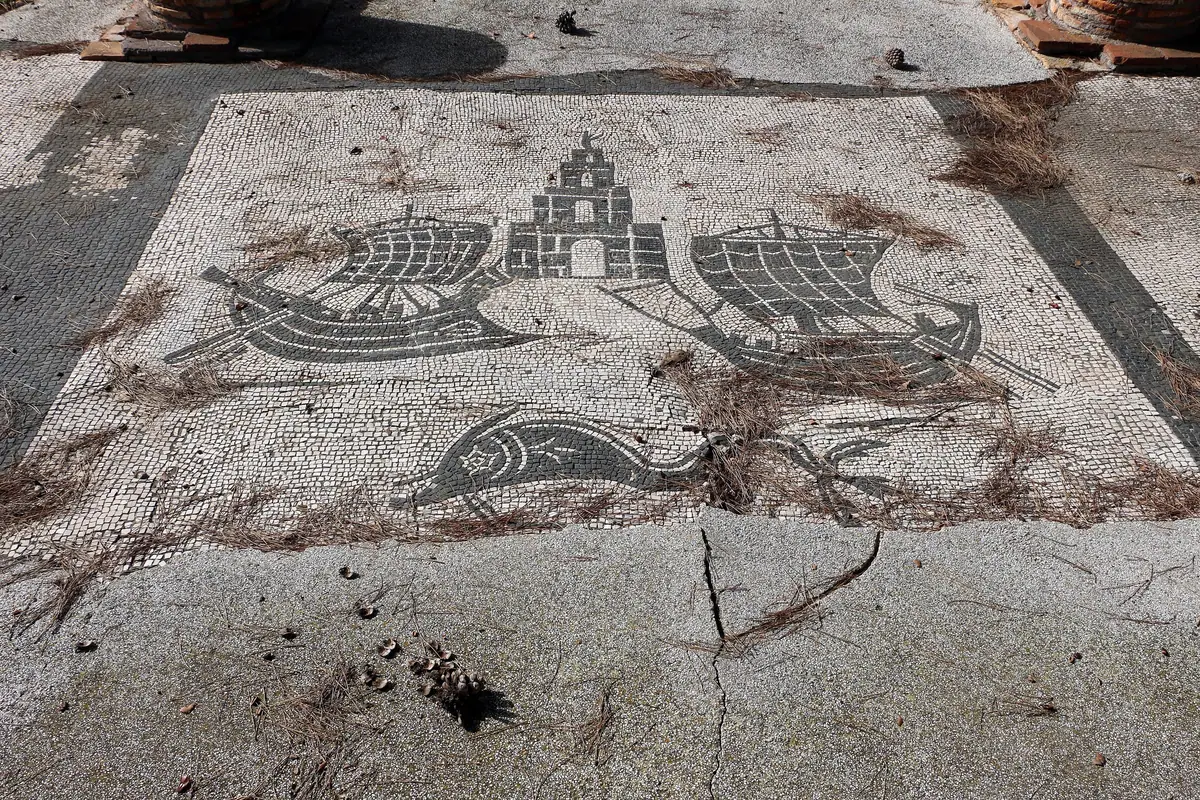
That square is the Piazzale delle Corporazioni, the Square of the Guilds, ringed by porticoes added under Emperor Claudius. Along them were the offices of the town’s trading guilds and shipping firms, and the mosaics on their floors still show what each one traded in, with ships, dolphins, a lighthouse and elephants among them.
Off the Decumanus, on Via di Diana, the Thermopolium is a Roman bar with its counter in place, marble shelves, paintings of food on the wall and a courtyard with a fountain. On the same street stands the House of Diana, one of the town’s insulae, the apartment blocks where people lived, and others are worth finding, such as the House of the Paintings, the Garden Houses and the House of Cupid and Psyche.
The street brings you to the Forum, the main square, closed at one end by the Capitolium, a temple to Jupiter, Juno and Minerva rebuilt around AD 120. Just off it are the Forum Baths, from around 160 and the largest in the town, with a public latrine of 20 marble seats. Elsewhere in the town you’ll come across the fishmongers’ shops and a synagogue.
The museum and the castle, on the same ticket
- Museo Ostiense
- The site museum, in 12 rooms. In winter 10:30–15:30, last entry 15:00; from April it opens at 9:30. Closed on the first Sunday of the month
- Castle of Pope Julius II
- 10:30–16:30 to the end of February, last entry half an hour before closing. Open while it's being restored
- Closed
- Both on Mondays; the castle also on 25 December and 1 January
How Ostia Antica grew from a river-mouth fort into Rome’s harbour
The name comes from ostium, Latin for a river mouth, because the town stood where the Tiber met the sea. Roman tradition says Ancus Marcius, the fourth king of Rome, founded it around 620 BC, but the oldest remains found here are of a fort from the 4th century BC.
By the 2nd century BC Ostia was Rome’s port. Emperor Claudius began a new harbour, Portus, in AD 42, and Nero completed it in 64. Between 100 and 112, as silt built up, Trajan added a new inner basin. Their remains are the Imperial Ports, on the same ticket. Some estimates, the park says, put the town at 50,000 people at its height.
The town declined from the middle of the 3rd century and was abandoned around 550. More than half of it is still unexcavated, so the streets you walk are only part of the town that stood here.
City cards
Ostia Antica with a city card
Pick the one that fits your trip. Prices are per adult, and you choose your dates on the next page.

Tickets
Popular tickets around Rome
The ones other visitors book most.


People also ask
Frequently asked questions
How do I get to Ostia Antica from Rome?
Take metro line B to Piramide and change to the Metromare train at Roma Porta San Paolo station, next door. Get off at Ostia Antica, about 30 minutes on, and walk 5 to 10 minutes to the entrance. A €1.50 BIT ticket covers the metro and the train, and the Roma Pass covers the line too.
How much does it cost to visit Ostia Antica?
The ticket costs €18 and gets you into every site and museum in the park, once each, over eight days in a row. Under-18s go in free, EU citizens aged 18 to 25 pay €2 at the ticket office, and on the first Sunday of the month entry is free for everyone.
Is Ostia Antica included in the Roma Pass?
Yes. It can be one of the card's included entries, and the card's transport covers the Metromare train out there. The Roma Pass price list also gives a €2 reduced ticket here, but the park's own €2 rate is for EU citizens aged 18 to 25, so ask at the ticket office which one applies before you spend an included entry on Ostia.
How long do you need at Ostia Antica?
Three to four hours at the least, for the main street, the baths, the theatre and the houses. The park's long audio guide route takes seven hours, more than a winter day allows: from late October to February the ticket office closes at 15:30 and the site at 16:30.
Is Ostia Antica open on Mondays?
No, the excavations close every Monday, and on 25 December. From Tuesday to Sunday, public holidays included, they open at 8:30, and from 25 October to the end of February they close at 16:30, with last entry at 15:30.
Can you have a picnic at Ostia Antica?
No, the park doesn't allow picnics. Inside there's a café, the Café degli Scavi, along with snack machines and toilets.
