
Naples · Naples City Card
Sansevero Chapel
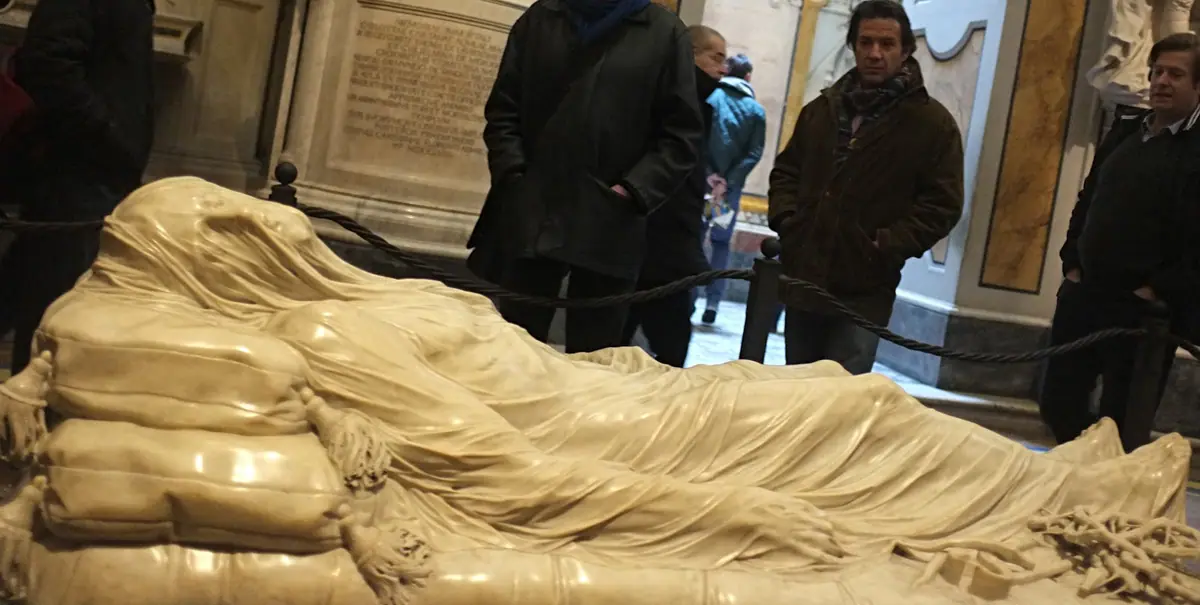
The veil over Sanmartino's Christ was carved from the same block of marble as the body beneath it.
Naples's Sansevero Chapel holds the Veiled Christ, Giuseppe Sanmartino's life-size marble of the dead Christ under a shroud so fine that for more than 250 years visitors believed an alchemist had turned real cloth to stone. Beside it stand Modesty, a woman behind a marble veil, and Disillusion, a man working himself free of a marble net, and down a spiral stair the same visit takes in the crypt where Prince Raimondo di Sangro's anatomical machines stand, two skeletons whose blood vessels were rebuilt in wax. Every visit has a booked time; ours come with a guide in English or with an audio guide.
Before you go
- Time inside30–45 min
- ClosedTuesday
- EntryTimed slot
TipEvery visit needs a booked half-hour slot and sales open 60 days ahead, so book as soon as your date is fixed; photos are not allowed inside.


Sansevero Chapel tickets: a booked time, with a guide or an audio guide
Every visit to the chapel is booked for a time, in half-hour slots from 9:00, and that goes for our tickets too. Slots go on sale 60 days ahead, with an extra batch released two days before. The desk at the door only sells to small groups, for the coming week and out of the same allocation, so a slot that’s gone online is gone there too.
A visit covers the whole chapel: the nave with the sculptures, the crypt with the anatomical machines and the sacristy, which doubles as the shop.
If you’d like the story told as you look, the guided visit costs from €22.40: 35 minutes with a guide in English, French, Italian or Spanish. It can’t be cancelled or changed, so book it once your Naples dates are firm.
The hosted entry, at €25.18, is the one you can cancel or move up to 24 hours before. The host speaks only Italian, with live translation by radio, and you also get an audio guide in English, French, German or Italian and an audio tour of the city for afterwards. Children aged 4 to 9 have their own price, and under-4s go free.


The guided visit and the hosted entry both meet in Piazza San Domenico Maggiore, a few steps from the chapel, and your ticket says exactly where. The third ticket is a longer outing: a two-and-a-half-hour walk through the old town for €48.50, from the tiled cloister of Santa Chiara to the chapel. Its options are listed in Italian, so make sure English is offered on your date.
The Sansevero Chapel on the Naples City Card
The Naples City Card is the only one of the Naples Pass and Naples city passes we sell that includes the chapel. It’s a bundle of dated tickets rather than a card you swipe: the hosted entry described above, the Archaeological Museum with an audio guide app, one underground visit of your choice and an audio guide to the city. It can’t be cancelled, so it suits a trip with fixed dates.
The Campania Artecard doesn’t include the chapel, because the chapel is private and the Artecard covers the region’s state sites.

The Veiled Christ and the legend of its marble veil
The Veiled Christ lies in the middle of the nave: the dead Christ, life-size, under a marble veil that looks transparent. Prince Raimondo di Sangro, who rebuilt his family’s burial chapel from the 1740s, first wanted Antonio Corradini, the sculptor of the veiled Modesty a few steps away. Corradini died in 1752 and left only a terracotta model, now in the Museo di San Martino, so the commission went to Giuseppe Sanmartino, a young Neapolitan sculptor, who finished the statue in 1753.
For more than 250 years, travellers and even some scholars believed the prince had made the veil by alchemy, turning real cloth to marble. Raimondo had a name as an alchemist and was happy to feed the story. The chapel, run today as a private museum, points to the papers that settle it: in a payment record of 16 December 1752, kept in the archive of the Bank of Naples, the prince asks for a statue “covered by a transparent veil of the same block”, and his letters say the same.
The statue has had famous admirers. Antonio Canova, the great neoclassical sculptor, tried to buy it and, the legend goes, said he’d give ten years of his life to have carved it. The Marquis de Sade praised its folds and the fineness of the veil, and the conductor Riccardo Muti put its face on the cover of his recording of Mozart’s Requiem.
The chapel's three great marbles
- Veiled Christ
- Giuseppe Sanmartino, 1753: the dead Christ under a veil
- Modesty
- Antonio Corradini, 1752: a woman behind a veil
- Disillusion
- Francesco Queirolo, 1753–54: a man caught in a net
Modesty, Disillusion and the anatomical machines in the crypt
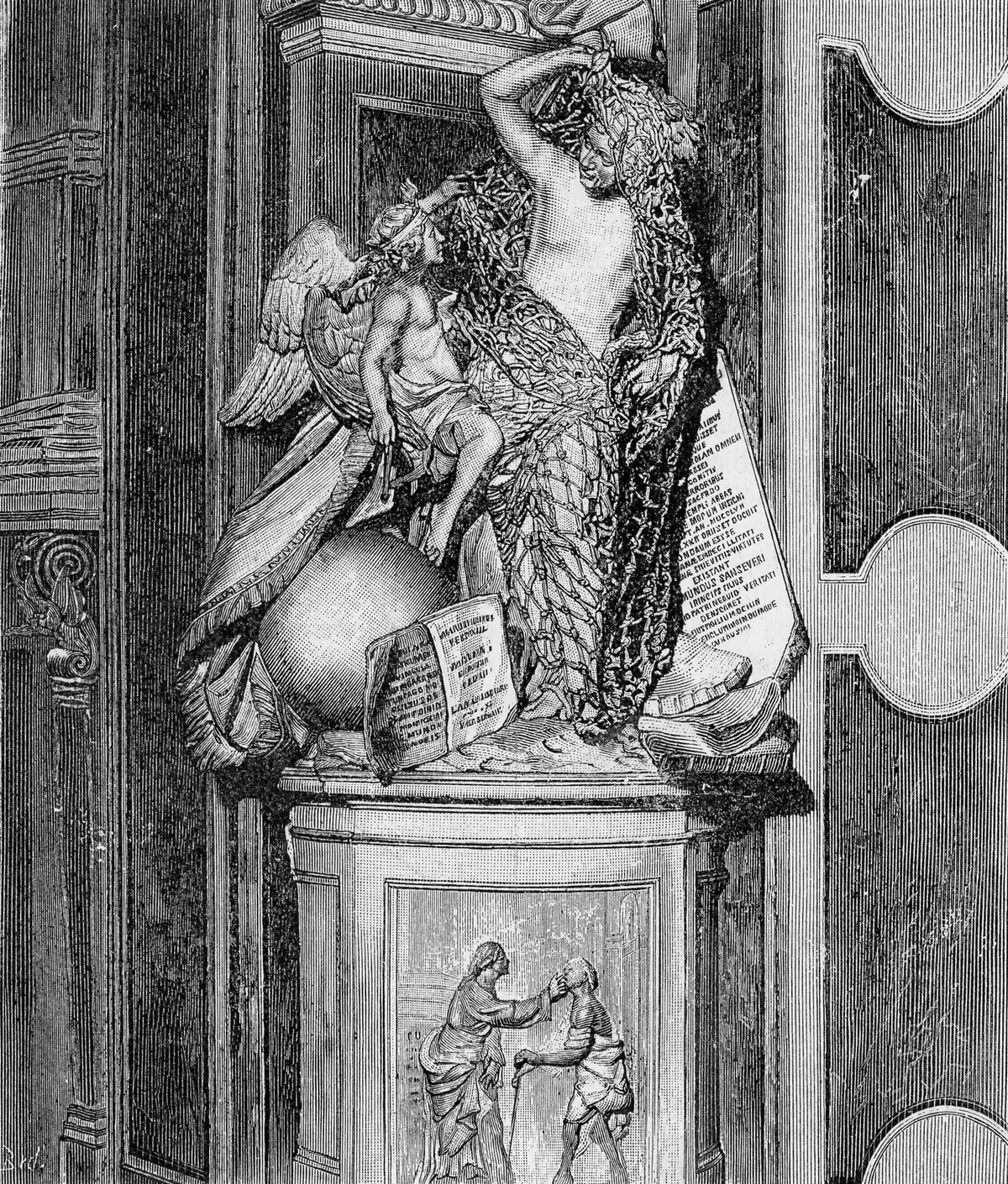
Two more statues stand with the Christ in the nave: Raimondo dedicated Modesty to his mother, Cecilia Gaetani d’Aquila d’Aragona, who died in 1710, and Disillusion to his father, Antonio. The net in Disillusion is so fine that Queirolo had to polish it himself, because the craftsmen refused to touch it, and the prince’s biographer, Origlia, called it the hardest test a sculptor in marble could set himself.
Look up, too, at the Glory of Paradise, painted on the vault by Francesco Maria Russo in 1749, and down at the maze pattern of the floor. Almost all of the floor was relaid in 1901, but a stretch of the original survives beside Raimondo’s tomb.
A narrow 19th-century spiral staircase leads down to the crypt, which Raimondo planned as a small oval funerary temple and never finished. In it stand the anatomical machines: two skeletons, a man and a woman, upright, each wrapped in an almost complete network of arteries and veins. Giuseppe Salerno, a doctor from Palermo, made them between about 1756 and 1764; Raimondo bought the man and paid Salerno to make the woman.
A foetus lay at her feet until it was stolen a few decades ago, and Naples told darker stories about the pair. An 18th-century pamphlet spoke of injections, and the philosopher Benedetto Croce recalled the popular belief that the prince had two servants killed for them. The chapel’s own account is plainer: the vessels are a reconstruction in beeswax and dyes, and one research team thinks work this fine points to earlier experiments with injections.
Sansevero Chapel opening hours and the rules inside
Opening hours
- Wednesday to Monday
- 9:00–19:00, last entry 18:30
- Closed
- Tuesdays and 25 December
- Open on these Tuesdays
- 29 December 2026 and 5 January 2027 (9:00–19:00); 8 December (9:00–20:30)
- Open to 20:30
- 5 to 8 December, 26 and 27 December, 1 to 3 January (from 10:00 on New Year's Day)
- Closes at 14:00
- 24 and 31 December
At the chapel
- 1Be on time: a booking is held for 10 minutes after its slot. For the guided visit and the hosted entry, be at the meeting point 10 to 15 minutes early.
- 2At the door: show your ticket on your phone or on paper, with no need to go through the ticket desk.
- 3Phones away: no photos, no filming and no using your phone inside, and no food, drink or animals other than guide dogs.
- 4What to wear: shoulders and knees covered, as the hosted entry asks.
Wheelchair users can reach the whole nave, with the Veiled Christ, and the sacristy, but not the crypt, which has only the spiral stairs. For blind and partially sighted visitors there’s a free audio-described route, DescriVedendo Sansevero, of about 25 minutes.
Finding the Sansevero Chapel behind Piazza San Domenico Maggiore
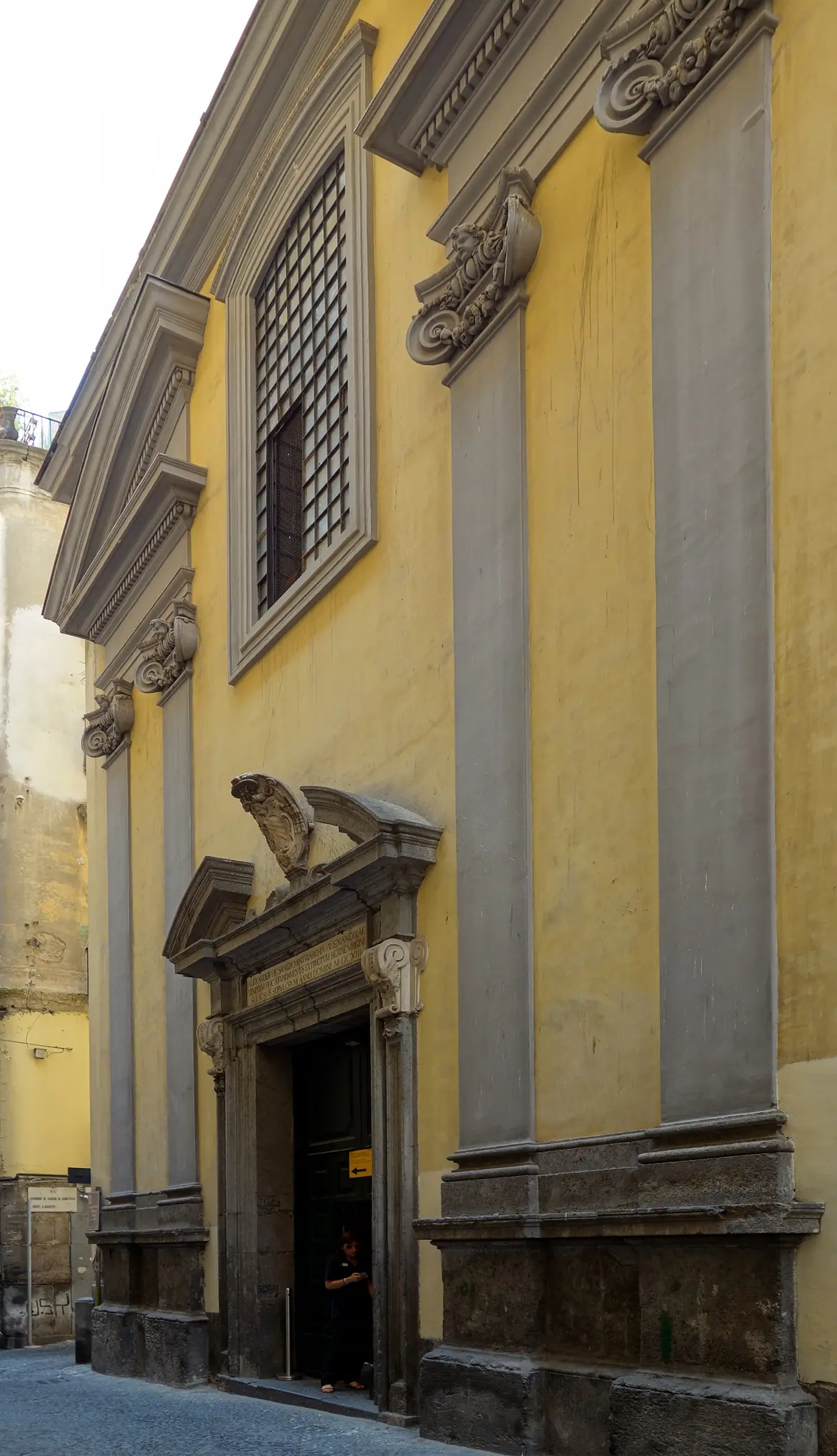
The door is at Via Francesco De Sanctis 19/21, just behind Piazza San Domenico Maggiore, a minute from Via dei Tribunali and two from Spaccanapoli, the street through the old town that’s called Via Benedetto Croce at this point. Piazza del Gesù, Santa Chiara and San Gregorio Armeno are a few minutes’ walk away.
From the metro, it’s 5 to 10 minutes on foot from Università or Dante on line 1, or from Cavour on line 2. Buses 151, 154 and R2, trolleybus 202 and tram 41 stop nearby, and since the old town is a limited traffic zone, it’s a place to arrive on foot.
Don’t mix it up with the Cappella dei Bianchi, about 1.3 kilometres north in the Sanità district, where the sculptor Jago’s Veiled Son, a marble child under a veil inspired by Sanmartino’s Christ, has stood since 2019. Its guided visit, in Italian, costs €10.
Tickets
Popular tickets around Naples
The ones other visitors book most.


People also ask
Frequently asked questions
Is the Sansevero Chapel free?
No. The chapel is privately run and lives on its tickets, so it isn't part of the free first Sundays at Italy's state museums. The guided visit we sell costs €22.40 and the hosted entry €25.18, both with a booked time, and under-4s go free on the hosted entry.
How long does it take to visit the Sansevero Chapel?
The audio guide takes about 25 minutes through the nave, the crypt and the sacristy, and our guided visits last 35, so plan on half an hour to 45 minutes.
Is the Sansevero Chapel worth visiting?
Yes, if you book a time. The Veiled Christ was carved from a single block, veil and all, and the same visit shows you two more marbles by other sculptors and the crypt with the anatomical machines. It's a short visit in the middle of the old town, so it fits between other sights.
What is the most famous statue in Naples?
The Veiled Christ in the Sansevero Chapel has the strongest claim: Antonio Canova tried to buy it, and the Marquis de Sade praised the folds of its veil.
Can you take photos in the Sansevero Chapel?
No. Photos, filming and even using your phone are banned inside, so put it away at the door.
Is the Sansevero Chapel open on Tuesdays?
It closes on Tuesdays, with three exceptions this winter: 8 December and 29 December 2026, and 5 January 2027.
