
Naples · Campania Artecard
Castel Nuovo (Maschio Angioino)
In its great vaulted hall a pope gave up the papacy in 1294, and almost two centuries later a king had his rebel barons arrested there.
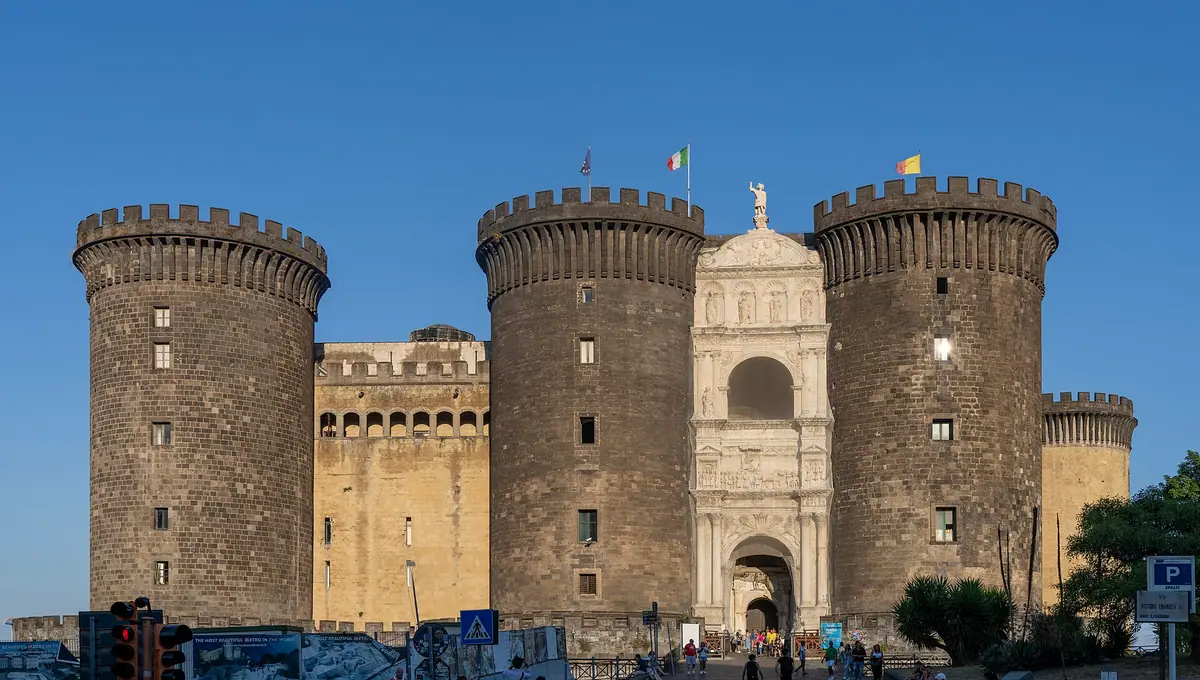
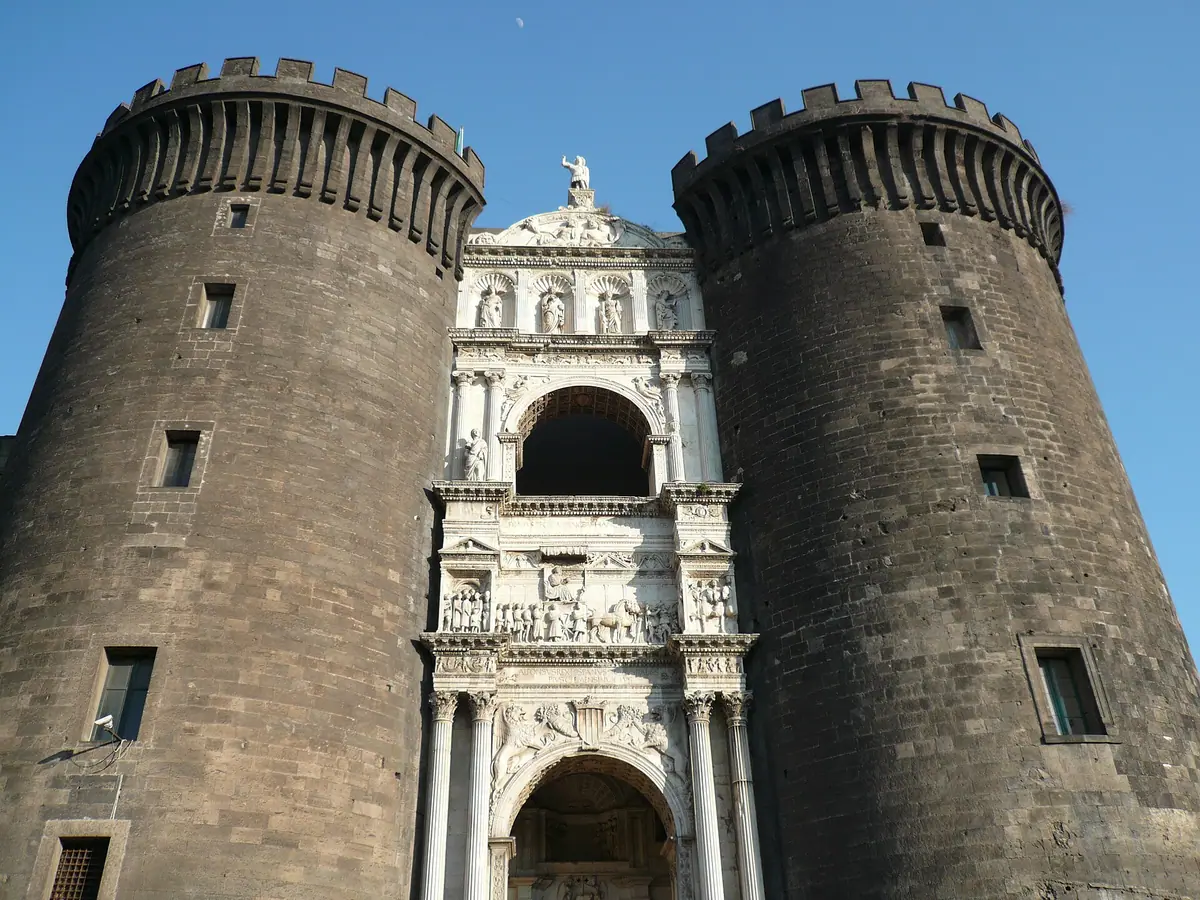
Five round towers and a triumphal arch on its front make Castel Nuovo, the Maschio Angioino, the landmark of Piazza Municipio in Naples. Charles I of Anjou built it in 1279-82, and Alfonso V of Aragon rebuilt it after taking the city in 1443; the arch between two of its towers celebrates his entry. Inside are the Sala dei Baroni, the Palatine Chapel, Roman ruins under a glass floor and a civic museum of Neapolitan painting. The Campania Artecard and the Naples Museum Card include entry.
Castel Nuovo tickets: €10 at the castle, or included on a card
The city of Naples runs Castel Nuovo and sells entry itself, at a ticket desk in the castle that takes cards only, and on the city’s ticket website. Nothing needs booking, and the triumphal arch on the front needs no ticket at all: you see it from the square.
Castel Nuovo ticket prices
- Full ticket
- €10
- Residents of Naples and its metropolitan area
- €6
- Under-18s
- Free; under-12s must come with an adult
- Disabled visitors
- Free, with a companion
- Campania Artecard and Naples Museum Card
- Entry included
Because the castle is the city’s and not the state’s, the national free days don’t apply here.
If the castle fills up, counting anyone at an event there at the same time, it stops letting people in, and the ticket isn’t refunded.
Castel Nuovo on a Naples card: no ticket to buy, nothing to book
Two of the cards we sell include Castel Nuovo, and with either one you walk in without buying anything or booking. They make sense when the castle is one stop of several: the Royal Palace is on both, and so is Castel Sant’Elmo up on the Vomero hill. Their full lists are on Naples Pass and Naples city passes.


When Castel Nuovo is open, and the rooms that close for events
The castle opens Monday to Saturday from 9:00 to 18:00, with the last entry at 17:30, all year round. It closes on Sundays and public holidays, unless the city announces a special opening.
Three spaces on the route, the Sala dei Baroni, the archaeological rooms in the old armoury and the Palatine Chapel, can be shut when the city lends them for an event, and the museum’s lift can be out of service. If the hall is your reason for coming, or you depend on the lift, ring the castle first on 081 7957703, Monday to Friday from 9:00 to 15:00. Food, drink and animals stay outside, apart from guide dogs and small dogs carried in your arms.
Inside the Maschio Angioino: from the courtyard to the Sala dei Baroni
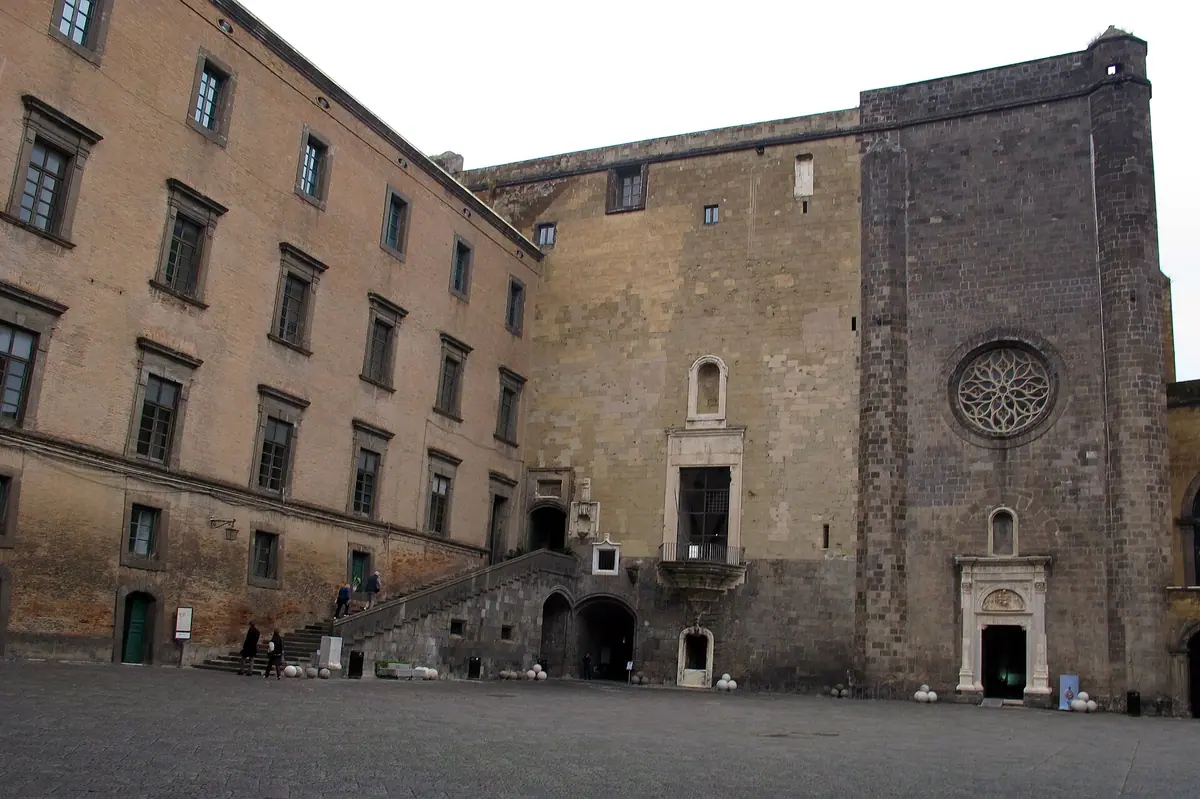
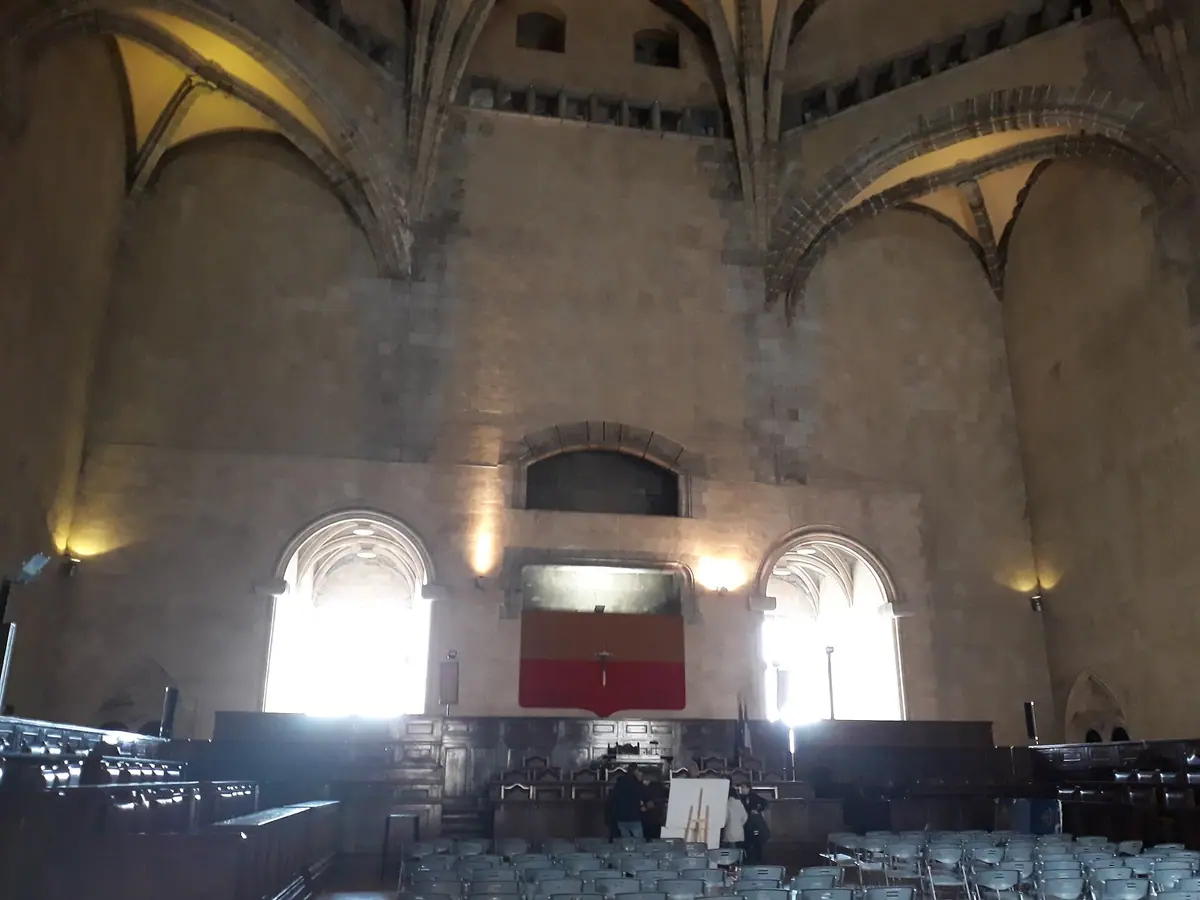
Inside the walls you come into the Cortile Monumentale, the courtyard that Guillem Sagrera, the architect who rebuilt the castle for Alfonso of Aragon, gave a portico of low Catalan arches. His stone staircase climbs from the courtyard to the Sala dei Baroni, a vaulted hall of about 26 by 28 metres, unless it’s closed for an event that day.
Pope Celestine V resigned in this hall on 13 December 1294, the “great refusal” that Dante, the Florentine poet, wrote into the Divine Comedy, and Boniface VIII was elected pope eleven days later. In the 1480s King Ferrante I had the barons who had plotted against him arrested in the same room, and until 2006 it was where Naples’s city council met.
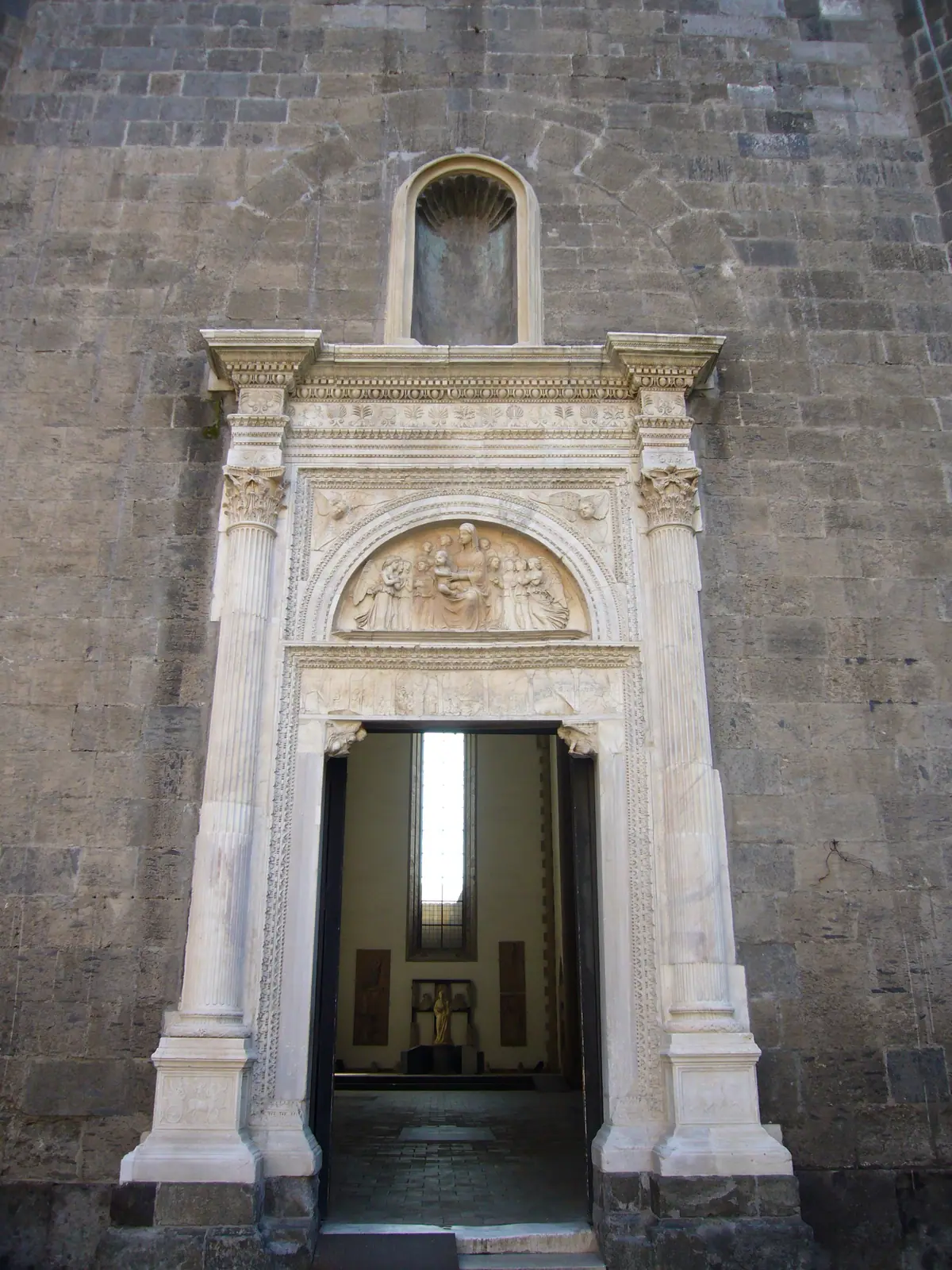
The Palatine Chapel, dedicated to Santa Barbara, is the only part of the Angevin castle still standing. Giotto, the great Florentine painter, frescoed it around 1330, but almost all his work is lost; what you see is the Renaissance doorway, with reliefs by the sculptors Francesco Laurana and Andrea dell’Aquila, and a tabernacle by Domenico Gagini. In the old armoury, a glass floor shows Roman remains from the 1st century BC and the 5th century AD.
The Civic Museum, opened in 1990, has Neapolitan painting from the 15th to the 18th century on its first floor, including followers of Caravaggio and Baroque works. A second floor covers the 18th to the 20th century, but at the end of October 2026 the city’s route listed only the first. There’s no public access to the towers, so come for the rooms rather than a view.
Who built Castel Nuovo: the Angevins and Alfonso of Aragon
Charles I of Anjou, the French-born king of Naples, ordered the castle in 1279 and had it finished by 1282, though he died in 1285 without living there. Under Robert of Anjou, king from 1309 to 1343, it held a court that Giotto and the poets Petrarch and Boccaccio passed through.
The castle you see today is mostly the work of Alfonso V of Aragon. After taking Naples in 1443 he had Sagrera rebuild it, from 1453 until 1479, and the triumphal arch on the front went up in the middle of the 15th century to mark his entry into the city.
Under the viceroys who governed Naples from 1503 it was a military base. At the start of the 20th century the city cleared away the buildings that had grown up against it, which is why it stands free on its square today.
Getting to Castel Nuovo on Piazza Municipio
Metro lines 1 and 6 both stop at Municipio, right beside the castle, though line 6 only runs between Mostra and Municipio. Coming down from the Vomero, the Funicolare Centrale leaves you on Via Toledo, a longer walk away, and from the central station the R2 bus runs to the square; trams 412 and 421 stop there too.
The Royal Palace on Piazza del Plebiscito is a few hundred metres from the castle, so the two make an easy pair on the same day.
City cards
Castel Nuovo (Maschio Angioino) with a city card
Pick the one that fits your trip. Prices are per adult, and you choose your dates on the next page.


Tickets
Popular tickets around Naples
The ones other visitors book most.


People also ask
Frequently asked questions
When was Castel Nuovo in Naples built?
Charles I of Anjou had it built between 1279 and 1282, but the castle you see is the one Alfonso V of Aragon rebuilt after he took Naples in 1443, with the work finished in 1479. Of the Angevin castle, only the Palatine Chapel is left.
How much does it cost to visit Castel Nuovo?
€10, or €6 for residents of Naples and its metropolitan area, paid by card. Under-18s go in free, and the Campania Artecard and the Naples Museum Card include entry.
Is Castel Nuovo open on Sundays?
No. It opens Monday to Saturday from 9:00 to 18:00, last entry 17:30, and closes on Sundays and public holidays unless the city announces a special opening.
Can you go up the towers of Castel Nuovo?
No. The route takes in the courtyard, the Sala dei Baroni, the Palatine Chapel, the archaeological rooms and the museum, with no towers or terrace, so it's a visit for the rooms rather than the view.
Is Castel Nuovo free on the first Sunday of the month?
No. The castle belongs to the city, not the state, so the national free Sundays don't apply, and it's closed on Sundays anyway.
