
Florence · Firenze Card
Santa Maria Novella
Florence's Dominican church stands beside the station, and inside it Masaccio made a flat wall look deep.
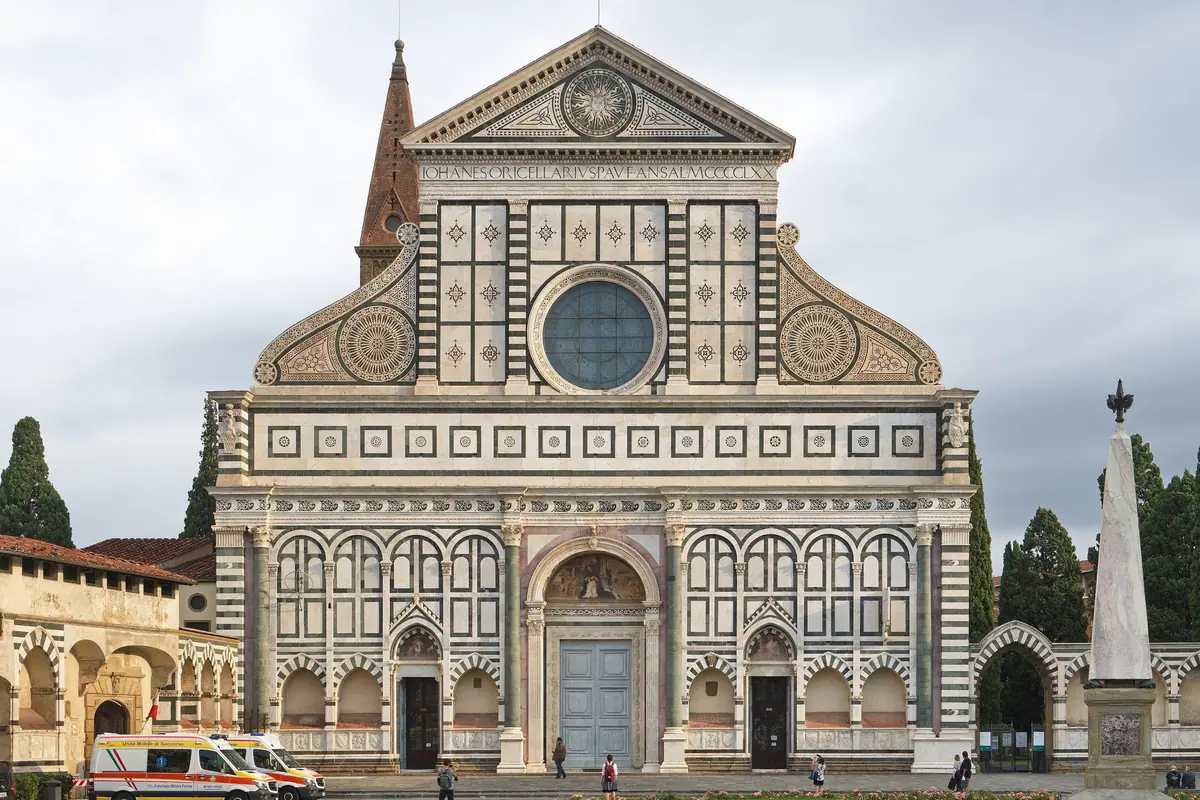
Florence's Santa Maria Novella is the Dominican basilica beside the city's train station, with a green and white marble facade finished by Leon Battista Alberti. Inside are Masaccio's Trinity, the first monumental Renaissance painting to use linear perspective, and a painted crucifix by Giotto. One ticket covers the basilica, the museum and the cloisters, frescoed Spanish Chapel included, and the ticket we sell adds an audio guide. The Firenze Card includes it, with nothing to book.
Santa Maria Novella tickets: one entry from the basilica to the cloisters
One Santa Maria Novella ticket takes you through the whole complex: the basilica with its chapels, sacristy and the Avelli cemetery, then the museum behind it, with the cloisters, the Spanish Chapel and the old refectory. Booking isn’t compulsory, and the ticket office on site sells tickets for the same day.
The ticket we sell costs €17.50 and adds an audio guide to the entry, with skip-the-line access at a time you choose when you book. You can cancel it up to 24 hours before that time. Children have their own price at checkout, audio guide included.

There’s no free day here for visitors from outside Florence, which surprises people used to the state museums’ free first Sundays. Santa Maria Novella is run by the church and the city, so residents of Florence go in free every day with ID, and the first Sunday of the month is free only for residents of the Metropolitan City of Florence. Children under 11 do go in free on any day, though, and so do visitors with a disability and one companion.
The Firenze Card at Santa Maria Novella: a bonus entry with no booking
The Firenze Card, Florence’s official museum card at €94, runs for 72 hours from your first entry and gets you into about 60 museums once each. Santa Maria Novella is one of them, and you don’t book a time for it: the card only needs a booking at the Uffizi, the Accademia, Palazzo Vecchio and its tower, and the Brancacci Chapel. You show the card at the complex’s ticket office and go in.
We’d treat it as a bonus on a card you buy for the bigger museums, since the card pays off from five or six paid museums and Santa Maria Novella’s ticket costs little next to theirs. No other pass covers it, the Uffizi Passepartout included, and our page on the Firenze Card and Florence’s other passes works through which one suits your list. The card is sold through GetYourGuide.
Santa Maria Novella opening hours: Fridays from 11:00, Sundays from 13:00
On Mondays, when much of Florence shuts, Santa Maria Novella is open as usual. What changes is the start time: Fridays open at 11:00 and Sundays at 13:00. The last entry is an hour before closing, and because the basilica is a working church, ceremonies can change the hours on any day.
Opening hours
- Monday to Thursday
- 9:00–17:30
- Friday and civil holidays
- 11:00–17:30
- Saturday and the eve of religious feasts
- 9:00–17:00
- Sunday and religious feasts
- 13:00–17:00
- Last entry
- One hour before closing
- Good Friday and Holy Saturday
- Open for prayer only, no visits
The religious feasts that take Sunday hours are 1 and 6 January, Easter, 15 August, 1 November, 8 December and 25 December. This year that means Tuesday 8 December and Friday 25 December only open at 13:00. If you want a morning visit, plan it for Monday to Thursday or a Saturday, the days the doors open at 9:00.
Santa Maria Novella’s entrances by the station, and what stays outside
The complex has two doors. The ticket office and the museum entrance are at Piazza della Stazione 5, in the city’s Welcome Center, right beside the train station. The basilica’s own door is at Piazza Santa Maria Novella 18, on the square under the marble facade.
Large bags and trolleys aren’t allowed in, and since the station is next door, that rule catches anyone coming straight off a train. A day’s luggage storage at Santa Maria Novella costs €6.75, with insurance and 24/7 support, though it can’t be refunded.

Umbrellas stay at the entrance too, with anything that could cause damage, and food, drink and animals aren’t allowed. Photos are fine, as long as you leave out the flash and the tripod.
In the church itself, phones are put away, voices stay low and clothes need to be suitable, so covering shoulders and knees is the safe choice. The city describes the complex as accessible to visitors with reduced mobility.
Inside the basilica of Santa Maria Novella: Masaccio’s Trinity and Giotto’s crucifix
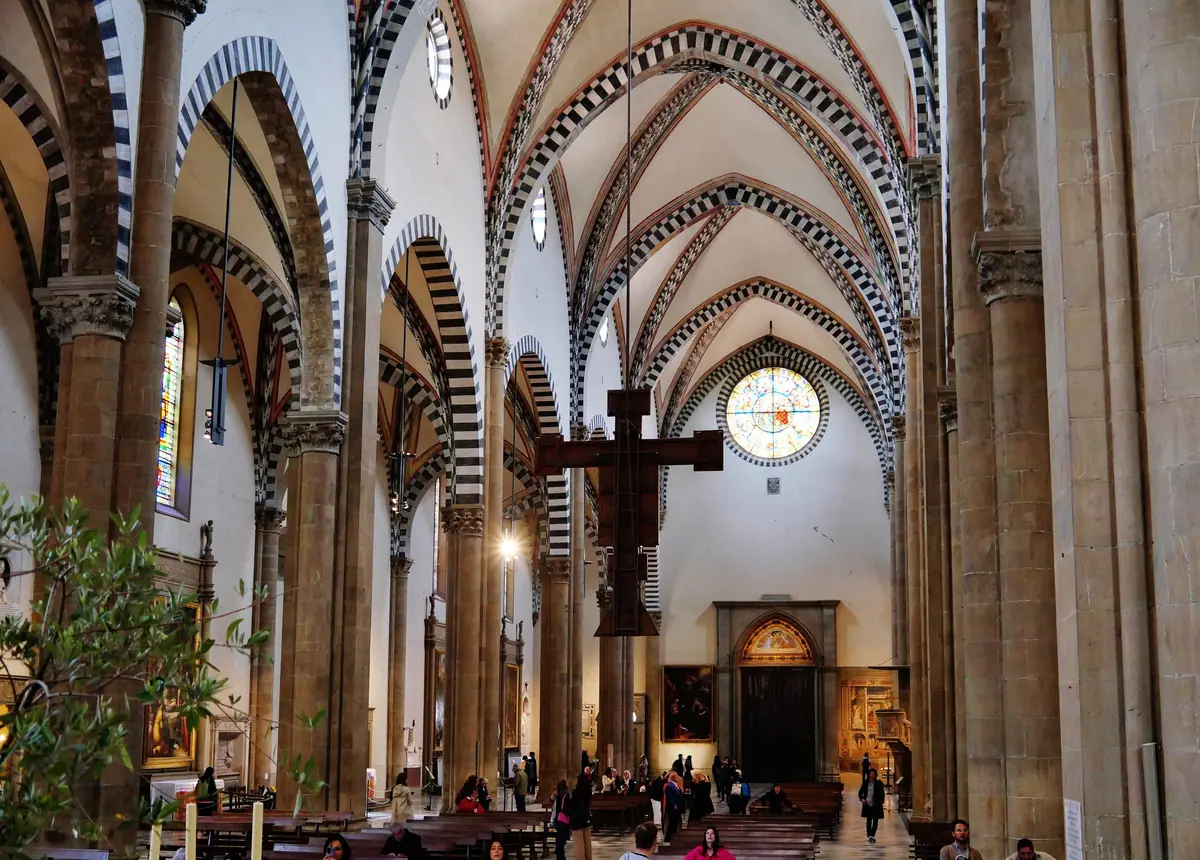
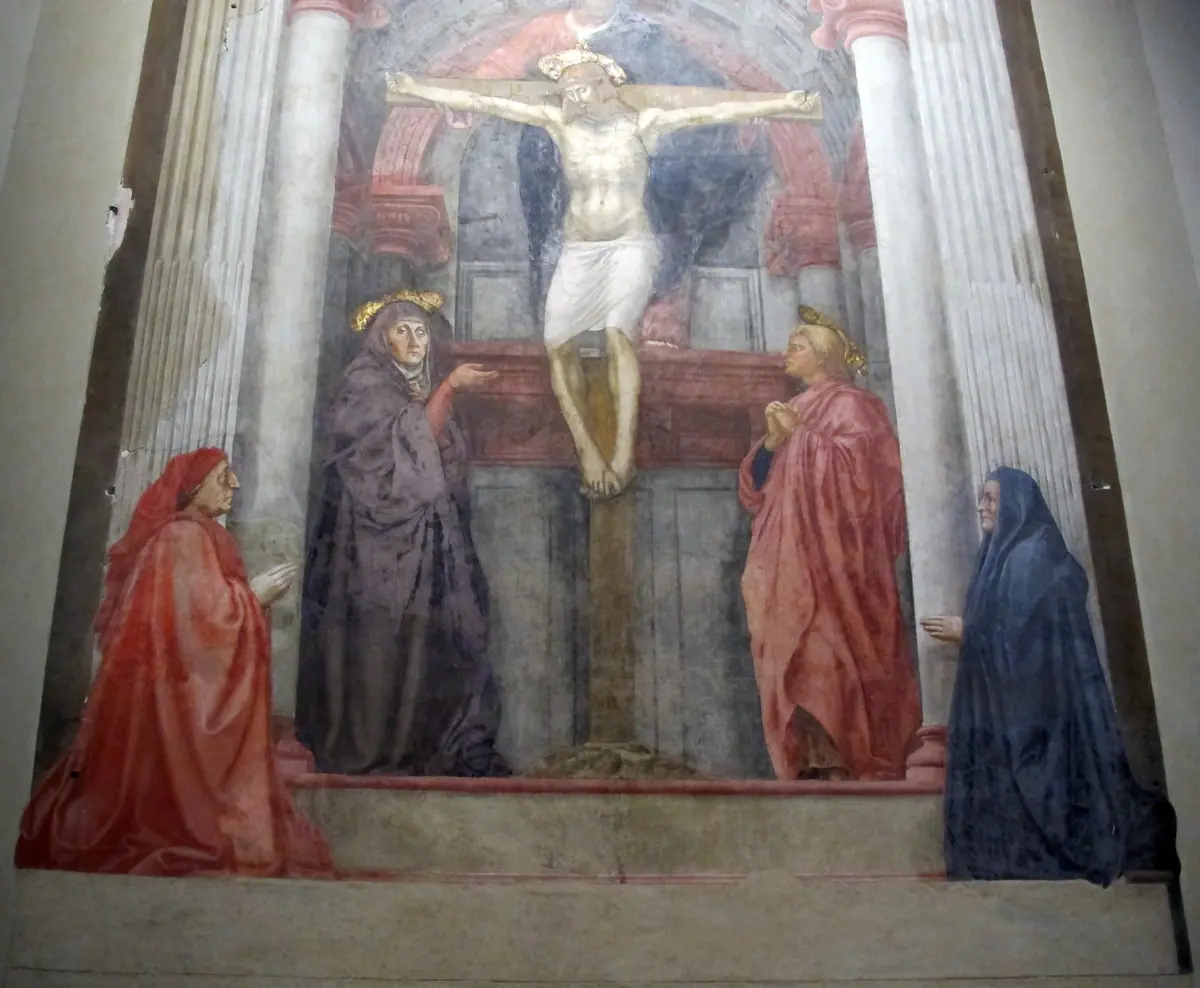
Start with Masaccio’s Trinity, painted around 1427 on the wall of the nave. It’s the first monumental Renaissance painting to use linear perspective, so the painted vault behind Christ seems to open a chapel in solid wall. Christ hangs on the cross between the Virgin and St John, with the two donors who paid for it kneeling outside the frame.
From there, look for the two crucifixes. Giotto’s painted cross changed how Christ was shown on the cross for the next two centuries, and the other, carved in wood, is by Brunelleschi, the architect of Florence’s cathedral dome. Brunelleschi also designed the marble pulpit, from 1443.
The chapels around the high altar are covered in frescoes. The Tornabuoni Chapel was painted by Ghirlandaio between 1485 and 1490, and there’s work by Filippino Lippi, Nardo di Cione and Botticelli as you go round, before the sacristy and the Avelli cemetery outside.
The Spanish Chapel and the cloisters of the Santa Maria Novella museum
The same ticket carries on into the museum behind the church, built around the cloisters of the Dominican friars, and the route ends at the Ubriachi Chapel and the old refectory.
Where to find what, in the museum
- Green Cloister
- Frescoes by Paolo Uccello
- Spanish Chapel
- The friars' old chapter house, painted by Andrea di Bonaiuto, 1365–1367
- Cloister of the Dead
- The first cloister on the route
- Ubriachi Chapel and refectory
- At the end of the museum route
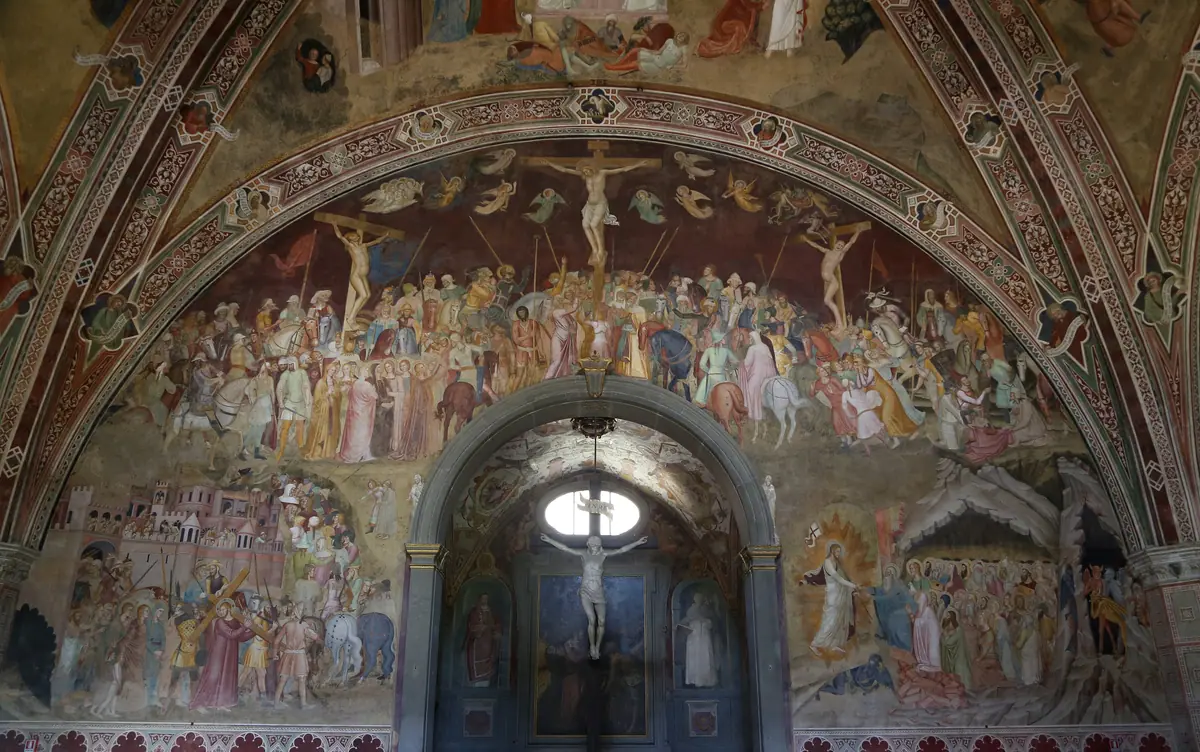
The Spanish Chapel was the chapter house, the room where the friars met, and Andrea di Bonaiuto covered every wall and the vault with frescoes in just three years. It’s the room to save time for. The city’s storerooms in the complex, which can sometimes be visited, are closed for works for now.
How the Dominicans built Santa Maria Novella, and Alberti finished its facade
Those cloisters were the Dominicans’ home: the friars were given a small oratory here, Santa Maria delle Vigne, in 1221. They began the church you see in 1279 and finished it by 1350, everything except the facade, and it was consecrated in 1420. Between 1439 and 1441 the Council of Florence, the church council that met in the city, held its sessions here.
The front came last. Leon Battista Alberti, the Renaissance architect, designed its upper part for Giovanni Rucellai, a wealthy wool merchant, and it was finished in 1470. On the square in front, the two obelisks on bronze tortoises from 1608, by the sculptor Giambologna, marked the course of the chariot race that used to be run there.
The church and the museum have different owners, the Fondo Edifici di Culto and the city of Florence, and since 2012 they’ve shared the single ticket that takes you from Masaccio’s wall to Uccello’s cloister.
Tickets
Popular tickets around Florence
The ones other visitors book most.


People also ask
Frequently asked questions
Do I need to book Santa Maria Novella in advance?
No, booking isn't compulsory, and the ticket office at Piazza della Stazione 5 sells tickets for the same day. The ticket we sell comes with a time you choose, skip-the-line access and an audio guide, and you can cancel it up to 24 hours before.
Is Santa Maria Novella included in the Firenze Card?
Yes, entry is included, and it isn't one of the museums where the card needs a booked time. You show the card at the complex's ticket office. No other Florence pass covers it.
Is Santa Maria Novella free on the first Sunday of the month?
Not for visitors. The first-Sunday free entry here is for residents of the Metropolitan City of Florence only. Children under 11 go in free on any day, and so do people with a disability and one companion.
Is Santa Maria Novella open on Mondays?
Yes, from 9:00 to 17:30, and it has no weekly closing day. Fridays start later, at 11:00, and Sundays at 13:00, with the last entry an hour before closing.
Can I bring my suitcase into Santa Maria Novella?
No. Large luggage and trolleys aren't allowed in, and umbrellas are left at the entrance. If you're arriving by train, we sell a day's luggage storage at Santa Maria Novella, insured and with 24/7 support.