
Florence · Firenze Card
Palazzo Davanzati
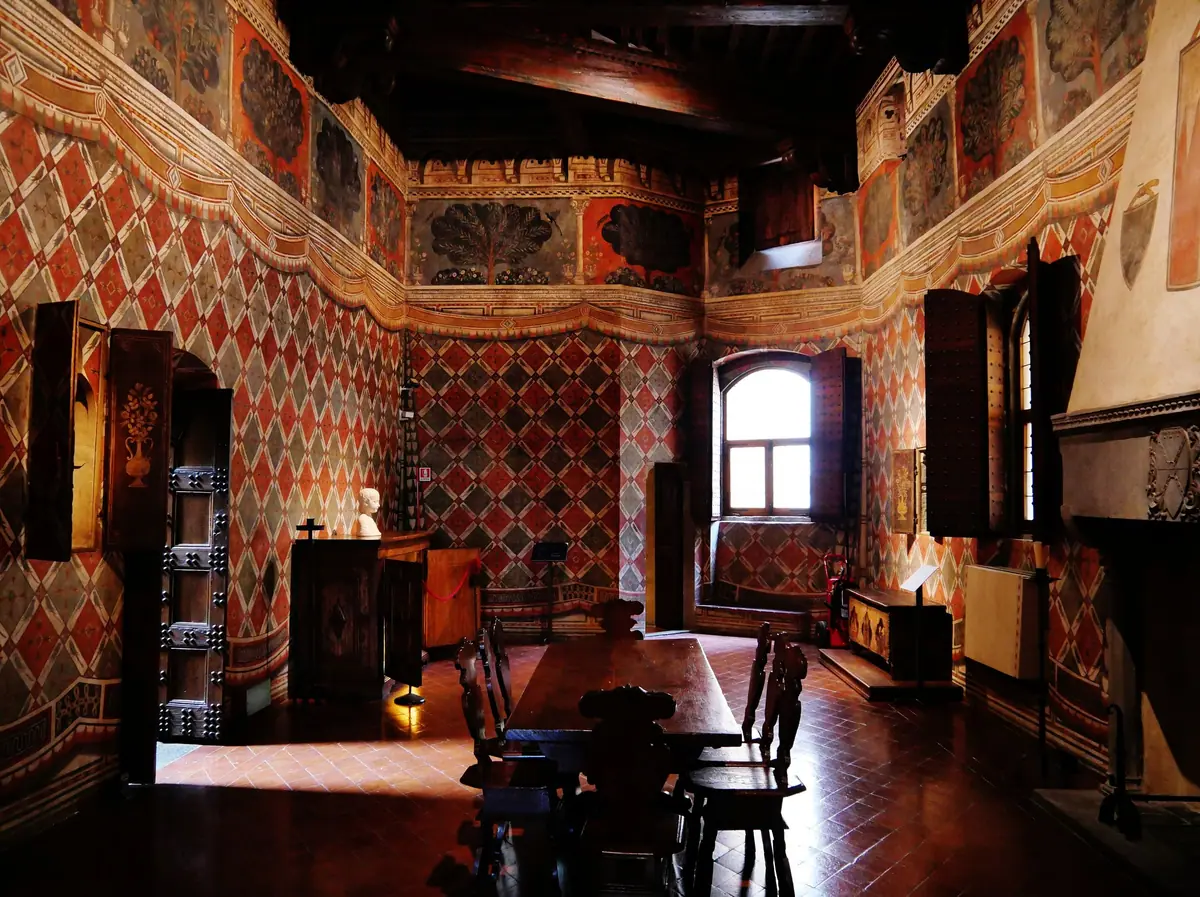
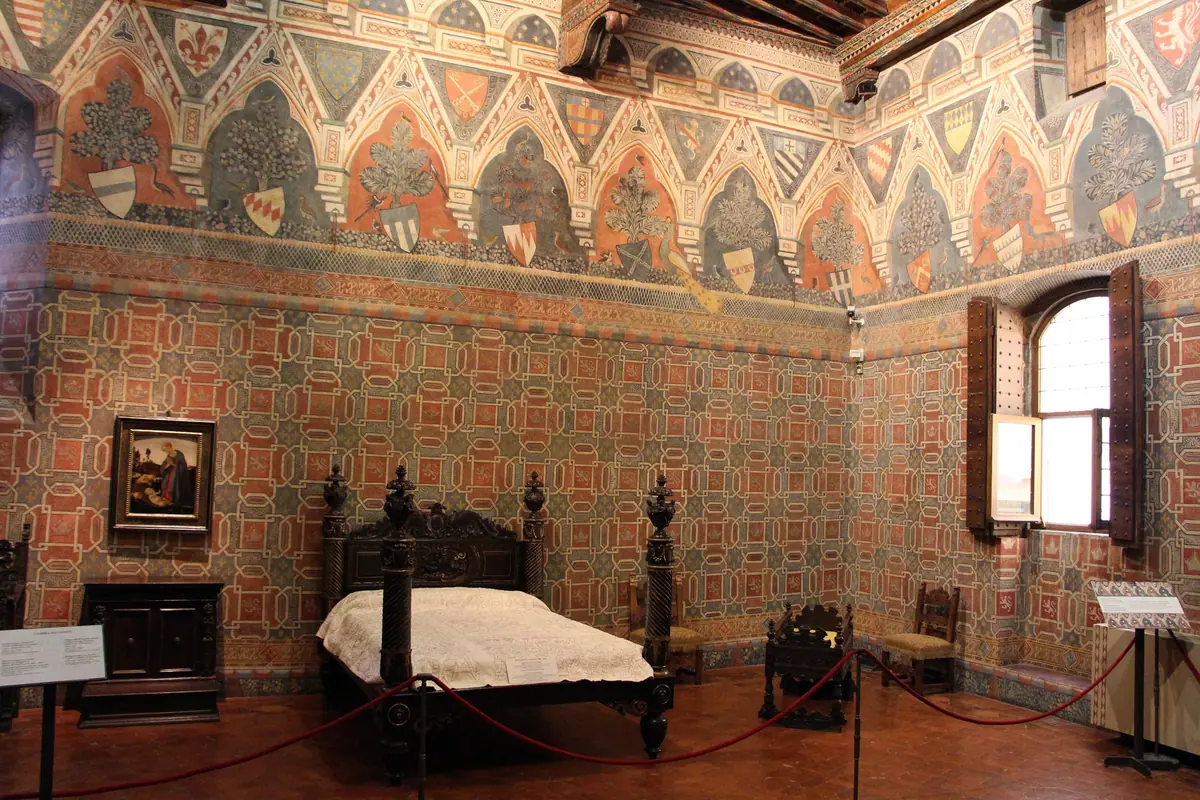
Parrots and peacocks still cover the walls of a Florentine merchant's house from the 1300s.
Florence's Palazzo Davanzati is a 14th-century merchant family's house, kept almost as it was: a tower house on its way to becoming a Renaissance palace, with rooms painted in parrots, peacocks and patterned hangings, a quilt stitched with Tristan and Isolde, a lace room and a kitchen. The €8 ticket includes themed tours led by the museum's own staff, there's nothing to book, and the Firenze Card covers it as an included entry.
Palazzo Davanzati tickets: €8 at the door, with tours at 11:00 and 16:00
Palazzo Davanzati is the house a family of Florentine merchants built in the 1300s, kept almost as it was, and its rooms are still painted with parrots, peacocks and patterned hangings. Getting in is easy: a ticket costs €8, there’s no time slot, and you buy it at the ticket office on Via Porta Rossa.
You can book ahead by phone, for a €4 fee, with Opera Laboratori, the museum’s booking service, on +39 055 294883. It’s optional, so unless you’re coming with a group there’s no reason to. Under-18s go in free, and EU citizens aged 18 to 25 pay €2, as at Italy’s other state museums.
That €8 also gets you a tour. From Tuesday to Sunday the museum’s own staff lead themed walks through the house at 11:00 and 16:00, with no booking and nothing extra to pay, so it’s worth timing your visit to join one.
What you pay at Palazzo Davanzati
- Full ticket
- €8, sold at the door
- EU citizens aged 18 to 25
- €2
- Under 18
- Free
- Booking by phone
- Optional, €4
- Themed tours by museum staff
- Included, Tuesday to Sunday at 11:00 and 16:00
- Free for everyone
- First Sunday of the month, 25 April, 2 June and 4 November
The next of those free days is Sunday 6 December. They run differently, though: bookings are suspended, and so are the themed tours that come with the ticket on other days.
Palazzo Davanzati on the Firenze Card
The Firenze Card counts Palazzo Davanzati as one of its included entries, and here, unlike at the Uffizi or the Accademia, there’s no time to book with it: you show the card at the door and go in. The card costs €94 and gives you 72 hours from your first entry to see about 60 museums, once each.
At €8, this house alone won’t make the card worth buying. It’s one to fit in when your three days already hold five or six paid museums. With just the Uffizi and the Accademia, the card costs you more than the tickets would. Our page on Firenze Card and Florence’s other passes weighs it against the alternatives, and if you go with the card, put this visit on a day that isn’t one of the free ones.
The Uffizi’s five-day Passepartout and the Duomo passes don’t include Palazzo Davanzati.
Palazzo Davanzati opening hours: closed Mondays, and a Sunday lunchtime break
Since 15 March 2026 the palace has been open all day from Tuesday to Sunday. Older guides still give morning-only weekdays and odd Sunday closures, and those hours no longer apply.
The day now runs from 8:15 to 18:50, with last entry at 18:10, and Monday is the closing day. On Sundays the palace also shuts from 12:20 to 13:30 for the weekly religious service, a break you won’t find in the opening hours on most listings.
So on a Sunday, go in first thing or after 13:30. And Monday 30 November, the Festa della Toscana, is the one Monday this year when the palace opens, in the evening from 17:15 to 21:00.
At the door, Via Porta Rossa 13
- 1Step-free entry: a mobile platform covers the 12 cm step at the main door, so tell the staff when you arrive.
- 2Bags: 40 lockers on the mezzanine take small bags, with a €1 deposit.
- 3Upstairs: a lift serves the upper floors, and ramps go over thresholds of up to 6 cm on request.
- 4Facilities: an accessible toilet and a baby-changing area on the ground floor.
Blind and partially sighted visitors can book a tactile route through the furniture and decoration, for up to three people at a time, on +39 055 0649444 (Tuesday and Wednesday, 9:00 to 12:00). The gloves for it are handed out at the ticket office.
Inside Palazzo Davanzati: the courtyard, the painted rooms and the Tristan quilt
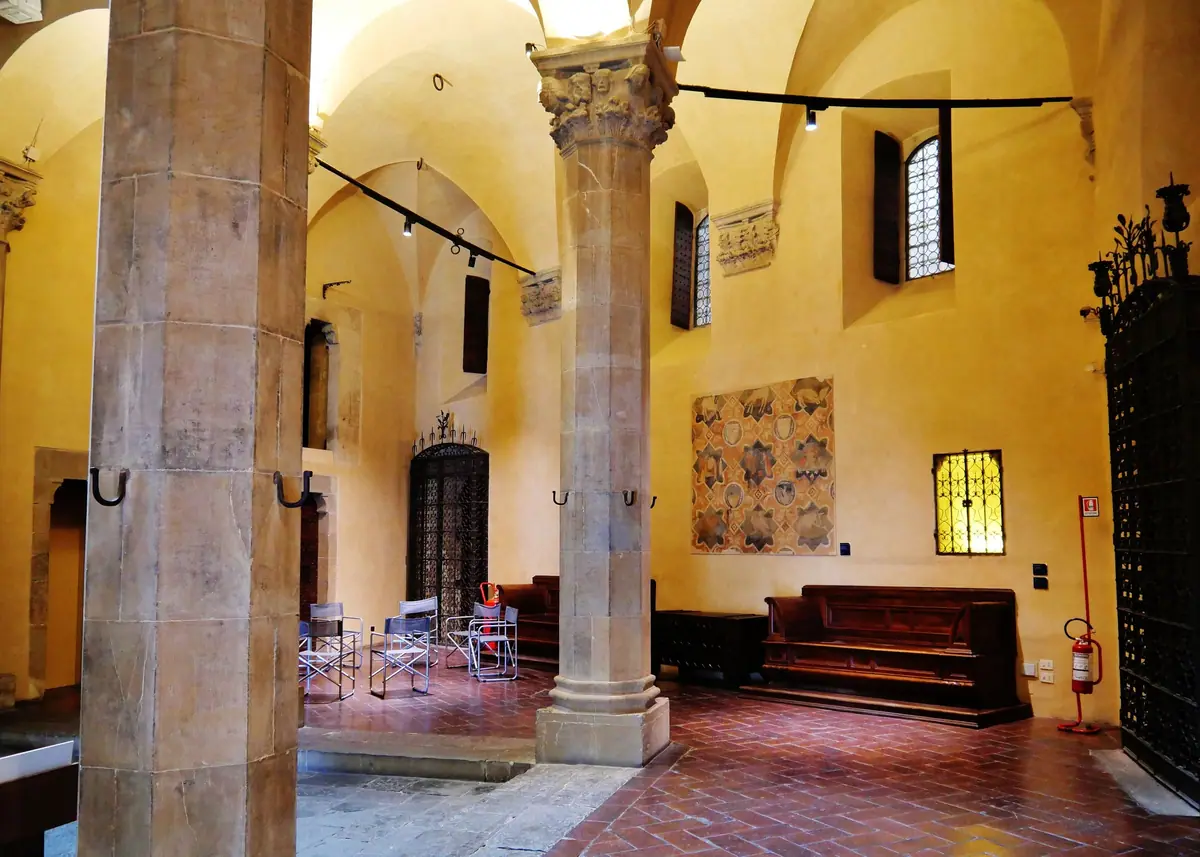
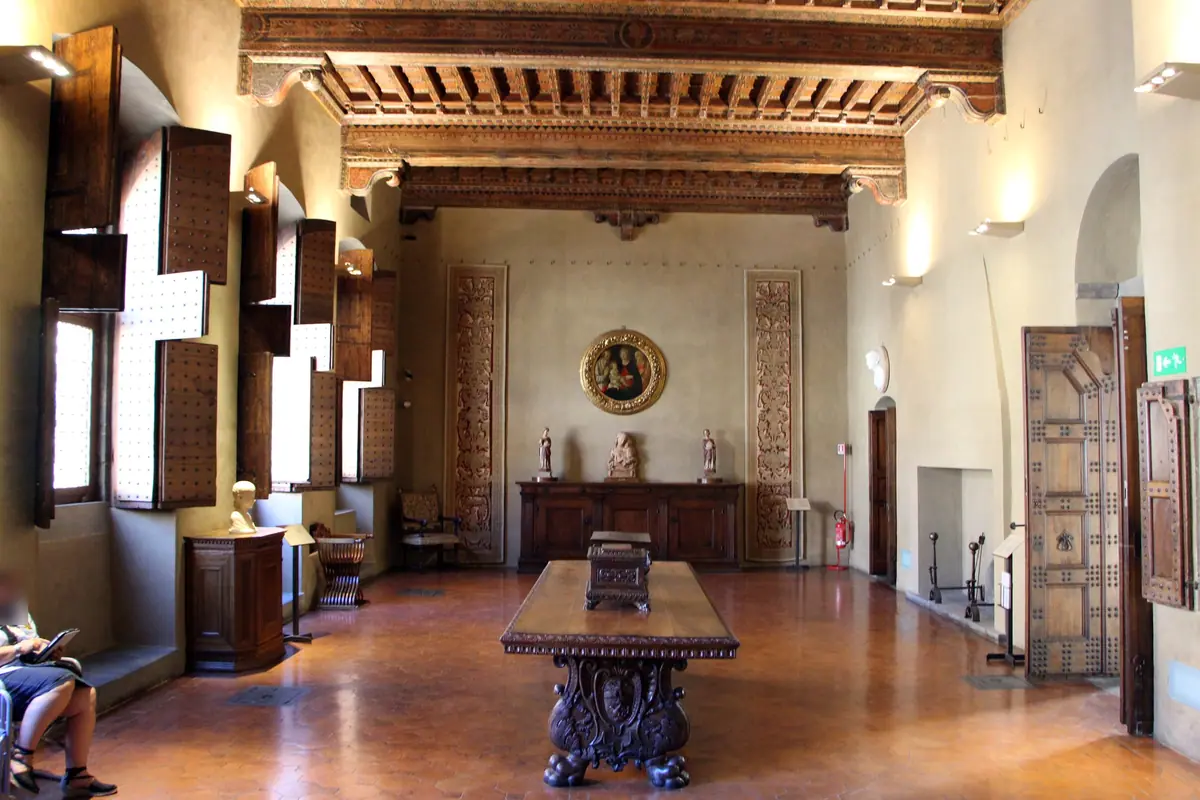
The museum presents the building as the step between two kinds of Florentine home: the medieval tower house and the Renaissance palace. On the ground floor you’re in the courtyard, with its stone columns, vaults and wrought-iron gate, and from there the house climbs floor by floor.
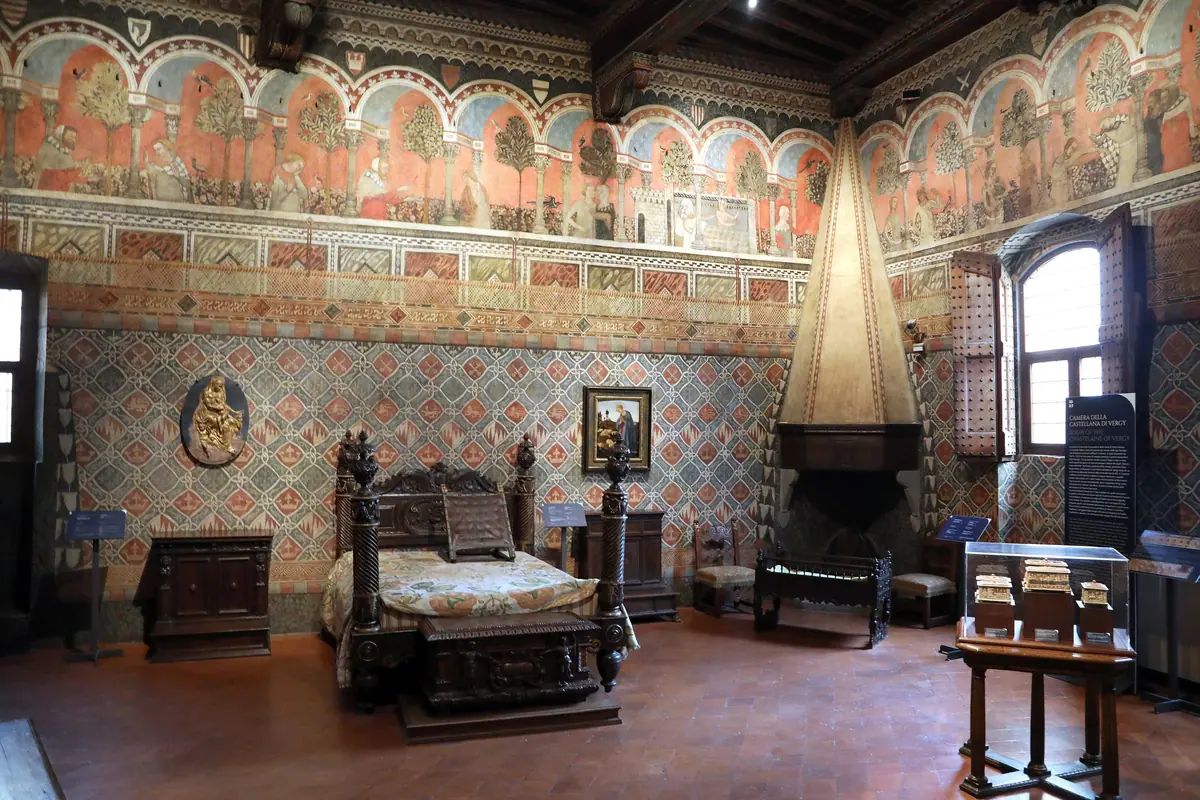
Upstairs are the painted rooms. The Sala dei Pappagalli, the Parrot Room on the first floor, is the one in the photo at the top of this page, its walls covered in diamond-shaped panels with parrots under a frieze of painted arches. In the Sala dei Pavoni, the Peacock Room, the walls are painted to look hung with patterned cloth, and the peacocks and coats of arms run along the frieze above the bed.
Look out for the Guicciardini Quilt, made in Sicily in the second half of the 14th century and stitched with scenes of Tristan and Isolde, the doomed lovers of medieval legend. There are paintings by Lo Scheggia and the Master of Serumido, made to decorate a home rather than a church, and a Sienese cabinet carved with grotesques. The visit also takes in a room of lace and embroidery, and the house’s kitchen.
Part of the second floor is shut for now. Since 25 September, three rooms have been closed for works, with no reopening date given, and no ticket or card opens them.
Closed for works since 25 September
- Camera della Castellana di Vergy
- The room whose walls tell a tragic love story from a 13th-century French poem
- Sala delle Armi
- The Arms Room
- Sala da Pranzo
- The Dining Room
From the Davizzi to the Davanzati: who lived in the palace
The palace was built in the second half of the 14th century by the Davizzi, rich merchants and bankers in Florence’s wool trade. In 1516 it passed to the Bartolini, and in 1578 Bernardo Davanzati, a historian and merchant, bought it, which is why it carries his family’s name. The Davanzati kept it until 1838.
In the 19th century it escaped demolition, thanks to the Association for the Defence of Old Florence. Then in 1904 Elia Volpi, an antique dealer, bought it, spent five years restoring it and opened it in 1910 as a private museum, the Museum of the Ancient Florentine House.
Volpi later sold what he had put inside at a series of auctions, the biggest of them in New York in 1916. The Italian state bought the palace in 1951, and today it’s one of the Musei del Bargello.
Getting to Palazzo Davanzati on Via Porta Rossa
Florence has no metro, so most visitors walk here. The entrance is at Via Porta Rossa 13, where you buy your ticket at the desk or, with the Firenze Card, go straight in.
Tickets
Popular tickets around Florence
The ones other visitors book most.


People also ask
Frequently asked questions
Is Palazzo Davanzati open on Mondays?
No, Monday is its closing day. The exception this year is Monday 30 November, the Festa della Toscana, when it opens in the evening from 17:15 to 21:00. From Tuesday to Sunday it's open from 8:15 to 18:50, with last entry at 18:10, and on Sundays it closes from 12:20 to 13:30.
Do I need to book Palazzo Davanzati tickets?
No. You can book by phone for a €4 fee, but it's optional, and you can simply buy your €8 ticket at the door. On the free days bookings are suspended anyway.
When is Palazzo Davanzati free?
On the first Sunday of every month and on 25 April, 2 June and 4 November. The next free day is Sunday 6 December 2026. Under-18s go in free on any day.
Is Palazzo Davanzati included in the Firenze Card?
Yes, as one of the card's included entries, once, and you don't need to book a time with the card. Just show it at the door on Via Porta Rossa.
Are all the rooms at Palazzo Davanzati open?
Not at the moment. Since 25 September three rooms on the second floor are closed for works: the Camera della Castellana di Vergy, the Arms Room and the Dining Room. The museum hasn't given a reopening date.
Can you visit Palazzo Davanzati in a wheelchair?
Yes. A mobile platform gets you over the 12 cm step at the main door (ask the staff), a lift takes you to the upper floors, ramps are laid over the higher thresholds on request, and there's an accessible toilet on the ground floor.